Crotalaria karagwensis
Taub.
gbif· cc0
Carnegie Museum of Natural History
gbif· cc0
Carnegie Museum of Natural History
gbif· cc0
Botanical Research Institute of Texas
Description
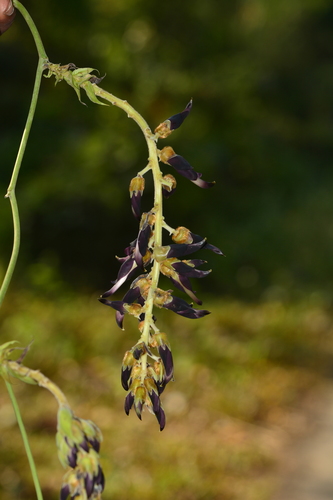
An erect annual herb. It grows 1 m tall. There are hairs on the stems. The leaves are simple and alternate. The leaf blade is narrow and 2-11 cm long by 2-12 mm wide. There are 10-24 flowers in a group at the top of the plant. These are yellow with red veins. The fruit is an oblong club shaped pod. It is 2.5 cm long by 3.5 cm wide and narrows to the base. There are 15-34 seeds. These are small and heart shaped. They are 2-4 mm across.
Edible Uses
Seed - cooked. Considered to be edible in Kenya. The oblong, club-shaped seedpod is around 25mm × 35mm × 5mm, containing 15 - 34 heart-shaped seeds 1.5 - 4mm in diameter. Some caution needs to be employed - see notes above on toxicity.
Traditional Uses
Caution: Many Crotalaria contains toxins. The seeds are eaten in Kenya. They are presumably cooked.
This uses section is brief — help expand it
Known Hazards
No specific mention of toxicity has been seen for this species, but many members of this genus are known to contain pyrrolizidine alkaloids, the most potent of which in this genus are monocrotaline, retrorsine and retronecine. These alkaloids have a cumulative effect upon the body and, unless concentrations in a plant are high, occasional consumption is generally completely safe. Pyrrolizidine alkaloids are derived from amino acids including ornithine. Many of these alkaloids have pronounced hepatic toxicity, but the lungs and other organs may be affected as well. Mutagenic and carcinogenic activities of pyrrolizidine alkaloids have also been reported.
Distribution
It is a tropical plant. It grows between 1,100-2,300 m altitude in grassland and woodland.
Where It Grows
Africa, Cameroon, Central Africa, Central African Republic, CAR, Congo DR, East Africa, Ethiopia, Kenya, Tanzania, West Africa,
Cultivation
Annual and short-lived perennial plants in this genus generally grow best in a sunny position, succeeding in most dry to moist, well-drained soils. We have no specific report for this species, but most species in this genus have a symbiotic relationship with certain soil bacteria; these bacteria form nodules on the roots and fix atmospheric nitrogen. Some of this nitrogen is utilized by the growing plant but some can also be used by other plants growing nearby.
Propagation
Seed - sow in situ. Pre-soaking the seed for 12 hours in warm water can help to reduce germination time.
Synonyms
References (3)
- Brink, M., 2006. Crotalaria karagwensis Taub. [Internet] Record from Protabase. Brink, M. & Belay, G. (Editors). PROTA (Plant Resources of Tropical Africa), Wageningen, Netherlands. < http://database.prota.org/search.htm>. Accessed 15 October 2009.
- Burkill, H. M., 1985, The useful plants of west tropical Africa, Vol. 3. Kew.
- World Checklist of Useful Plant Species 2020. Royal Botanic Gardens, Kew