Hultholia mimosoides
(Lamk.) E. Gagnon & G. P. Lewis
iNaturalist· cc-by-nc-sa
(c) Jkadavoor (Jee), some rights reserved (CC BY-NC-SA)
iNaturalist· cc-by-sa
(c) Dinesh Valke, some rights reserved (CC BY-SA)
iNaturalist· cc-by-sa
(c) Dinesh Valke, some rights reserved (CC BY-SA)
Description
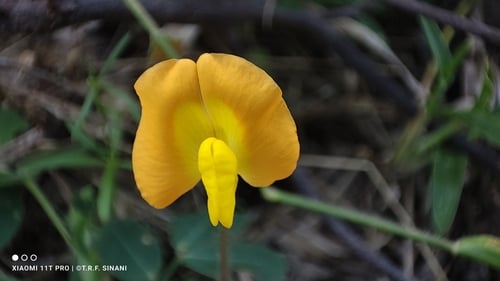
An erect or climbing shrub. It grows up to 1 m high. It is a thorny plant. The thorns on the stems are hooked. The leaves are compound. There are 10-30 pairs of leaflets on the leaf stalk. These are 3-5 cm long. The flowers are yellow. They are clustered at the ends of branches.
Edible Uses
Young shoots and leaves can be eaten raw or cooked and used to make chutney. Flower buds have a bitter taste and are used in cooking.
Traditional Uses
The young shoots and leaves can be eaten raw. They are also cooked. They are used to make chutney. The flower buds have a bitter taste and can be used in cooking.
Distribution
A tropical plant. It grows in mixed forests and scrubby areas. It grows in limestone areas. In southern China it grows between 600-700 m above sea level. In Yunnan.
Where It Grows
Asia, Bangladesh, Cambodia, China, India, Indochina, Laos, Myanmar, SE Asia, Thailand, Vietnam,
Production
Leaves are harvested during the rainy season.
Notes
There are about 150 Caesalpinia species. They grow in the tropics and subtropics. Also as Caesalpinaceae.
Synonyms
Also Known As
Brasiletto, Cha lued, Cha rueat, Chalueat, Diep trinhnu, Gyabo-zawnan, Mocmeo, Nam phak kha nya, Pak krad ya, Pak-yu-yah, Pulinagakondrai, Sukyanbo, Tikayan-gyi, Yadong
References (12)
- Anderson, E. F., 1993, Plants and people of the Golden Triangle. Dioscorides Press. p 205 (As Caesalpinia mimosoides)
- Eiadthong, W., et al, 2010, Management of the Emerald Triangle Protected Forests Complex. Botanical Consultant Technical Report. p 47 (As Caesalpinia mimosoides)
- Jacquat, C., 1990, Plants from the Markets of Thailand. D.K. Book House p 43 (As Caesalpinia mimosoides)
- Khumgratok, S., Edible Plants in Cultural Forests of Northeastern Thailand. Mahasarakham University Thailand. (As Caesalpinia mimosoides)
- Luczaj, L., et al, 2021, Wild food plants and fungi sold in the markets of Luang Prabang, Lao PDR. Journal of Ethnobiology and Ethnomedicine (2021) 17:6 (As Caesalpinia mimosoides)
Show all 12 references Hide references
- McMakin, P.D., 2000, Flowering Plants of Thailand. A Field Guide. White Lotus. p 52 (As Caesalpinia mimosoides)
- Ramachandran,V. S., & Udhayavani, C., 2013, Knowledge and uses of wild edible plants by Paniyas and Kurumbas of Western Nilgiris, Tamil Nadu. Indian Journal of Natural Products and Resources. 4(4) December 2013, pp 412-418 (As Caesalpinia mimosoides)
- Srichaiwong, P., et al, 2014, A Study of the Biodiversity of Natural Food Production to Support Community Upstream of Chi Basin, Thailand. Asian Social Science 10 (2): (As Caesalpinia mimosoides)
- Sutjaritjai, N., et al, 2019, Traditional Uses of Leguminosae among the Karen in Thailand. Plants 2019, 8, 600 p 7
- Thitiprasert, W., et al, 2007, Country report on the State of Plant Genetic Resources for Food and Agriculture in Thailand (1997-2004). FAO p 95 (As Caesalpinia mimosoides)
- Xu, Z., Tao, G. & Tan, J., 1988, Tropical Wild Flowers and Plants in Xishuangbanna, Agricultural Publishing House. photo 100 (As Caesalpinia mimosoides)
- Xu, You-Kai, et al, 2004, Wild Vegetable Resources and Market Survey in Xishuangbanna, Southwest China. Economic Botany. 58(4): 647-667. (As Caesalpinia mimosoides)