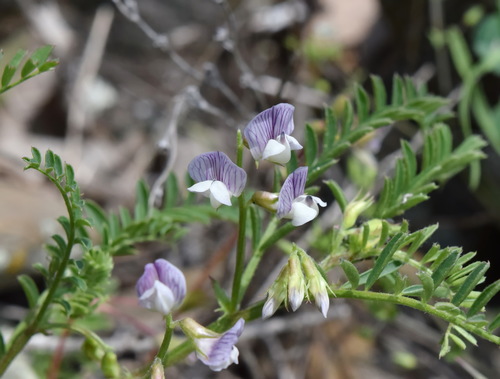
Bussea occidentalis
Hutch
iNaturalist· cc-by-nc
(c) Carel Jongkind, some rights reserved (CC BY-NC), uploaded by Carel Jongkind
iNaturalist· cc-by
(c) Justin Ponder, some rights reserved (CC BY)
Description
A tree. It grows 30 m high. The trunk is usually straight. It is 75 cm across. The crown is small and dense. The leaves are compound. They are twice divided. There are 4-6 pairs of opposite pinnae each 7-20 cm long. They are swollen at the base. These each have 5-8 leaflets 4-10 cm long by 2-4 cm wide. Young leaves have rusty hairs. The flowers are large and yellow. They have a scent. The flowering clusters are 20-30 cm long and have rusty hairs. The fruit are curved pods. They are 15-30 cm long. The pod curls up after opening. The seeds are thick and oily.
Edible Uses
The seeds are roasted and eaten. Fruit are sold in local markets.
Traditional Uses
The seeds are roasted and eaten.
This uses section is brief — help expand it
Medicinal Uses
The bark is diuretic. It is used in the treatment of liver and kidney problems. The bark and seed are cardiac. The leaves contain several medicinal compounds, including glycosides, saponims and steroids.
Known Hazards
The leaves and seedcoats are used to poison fish.
Distribution
A tropical plant. It grows in evergreen and deciduous forests in West Africa.
Where It Grows
Africa, Côte d'Ivoire, Ghana, Guinea, Guinée, Ivory Coast, Liberia, Sierra Leone, West Africa,
Other Uses
A gum is obtained from the trunk and branches. The wood of species in this genus is hard, heavy, tough and strong. It is difficult to work and is only suitable for rough, unfinished work. It is used localy for construction and agricultural implements.
Production
In Sierra Leone the flowers are in June and fruit mature in December or January.
Other Information
Fruit are sold in local markets.
Notes
There are 7 Bussea species. Also as Caesalpinaceae. It has previously been confused with Peltophorum perocarpum in West Africa.
Also Known As
Gpaoro, Helei, Hilei, Kpakelay, Samanta, Silo, Tuammaklayea
References (16)
- Bircher, A. G. & Bircher, W. H., 2000, Encyclopedia of Fruit Trees and Edible Flowering Plants in Egypt and the Subtropics. AUC Press. p 69
- Burkill, H. M., 1985, The useful plants of west tropical Africa, Vol. 3. Kew.
- Busson, 1965,
- Dalziel, J. M., 1937, The Useful plants of west tropical Africa. Crown Agents for the Colonies London.
- Food Composition Tables for use in Africa FAO http://www.fao.org/infoods/directory No. 461
Show all 16 references Hide references
- Hawthorne, W.& Marshall, C., 2013, Nimba Western Area Iron Ore Concentrator Mining Project Environmental and Social Impact Assessment. AcelorMittel Liberia. p 463
- Hwang, L. C., et al, 2020, Traditional Botanical Uses of Non-Timber Forest Products (NTFP) in Seven Counties in Liberia. ACS Symposium Series; American Chemical Society: Washington, DC, 2020.
- ILDIS Legumes of the World http:www;ildis.org/Legume/Web
- Jardin, C., 1970, List of Foods Used In Africa, FAO Nutrition Information Document Series No 2.p 24
- Jusu, A. & Cuni-Sanchez, A., 2017, Priority indigenous fruit trees in the African rainforest zone: insights from Sierra Leone. Genet Resour Crop Evol (2017) 64:745–760
- Kunkel, G., 1965, The Trees of Liberia. German Forestry Mission Report No. 3 p 58
- Manvell, A., 2011, Use of Non-Timber Forest Products around Sapo National Park, Liberia (Report B) p 50
- Peters, C. R., O'Brien, E. M., and Drummond, R.B., 1992, Edible Wild plants of Sub-saharan Africa. Kew. p 121
- Savill, P. S. & Fox, J. E. D., Trees of Sierra Leone. p 74
- Voorhoeve, A. G., 1965, Liberian high forest trees. Pudoc p 171
- World Checklist of Useful Plant Species 2020. Royal Botanic Gardens, Kew