Harpagophytum zeyheri
Decne, (Engl.) Ihlenf. & Hartm.
Grapple plant
iNaturalist· cc-by
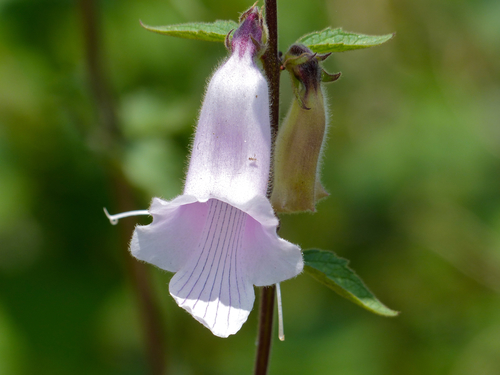
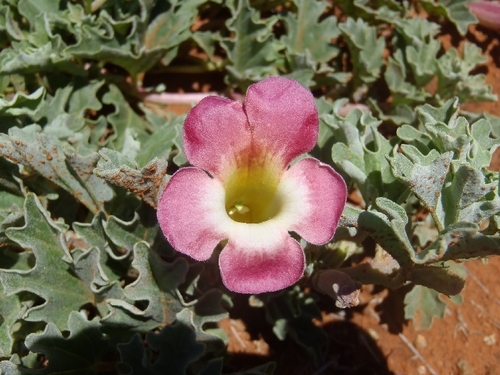
(c) Karen Eichholz, some rights reserved (CC BY), uploaded by Karen Eichholz
iNaturalist· cc-by-nc
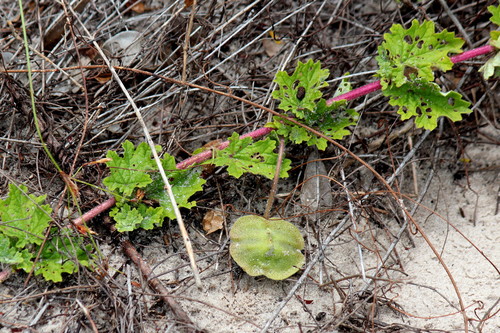
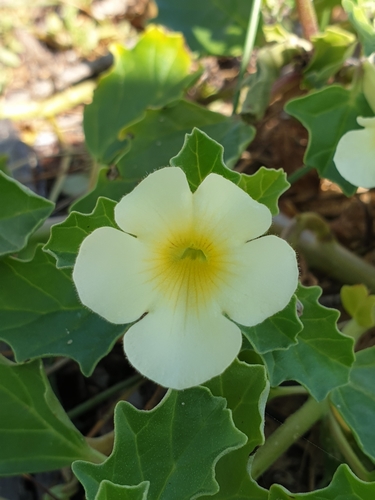
(c) Tony Benn, some rights reserved (CC BY-NC)
iNaturalist· cc-by-nc
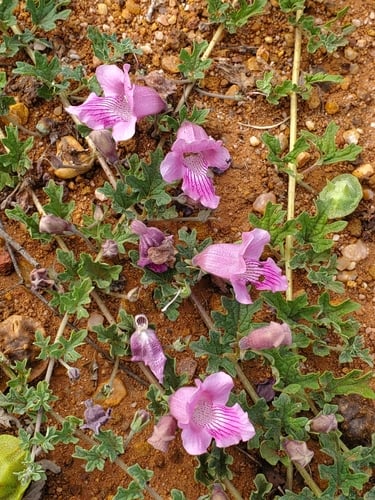
(c) Tony Benn, some rights reserved (CC BY-NC)
Description
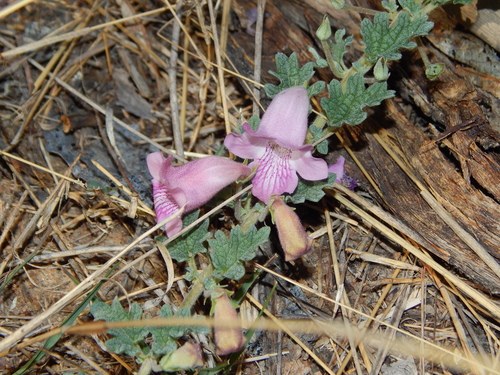
A herb that lies along the ground. It has a succulent taproot. It produces annual stems. The leaves are opposite. They are broadly oval. The edges have rounded teeth or deep lobes. The flowers are pink with a yellow throat. They occur singly in the axils of leaves. The fruit is a capsule with 4 lines of backward curving spines. There are some subspecies.
Edible Uses
The flower nectar is eaten raw, especially by children.
Traditional Uses
The flower nectar is eaten raw.
This uses section is brief — help expand it
Distribution
It is a tropical plant. It grows in dry open woodland and on Kalahari sand. It can grow in the desert. It grows in hot arid places with a marked dry season. The dry season can be 6-11 months. It grows between 350-1,430 m above sea level. It can grow in arid places.
Where It Grows
Africa, Angola, Botswana, Central Africa, East Africa, Mozambique, Namibia, South Africa, Southern Africa, Zambia, Zimbabwe,
Other Information
They are eaten especially by children.
Synonyms
References (6)
- Peters, C. R., O'Brien, E. M., and Drummond, R.B., 1992, Edible Wild plants of Sub-saharan Africa. Kew. p 160
- Pickering, H., & Roe, E., 2009, Wild Flowers of the Victoria Falls Area. Helen Pickering, London. p 92 (not subsp. sublobatum)
- Rodin, 1985,
- Royal Botanic Gardens, Kew (1999). Survey of Economic Plants for Arid and Semi-Arid Lands (SEPASAL) database. Published on the Internet; http://www.rbgkew.org.uk/ceb/sepasal/internet [Accessed 5th May 2011]
- Ruiters-Welcome, A. K., 2019, Food plants of southern Africa. Ph.D. thesis. Univ. of Johannesburg p 85
Show all 6 references Hide references
- Welcome, A. K. & Van Wyk, B.-E., 2019, An inventory and analysis of the food plants of southern Africa. South African Journal of Botany 122 (2019) 136–179