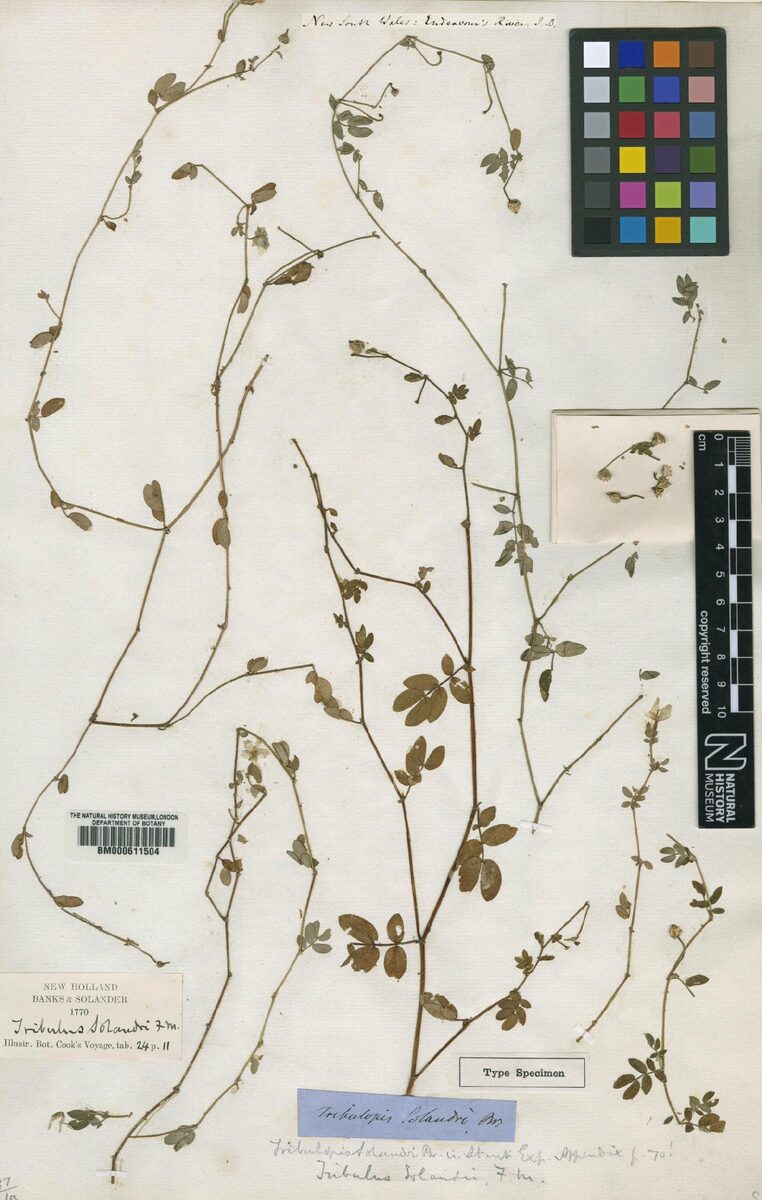
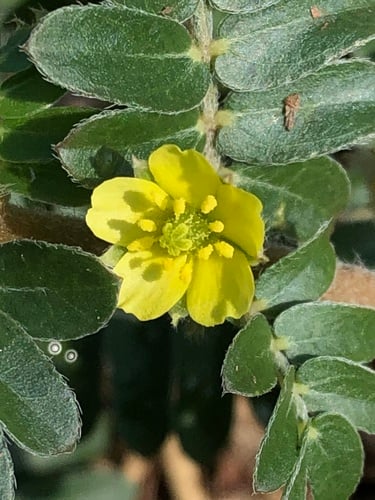
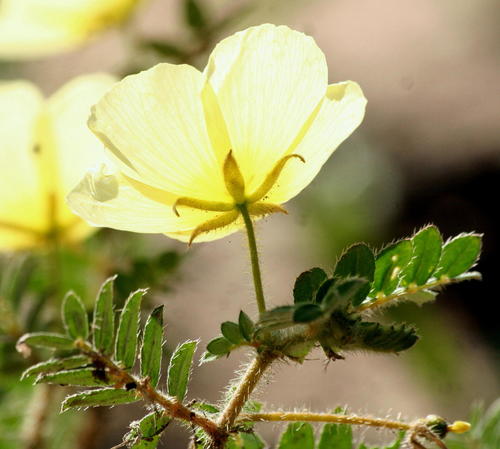
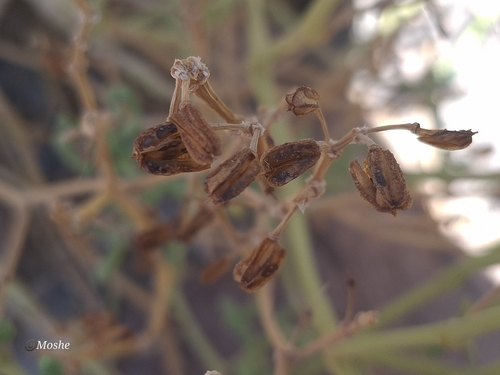
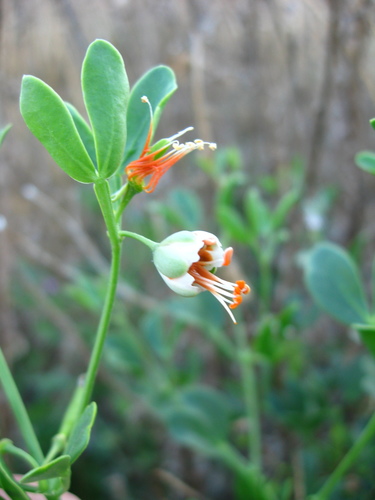
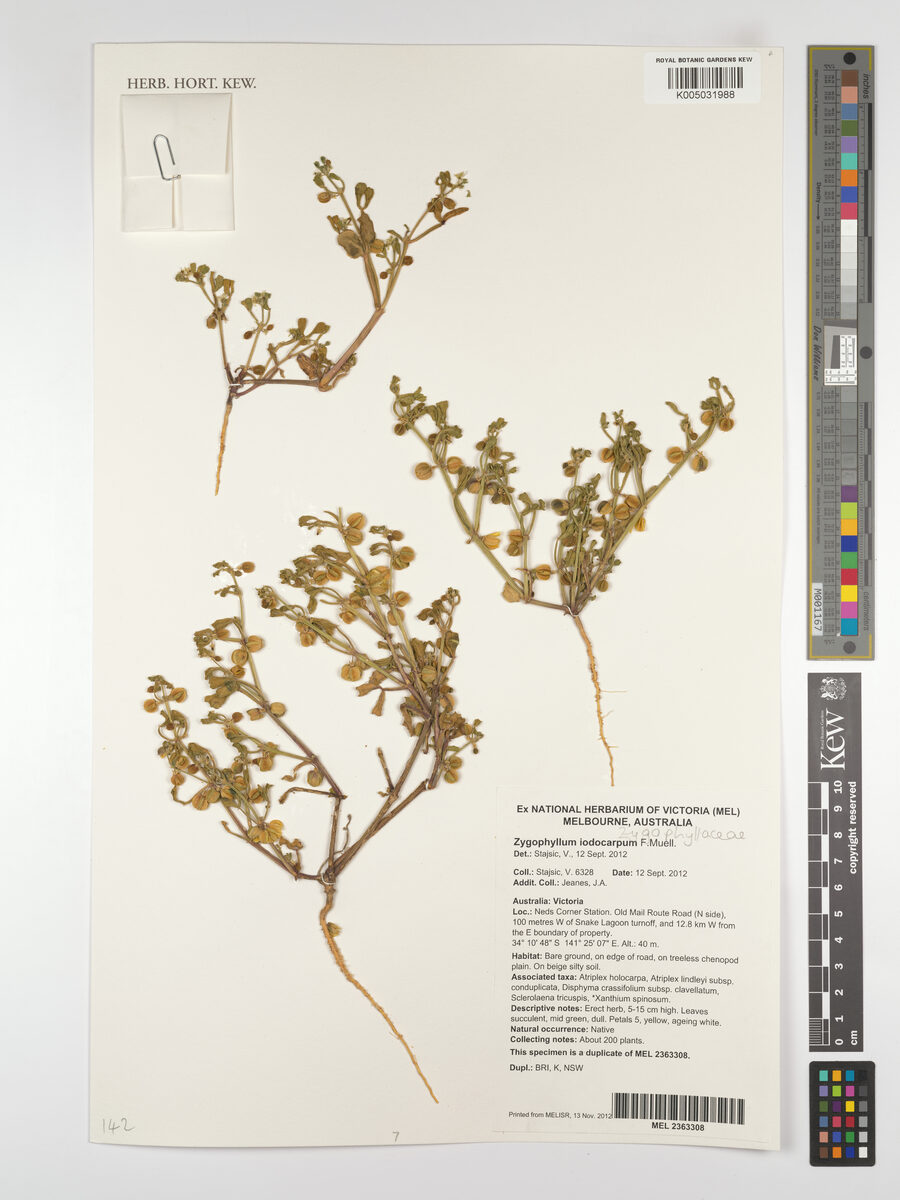
Balanites rotundifolia
(Tiegh.) Blatt.
Bedeno
iNaturalist· cc-by-nc
(c) Odile Weber, some rights reserved (CC BY-NC), uploaded by Odile Weber
iNaturalist· cc-by-nc
(c) Odile Weber, some rights reserved (CC BY-NC)
Summary
Source: WikipediaBalanites rotundifolia, known in Swahili as Mbamba ngoma is a spiny bush or small tree from eastern Africa and southern Arabia. It is a member of the caltrop family, Zygophyllaceae.
Description
A shrub or small tree. It is evergreen and spiny. It can grow to 6-8 m high. The trunk can be 40 cm across and usually there are many branches. The bark is grey-brown. The spines can be 3-8 cm long. They are 2-5 mm across. The leaves have short leaf stalks or none at all. The leaflets are 1-6 cm long by 2-4 cm wide. They are broadly oval. They are rough and can be wavy. The flowers are on the stems. There can be 8 flowers in a group. The flowers have 4 parts. The fruit are 2-3 cm long and 2-2.5 cm wide. They are hard and brittle on the outside. They are orange or yellow when ripe.
Edible Uses
The ripe fruit can be peeled and boiled for 3-4 hours then eaten with milk, or eaten raw when very ripe. Very ripe fruit can also be stored for later consumption. Young leaves are cooked and eaten as a vegetable. The seeds are edible.
Traditional Uses
The fruit can be stored and eaten later. The fruit are peeled and then boiled and the outside flesh is eaten. They are boiled for 3-4 hours and eaten with milk. The very ripe fruit are eaten raw. The young leaves are cooked and eaten as a vegetable.
Distribution
It is a tropical plant. It grows in dry rocky areas, In Kenya it grows between 50-1,350 m altitude and in areas with 150-400 mm rainfall. It is drought resistant.
Where It Grows
Africa, Djibouti, East Africa, Ethiopia, Kenya, Middle East, Somalia, South Sudan, Sudan, Tanzania, Uganda, Yemen,
Cultivation
Plants can be grown from seeds. It is best to sow the seeds in the field where they are to grow.
Propagation
Seed - Root suckers
Other Uses
The tree is the source of a gum resin called Hanjigoad. The tears are globular pieces from the size of a cherry to a pigeon's egg, dark greenish yellow to deep orange red. The wood is used for poles, tool handles, spoons, combs and carvings. The wood is used for fuel and is made into charcoal.
Synonyms
Also Known As
Alayto, Baddan, Baddana okolee, Ebei, Esei, Hankalta, Kulum, Kurarta, Kuteta, Kuze, Loma, Lomaa, Lomion, Mkonga, Mubadana, Mvambandusi, Mvanga ng'oma, Olkwai, Patana, Sarei
References (18)
- Addis, G., Asfaw, Z & Woldu, Z., 2013, Ethnobotany of Wild and Semi-wild Edible Plants of Konso Ethnic Community, South Ethiopia. Ethnobotany Research and Applications. 11:121-141
- Addis, G., et al, 2013, The Role of Wild and Semi-wild Edible Plants in Household Food Sovereignty in Hamer and Konso Communities, South Ethiopia. Ethnobotany Research & Applications. 11:251-271
- Asfaw, Z. and Tadesse, M., 2001, Prospects for Sustainable Use and Development of Wild Food Plants in Ethiopia. Economic Botany, Vol. 55, No. 1, pp. 47-62
- Assefa, A. & Abebe, T., 2010, Wild Edible Trees and Shrubs in the Semi-arid Lowlands of Southern Ethiopia. Journal of Science and Development 1 (1) 2010
- Gemedo-Dalle, T., et al, 2005, Plant Biodiversity and Ethnobotany of Borana Pastoralists in Southern Oromia, Ethiopia. Economic Botany 59(1) pp. 43-65
Show all 18 references Hide references
- Grubben, G. J. H. and Denton, O. A. (eds), 2004, Plant Resources of Tropical Africa 2. Vegetables. PROTA, Wageningen, Netherlands. p 559 (As Balanites gillettii)
- Kidane, B., et al, 2014, Ethnobotany of Wild and Semi-Wild Edible Fruit Species used by Maale and Ari Ethnic Communities in Southern Ethiopia. www.ethnobotanyjournal.org/vol12/i1547-3465-12-455.pdf
- Lulekal, E., et al, 2011, Wild edible plants in Ethiopia: a review on their potential to combat food insecurity. Afrika Focus - Vol. 24, No 2. pp 71-121
- Maundu, P. et al, 1999, Traditional Food Plants of Kenya. National Museum of Kenya. p 72
- Mutie, F. G., 2020, Conservation of Wild Food Plants and Their Potential for Combatting Food Insecurity in Kenya as Exemplified by the Drylands of Kitui County. Plants 2020, 9, 1017
- Mutie, F. M., et al, 2023, Important Medicinal and Food Taxa (Orders and Families) in Kenya, Based on Three Quantitative Approaches. Plants 2023, 12, 1145
- Ngugi, G., 2000, Case Study from Kenya on Indigenous Wild Vegetables. Paper 4 Workshop in Kenya 1999. p 32
- Ocho, D. L., et al, 2012, Assessing the levels of food shortage using the traffic light metaphor by analyzing the gathering and consumption of wild food plants, crop parts and crop residues in Konso, Ethiopia. Journal of Ethnobiology and Ethnomedicine 8:30
- Ojelel, S., et al, 2019, Wild edible plants used by communities in and around selected forest reserves of Teso-Karamoja region, Uganda. Journal of Ethnobiology and Ethnomedicine (2019) 15:3
- Sands, M. J. S., 2001, The Desert Date and Its Relatives: A Revision of the Genus Balanites. Kew Bulletin, Vol. 56, No. 1 (2001), pp. 1-128
- Teklehaymanot, T., and Mirutse Giday, M., 2010, Ethnobotanical study of wild edible plants of Kara and Kwego semi-pastoralist people in Lower Omo River Valley, Debub Omo Zone, SNNPR, Ethiopia Journal of Ethnobiology and Ethnomedicine 2010, 6:23
- Teklehaymanot, T., 2017, An ethnobotanical survey of medicinal and edible plants of Yalo Woreda in Afar regional state, Ethiopia. Journal of Ethnobiology and Ethnomedicine 13:40
- Termote, C., et al, 2014, Assessing the potential of wild foods to reduce the cost of a nutritionally adequate diet: An example from eastern Baringo District, Kenya. Food and Nutrition Bulletin, vol. 35, no. 4