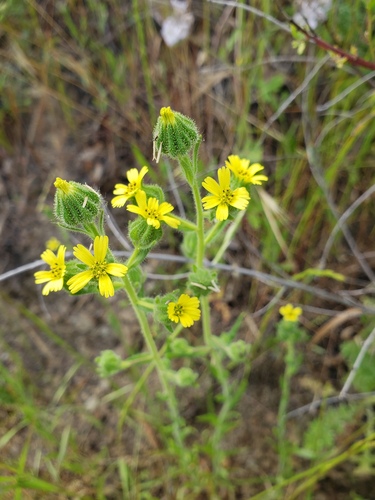
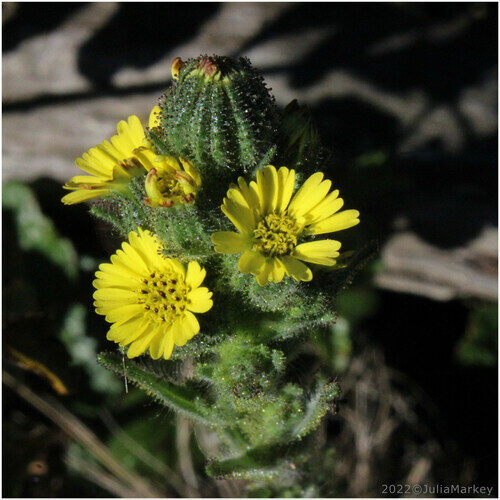
Tragopogon porrifolius subsp. longirostris
(Bisch. ex Sch. Bip.)
Long-beaked goat's beard, Purple salsify
iNaturalist· cc-by-nc
(c) Valerio Lazzeri, some rights reserved (CC BY-NC), uploaded by Valerio Lazzeri
iNaturalist· cc-by-nc
(c) Gideon van Melle, some rights reserved (CC BY-NC), uploaded by Gideon van Melle
iNaturalist· cc-by-nc
(c) rudyclaeys, some rights reserved (CC BY-NC)
Summary
Source: WikipediaTragopogon porrifolius is a species of plant commonly known as purple or common salsify, oyster plant, vegetable oyster, Jerusalem star, Jack go to bed, goatsbeard, or simply salsify. These last two names are also applied to other species. It grows wild in many places and is one of the most widely known species of the salsify genus, Tragopogon. It is cultivated for its ornamental flower and edible root.
Description
A herb.
This description is brief — help expand it
Edible Uses
A latex derived from the root can be used as a chewing gum. The plant is edible, but the roots and leaves are most palatable when collected before the flower stalk is produced. The root is noted for having a mild taste when uncooked, described as like asparagus or oysters, from which the plant derives its alternative name of oyster plant. The outer layers can be scraped off, with the root dipped in cold water to preserve its colour. If too tough for eating, they can be boiled with a pinch of baking soda and a change of water. Raw young roots can be grated for use in salads, but older roots are better cooked. They can be added to soups, stews or stir-fries. Salsify purée (alone or including potato) is recommended with fish. The flowering shoots can be used like asparagus, either raw or cooked and the flowers can be added to salad, while the sprouted seeds can be used in salads or sandwiches. Raw salsify is 77% water, 19% carbohydrates, 3% protein and contains negligible fat. In a 100 gram reference amount, raw salsify supplies 82 calories and moderate contents of riboflavin, vitamin B6, vitamin C, manganese and phosphorus.
Traditional Uses
The leaves are used in salads and added to pastries. They are boiled and then fried.
This uses section is brief — help expand it
Distribution
It is a temperate plant.
Where It Grows
Europe, Iraq, Middle East, Turkey, Türkiye,
Nutrition
| Part | Moisture | kJ | kcal | Protein | Vit A | Vit C | Iron | Zinc |
|---|---|---|---|---|---|---|---|---|
| Leaves | 87.5 | 160 | 39 | 0.2 | — | 32.4 | 0.5 | 0.2 |
Synonyms
Also Known As
Fisa pirie, Gezrik, Pelgizeir, Sipling, Tekesakali, Yemlik
References (9)
- Dogan, A. & Tuzlaci, E., 2015, Wild Edible Plants of Pertek (Tunceli-Turkey). Marmara Pharmaceutical Journal 19: 126-135 (As Tragopogon longirostris)
- Dogan, Y., 2012, Traditionally used wild edible greens in the Aegean Region of Turkey. Acta Societatis Botanicorum Poloniae 81(4): 329-342 (Also as Tragopogon longirostris)
- Ertug, F., 2004, Wild Edible Plants of the Bodrum Area. (Mugla, Turkey). Turk. J. Bot. 28 (2004): 161-174
- Ertug, F, Yenen Bitkiler. Resimli Türkiye Florası -I- Flora of Turkey - Ethnobotany supplement
- Galalaey, A. M. K., et al, 2021, Ethnobotanical study of some wild edible plants in Hujran Basin, Kurdistan Region of Iraq. ZANCO Journal of Pure and Applied Sciences. Salahaddin University-Erbil p 26 (As Tragopogon longirostris)
Show all 9 references Hide references
- Gunes, S. et al, 2018, Survey of wild food plants for human consumption in Karaisali (Adana-Turkey). Indian Journal of Traditional Knowledge. Vol. 17(2), April 2018, pp 290-298 (As Tragopogon longirostris)
- Guzelsoy, N. A., et al, 2017, Nutritional Properties of some Wild Edible Plant Species in Turkey. ANADOLU, J. of AARI 27(2) 2017, 39-45
- Kaya, O. M., et al, 2020, An ethnobotanical research in Sanhurfa central district and attached Villages (Turkey). Indian Journal of Traditional Knowledge. Vol. 19(1) pp 7-23
- Yesil, Y., et al, 2019, Wild edible plants in Yeşilli (Mardin-Turkey), a multicultural area. Journal of Ethnobiology and Ethnomedicine (2019) 15:52