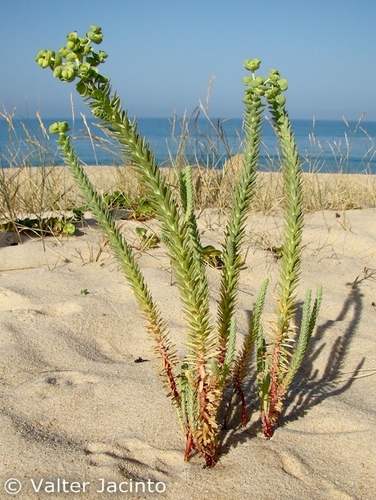
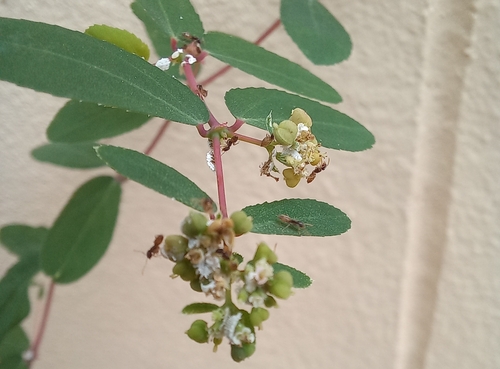
Acalypha indica
(L.) Vell.
Indian acalypha
iNaturalist· cc-by
(c) Siddarth Machado, some rights reserved (CC BY), uploaded by Siddarth Machado
iNaturalist· cc0
no rights reserved, uploaded by 葉子
iNaturalist· cc0
no rights reserved, uploaded by 葉子
Summary
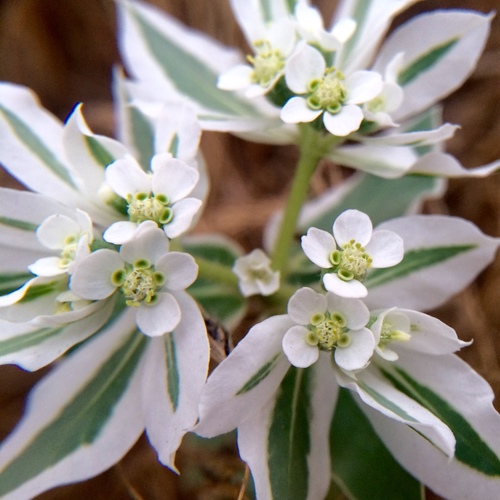
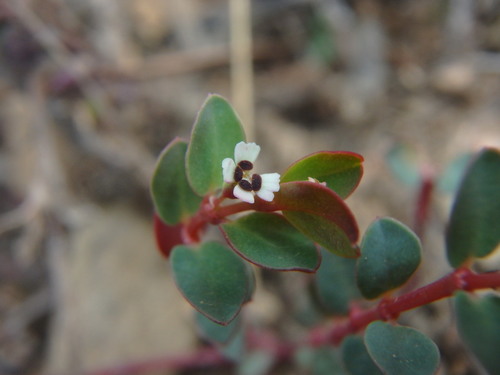
Source: WikipediaAcalypha indica (English: Indian acalypha, Indian mercury, Indian copperleaf, Indian nettle, three-seeded mercury) is an herbaceous annual that has catkin-like inflorescences with cup-shaped involucres surrounding the minute flowers. It is mainly known for its root being attractive to domestic cats, and for its various medicinal uses. It occurs throughout the Tropics.
Description
A shrub or small tree. It grows 5 m tall. There are prickles along the stem. The leaves are twice divided and there are 8-18 pairs of pinnae. There are up to 50 pairs of pinnules on each pinnae. The flowers are yellow. They are in large clusters at the ends of branches. The pods are flattened.
Edible Uses
In India and Indonesia the plant is cultivated for its edible shoots and leaves, which are cooked as a vegetable.
Traditional Uses
The leaves are eaten cooked as a vegetable. CAUTION: The plant contains glucosides which cause cancer.
This uses section is brief — help expand it
Medicinal Uses
The plant has many traditional medicinal uses. In Madagascar, the crushed plant is used for skin parasites. In Mauritius, the sap of crushed leaves mixed with salt, or a decoction of plant, is used for scabies and other skin problems. In the Seychelles and Réunion, a root infusion or decoction is taken for asthma, and also to clean the liver and kidneys. The root decoction is also taken for intestinal worms and stomach ache. The leaf sap is taken as an emetic. An infusion together with the roots of Tylophora indica is taken in Réunion as an emetic in the case of poisoning. A leaf infusion is also taken as a purgative and vermifuge in Réunion and Madagascar. In East Africa sap of the leaves is used for eye infections. Leaf powder is used for maggot-infested wounds. Acalypha indica is listed in the Pharmacopoeia of India as an expectorant to treat asthma and pneumonia. It was formerly listed in the British Pharmacopoeia. Some of the chemical compounds in Acalypha indica cause dark chocolate-brown discoloration of blood, and gastrointestinal irritation in rabbits. Ingestion of Acalypha indica may lead to hemolysis in people suffering from glucose-6-phosphate dehydrogenase deficiency. Acalyphin is used as a substitute for ipecacuanha, a vermifuge, expectorant and emetic. Acalypha indica leaves are used in the traditional medicine of India as a jaundice remedy.
Known Hazards
Care needs to be taken when using the species as a vegetable as it contains several alkaloids as well as hydrocyanic acid.
Distribution
A tropical plant. It grows in hot places. They occur as a weed and are found throughout the Philippines in waste places. In tropical Africa it grows up to 1,350 m altitude. It can grow in arid places. It grows in sunny waste places.
Where It Grows
Africa, Angola, Asia, Bangladesh, Botswana, British Indian Ocean Terr., BIOT, Cambodia, Central Africa, China, Congo, East Africa, Eswatini, Ethiopia, Fiji, Guyana, India, Indochina, Indonesia, Japan, Kenya, Madagascar, Malawi, Malaysia, Middle East, Mozambique, Myanmar, Namibia, Nigeria, Oman, Pacific, Pakistan, Philippines, SE Asia, Somalia, South Africa, Southern Africa, South America, Sri Lanka, Sudan, Swaziland, Taiwan, Tanzania, Thailand, Timor, Uganda, Vietnam, West Africa, Yemen, Zambia, Zimbabwe,
Cultivation
Plants are grown from seed.
Other Uses
The plant is known to have antifungal activity against plant pathogens.
Other Information
It is a cultivated food plant.
Notes
There are over 450 Acalypha species. They are tropical. There are 225 in tropical America. This one is used in medicine.
Nutrition
| Part | Moisture | kJ | kcal | Protein | Vit A | Vit C | Iron | Zinc |
|---|---|---|---|---|---|---|---|---|
| Leaves fresh | 80 | 269 | 64 | 6.7 | — | 147 | 17 | — |
Synonyms
Also Known As
Alcalifa, Biralkatshi, Bogus-damohan, Brennkraut, Chika mas, Copperleaf, Dadano, Harita-manjari, Hurita munjari, Indian nettle, Khokli, Khotka, Khotke, Kkokhali, Koopay maynei, Kuppaimeni, Kuppi gida, Kuppi, Kuppichettu, Kyaung-se-pin, Kyaung-yo-the, Lelatang, Muktajhuri, Poonamayakki, Ricinela, Rumput lis-lis, Swetbasanta, Tam ye tuaopu, Tamyae maeo, Three-seeded mercury
References (34)
- Ambasta S.P. (Ed.), 2000, The Useful Plants of India. CSIR India. p 8
- Ara, R. I. T., 2015, Leafy Vegetables in Bangladesh. Photon eBooks. p 35
- Bircher, A. G. & Bircher, W. H., 2000, Encyclopedia of Fruit Trees and Edible Flowering Plants in Egypt and the Subtropics. AUC Press. p 5
- Burkill, I.H., 1966, A Dictionary of the Economic Products of the Malay Peninsula. Ministry of Agriculture and Cooperatives, Kuala Lumpur, Malaysia. Vol 1 (A-H) p
- East African Herbarium records, 1981,
Show all 34 references Hide references
- Flora of Pakistan. www.eFloras.org
- Fowler, D. G., 2007, Zambian Plants: Their Vernacular Names and Uses. Kew. p 24
- GUPTA & KANODIA,
- Hossain, U. & Rahman, A., 2018, Study and quantitative analysis of wild vegetable floral diversity available in Barisal district, Bangladesh. Asian J. Med. Biol. Res. 2018, 4 (4), 362-371
- Jansen, P.C.M., 2004. Acalypha bipartita Müll.Arg. [Internet] Record from Protabase. Grubben, G.J.H. & Denton, O.A. (Editors). PROTA (Plant Resources of Tropical Africa / Ressources végétales de l’Afrique tropicale), Wageningen, Netherlands. < http://database.prota.org/search.htm>. Accessed 13 October 2009.
- Karthi, Sathya, & Salome, 2014, Uncultivated Edible Greens from Small Millet Farms Tamil Nadu India. IDRC
- Macmillan, H.F. (Revised Barlow, H.S., et al), 1991, Tropical Planting and Gardening. Sixth edition. Malayan Nature Society. Kuala Lumpur. p 356
- Martin, F.W. & Ruberte, R.M., 1979, Edible Leaves of the Tropics. Antillian College Press, Mayaguez, Puerto Rico. p 191
- Marwah, R. G., et al, 2006, Antioxidant capacity of some edible and wound healing plants in Oman. Journal of Food Chemistry.
- McMakin, P.D., 2000, Flowering Plants of Thailand. A Field Guide. White Lotus. p 92
- Miller, A. G., Morris, M. & Stuart-Smith, S., 1988, Plants of Dhofar. The Southern Region of Oman, Traditional, Economic and Medicinal Uses. Sultanate of Oman. p 130
- Monsalud, M.R., Tongacan, A.L., Lopez, F.R., & Lagrimas, M.Q., 1966, Edible Wild Plants in Philippine Forests. Philippine Journal of Science. p 465
- Morgan, W. T. W., 1981, Ethnobotany of the Turkana: Use of plants by a Pastoral People and Their Livestock in Kenya. Economic Botany 35(1):96-130
- Mutie, F. M., et al, 2023, Important Medicinal and Food Taxa (Orders and Families) in Kenya, Based on Three Quantitative Approaches. Plants 2023, 12, 1145
- Ochse, J.J. et al, 1931, Vegetables of the Dutch East Indies. Asher reprint. p 257
- Peters, C. R., O'Brien, E. M., and Drummond, R.B., 1992, Edible Wild plants of Sub-saharan Africa. Kew. p 108
- PROTA 11(1) Medicinal Plants 1. p 23
- Royal Botanic Gardens, Kew (1999). Survey of Economic Plants for Arid and Semi-Arid Lands (SEPASAL) database. Published on the Internet; http://www.rbgkew.org.uk/ceb/sepasal/internet [Accessed 16th April 2011]
- Sasi, R. et al, 2011, Wild edible plant Diversity of Kotagiri Hills - a Part of Nilgiri Biosphere Reserve, Southern India. Journal of Research in Biology. Vol. 1 No. 2, pp 80-87
- SAXENA,
- Schmelzer, G.H., 2007. Acalypha indica L. [Internet] Record from Protabase. Schmelzer, G.H. & Gurib-Fakim, A. (Editors). PROTA (Plant Resources of Tropical Africa / Ressources végétales de l’Afrique tropicale), Wageningen, Netherlands. < http://database.prota.org/search.htm>. Accessed 13 October 2009
- SHORTT,
- Siemonsma, J. S. & Kasem Piluek, eds. 1993. Vegetables. In: Plant Resources of South-East Asia (PROSEA) 8:311.
- Sp. pl. 2:1003. 1753
- Swaziland's Flora Database http://www.sntc.org.sz/flora
- Terra, G.J.A., 1973, Tropical Vegetables. Communication 54e Royal Tropical Institute, Amsterdam, p 18
- Topp, J. M. W., 1988, An Annotated Check List of the Flora of Diego Garcia, British Ocean Territory. Atoll Research Bulletin No. 313
- WATT.
- World Checklist of Useful Plant Species 2020. Royal Botanic Gardens, Kew