Bridelia retusa
(L.) A. Juss.
Gamble's man, Spinous kino tree
iNaturalist· cc-by
(c) Siddarth Machado, some rights reserved (CC BY), uploaded by Siddarth Machado
iNaturalist· cc-by
(c) Siddarth Machado, some rights reserved (CC BY), uploaded by Siddarth Machado
iNaturalist· cc-by-nc
(c) Rock Outcrops Network VBR test, some rights reserved (CC BY-NC), uploaded by Rock Outcrops Network VBR test
Summary
Source: WikipediaBridelia retusa is a plant found in Bangladesh, Nepal, India, Sri Lanka, southern China, Indochina, Thailand and Sumatra. This is the most common Indian species of Bridelia, found in dry deciduous to moist deciduous forests, mixed forest, riverbanks, rocky places, up to 2,000 m (6,560 ft) in South India, 600 m (1,970 ft) in central and Central-East India, 1,600 m (5,250 ft) on the Himalayas and 1,000 m (3,280 ft) in North-east India. It is found throughout the country excluding Andaman and Nicobar Islands. The bark of the roots is used in traditional medicine.
Description
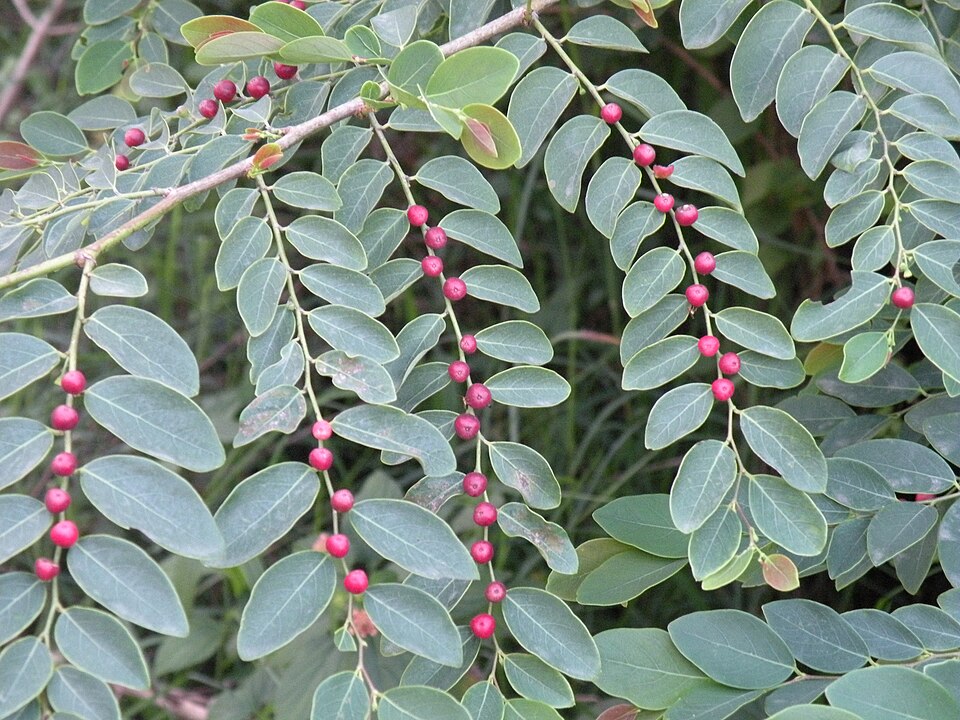
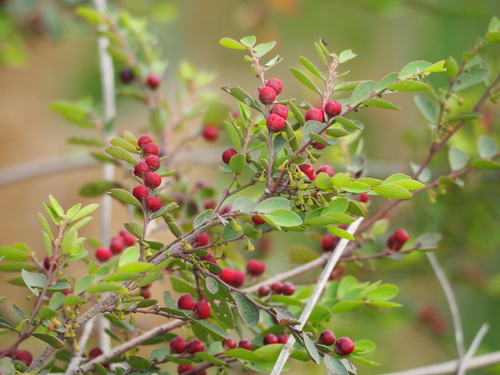
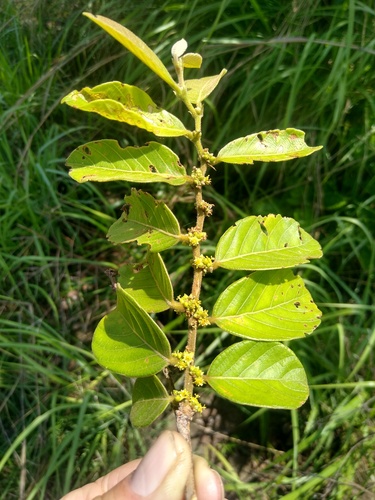
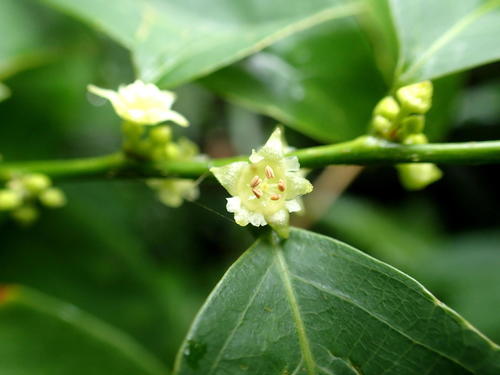
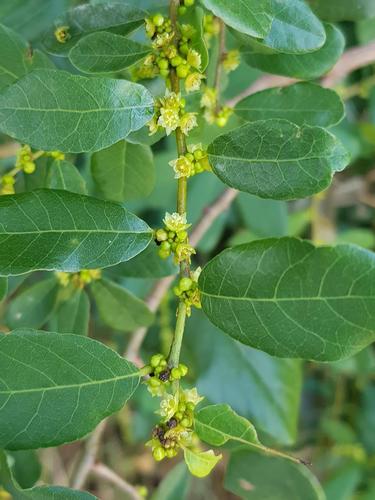
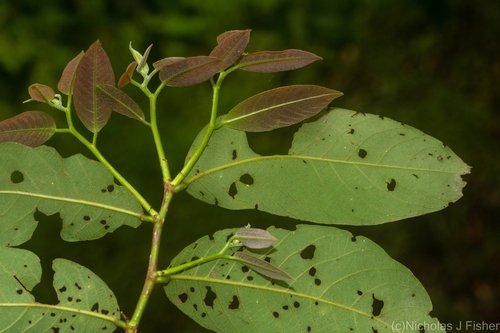
A deciduous tree. It grows to about 6-20 m high. The bark is greyish and has spines when young. The leaves are alternate and 6-15 cm long by 3.5-8 cm wide. They are oval and leathery. They taper to the tip. The base is rounded. There are many side veins. (15-20 pairs). They are parallel and distinct. The leaves are bright green but turn pink before falling. They are slightly hairy underneath. The flowers have short stalks. They are yellowish. They are clustered in the axils of leaves or at the ends of branches. The fruit has a stone inside. It is round and purplish-black when ripe. It is the size of a pea.
Edible Uses
The fruit is eaten by birds such as hornbills. The flowers are an excellent attractor of butterflies and its leaves are used as fodder.
Traditional Uses
The ripe fruit are eaten raw. They have a salty sour taste.
This uses section is brief — help expand it
Medicinal Uses
The bark is antiviral, hypoglycaemic, hypotensive. The bark contains tannins.
Known Hazards
The bark is used as a poison.
Distribution
A tropical plant. It grows to about 1200 m altitude in Nepal. In India it is common on low hills. It can grow on limestone. In Yunnan.
Where It Grows
Asia, Bangladesh, Bhutan, Cambodia, Himalayas, India, Indochina, Indonesia, Laos, Malaysia, Myanmar, Nepal, Northeastern India, Pakistan, SE Asia, Sikkim, Sri Lanka, Thailand, Vietnam,
Cultivation
Plants can be grown from seed or cuttings.
Other Uses
The bark contains 16 - 40% tannins. The dull red wood is close-grained, moderately hard to hard. The wood is of good quality and colour, it is used for construction, railway ties, rafters, posts, and floor-boards; also used for cart-shafts, wheels and agricultural implements. It is suitable for tool-handles and helves. The wood is used for fuel.
Production
In southern India fruit are available March to September.
Other Information
Fruit are sold in local markets.
Notes
There are about 60 Bridelia species.
Synonyms
Also Known As
Adamarudu, Akano, Akdana, Asan, Asana, Ashind, Bontha-yepi, Ekadivi, Ekdania, Gauli, Gaya, Gayo, Geio, Goje, Gondui, Hle-kanan, Jhaijhuwa, Kadukaipalam, Kage kaayi, Kaj, Kakai, Kamkui, Kanta-kauchi, Kasai, Kasi, Kassi, Kata kushui, Khais, Khaja, Khasai, Kovehannu, Kuhir, Kumkumi, Kutki, Mak-kawng-tawn, Mangritchok, Mark, Monj, Mukkayini, Mullu-vengai, Pani-kasi, Phaktel lien, Pathor, Pohon gayo, Pow nam, Seik-chi, Seikchi-bo, Suviraka, Teng nam, Thaidaoblib
References (49)
- Acharya K. P. and Acharya, R., 2010, Eating from the Wild: Indigenous knowledge on wild edible plants in Parroha VDC of Rupandehi District, Central Nepal. International Journal of Social Forestry. 3(1):28-48
- Ambasta S.P. (Ed.), 2000, The Useful Plants of India. CSIR India. p 87
- Arinathan, V., et al, 2007, Wild edibles used by Palliyars of the western Ghats, Tamil Nadu. Indian Journal of Traditional Knowledge. 6(1) pp 163-168
- Avinash, B. K., Kumar, R., et al, 2013, Ethnoboptany of Tharus of Dudhwa National Park, India. Mintage journal of Pharmaceutical & Medical Science 6-11
- Bandyopadhyay, S. et al, 2009, Wild edible plants of Koch Bihar district, West Bengal. Natural Products Radiance 8(1) 64-72
Show all 49 references Hide references
- Behera, K. K. et al, 2008, Wild Edible Plants of Mayurbhanj District, Orissa, India. J. Econ. Taxon. Bot. Vol. 32 (Suppl,) pp 305-314
- Bircher, A. G. & Bircher, W. H., 2000, Encyclopedia of Fruit Trees and Edible Flowering Plants in Egypt and the Subtropics. AUC Press. p 66
- Bohra, N., et al, 2017, Ethnobotany of wild edible plants traditionally used by the local people in the Ramnagar regions from Nainital District, Uttarakhand, India. Biolife 5(1): 12-19
- Bole, P.V., & Yaghani, Y., 1985, Field Guide to the Common Trees of India. OUP p 21
- Burkill, I.H., 1966, A Dictionary of the Economic Products of the Malay Peninsula. Ministry of Agriculture and Cooperatives, Kuala Lumpur, Malaysia. Vol 1 (A-H) p 370
- Chakraborty, S. & Chaturbedi, H. P., 2014, Some Wild Edible Fruits of Tripura- A Survey. Indian Journal of Applied research. (4) 9
- Chandrakumar, P., et al, 2015, Ethnobotanical studies of wild edible plants of Gond, Halba and Kawar tribes of Salekasa Taluka, Gondia District, Maharashtra State, India. International Research Journal of Pharmacy 6(8)
- Chauhan, S. H., et al, 2018, Consumption patterns of wild edibles by the Vasavas: a case study from Gujarat, India. Journal of Ethnobiology and Ethnomedicine (2018) 14:57 (As Bridelia squamosa (Lam.) Gehrm)
- Dangol, D. R., 2002, Economic uses of forest plant resources in western Chitwan, Nepal. Banko Janakari, 12(2): 56-64
- Dangol, D. R. et al, 2017, Wild Edible Plants in Nepal. Proceedings of 2nd National Workshop on CUAOGR, 2017.
- Dobriyal, M. J. R. & Dobriyal, R., 2014, Non Wood Forest Produce an Option for Ethnic Food and Nutritional Security in India. Int. J. of Usuf. Mngt. 15(1):17-37
- Flora of Pakistan. www.eFloras.org
- Ghosh, C. & Das A. P., 2011, Some useful and poisonous tea garden weeds from the Darjiling District of West Bengal, India. Pleione 5(1): 91 - 114
- Gautam, R. S., et al, 2020, Wild Edible Fruits of Nepal. Int. J. Appl. Sci. Biotechnol. Vol 8(3): 289-304
- GUPTA
- Hedrick, U.P., 1919, (Ed.), Sturtevant's edible plants of the world. p 136
- Jadhav, R., et al, 2015, Forest Foods of Northern Western Ghats: Mode of Consumption, Nutrition and Availability. Asian Agri-History Vol. 19, No. 4: 293-317
- Kiran, K. C., et al, 2019, Diversity and Seasonal Availability of Potential Wild Edible Plants from Vidarbha Region of Maharashtra State, India. Int.J.Curr.Microbiol.App.Sci (2019) 8(2): 1434-1446
- Krishen P., 2006, Trees of Delhi, A Field Guide. DK Books. p 85
- Kuvar, S. D. & Shinde, R. D., 2019, Wild Edible Plants used by Kokni Tribe of Nasik District, Maharashtra. Journal of Global Biosciences. Volume 8, Number 2, 2019, pp. 5936-5945
- Majumdar, K and Datta, N., 2009, Traditional wild edible fruits for the forest dwellers of Tripura, India. Pleione 3(2) 167-178
- Manandhar, N.P., 2002, Plants and People of Nepal. Timber Press. Portland, Oregon. p 122
- Medhi, P. & Borthakur, S. K., 2012, Phytoresources from North Cachur Hills of Assam -3: Edible plants sold at Hflong market. Indian Journal of Natural Products and Resources. 3(1) pp 84-109
- Medhi, P., Sarma, A and Borthakur, S. K., 2014, Wild edible plants from the Dima Hasao district of Assam, India. Pleione 8(1): 133-148
- Misra S. & Misra M., 2016, Ethnobotanical and Nutritional Evaluation of Some Edible Fruit Plants of Southern Odisha, India. International Journal of Advances in Agricultural Science and Technology, Vol.3 Issue.1, March- 2016, pg. 1-30
- Pasha, M. K. & Uddin, S. B., 2019, Minor Edible Fruits of Bangladesh. Bangladesh J. Plant Taxon. 26(2): 299–313
- Patil, M. V. & Patil, D. A., 2000, Some More Wild Edible Plants of Nasik District (Maharashtra). Ancient Science of Life Vol. X1X (3&4): 102-104 (As Bridelia airy-shaw)
- Ramachandran, V. S., 2007, Wild edible plants of the Anamalais, Coimbatore district, western Ghats, Tamil Nadu. Indian Journal or Traditional Knowledge. 6(1) pp 173-176
- Ramachandran,V. S., & Udhayavani, C., 2013, Knowledge and uses of wild edible plants by Paniyas and Kurumbas of Western Nilgiris, Tamil Nadu. Indian Journal of Natural Products and Resources. 4(4) December 2013, pp 412-418
- Reddy, B. M., 2012, Wild edible plants of Chandrapur district, Maharashtra, India. Indian Journal of Natural Products and Resources. 3(1) pp 110-117
- Sasi, R. & Rajendran, A., 2012, Diversity of Wild Fruits in Nilgiri Hills of the Southern Western Ghats - Ethnobotanical Aspects. IJABPT, 3(1) p 82-87
- Savita, et al, 2006, Studies on wild edible plants of ethnic people in east Sikkim. Asian J. of Bio Sci. (2006) Vol. 1 No. 2 : 117-125
- Setiya, A. V., et al, 2016, Exploration and documentation of some wild edible plants used by the aboriginals from Gadchiroli District (M.S.) India. International Advanced Research Journal in Science, Engineering and Technology. 3(7)
- Singh, B., et al, 2012, Wild edible plants used by Garo tribes of Nokrek Biosphere Reserve in Meghalaya, India. Indian Journal of Traditional Knowledge. 11(1) pp 166-171
- Sukarya, D. G., (Ed.) 2013, 3,500 Plant Species of the Botanic Gardens of Indonesia. LIPI p 162
- Sundriyal, M. & Sundriyal, R. C., 2004, Structure, Phenology, Fruit Yield, and Future Prospects of some Prominent Wild Edible Plant Species of the Sikkim Himalaya, India. Journal of Ethnobiology 24(1): 113-138
- Syst. veg. 3:48. 1826
- Thapa, L. B., et al, 2014, Wild Edible Plants used by endangered and Indigenous Raji Tribe in Western Nepal. International Journal of Applied Sciences and Biotechnology. Vol 2(3):243-252
- Toppo, P. et al, 2016, Wild edible plants of Dhamtari district of Chhattisgarh, India. Van Sangyan Vol. 3, No. 4
- Upreti, K., et al, 2010, Diversity and Distribution of Wild Edible Fruit Plants of Uttarakhand. Bioversity Potentials of the Himalaya. p 161
- Ravikrishna, S., 2011, Ethno-medico-botanical survey on Wild Edible fruits of Udupi Taluq, Udupi p 61
- Wild edible plants of Himachal Pradesh
- World Checklist of Useful Plant Species 2020. Royal Botanic Gardens, Kew
- www.nationalherbarium.nl/thaueuph/ Flora of Thailand.