Bridelia cathartica
Bertol. f.
Knobbly bridelia, Blue sweetberry
iNaturalist· cc-by-nc-sa
(c) Rob Palmer, some rights reserved (CC BY-NC-SA), uploaded by Rob Palmer
iNaturalist· cc-by-nc
(c) berthapi2, some rights reserved (CC BY-NC), uploaded by berthapi2
iNaturalist· cc-by-nc
(c) Mark Hyde, Bart Wursten and Petra Ballings, some rights reserved (CC BY-NC)
Description
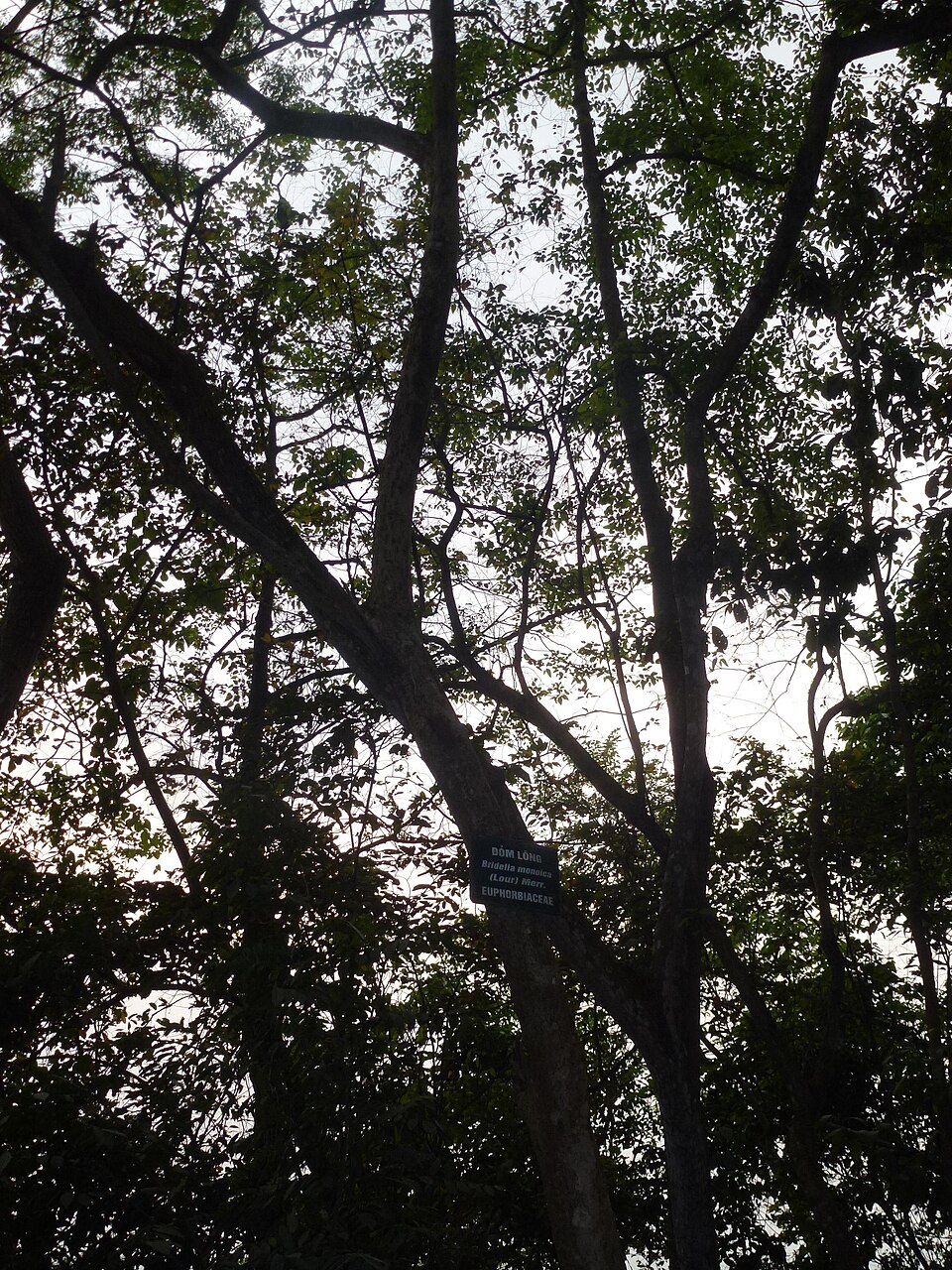
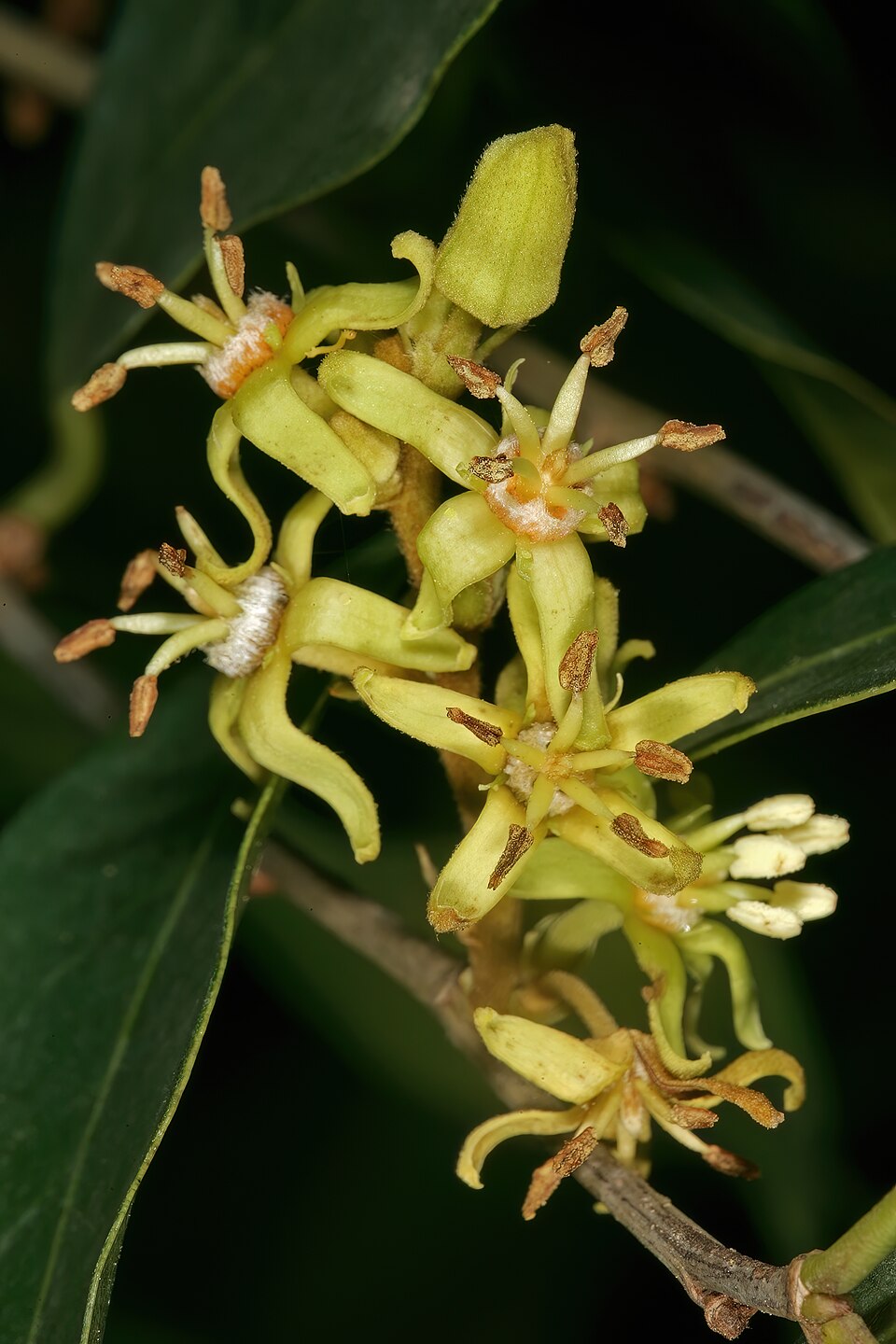
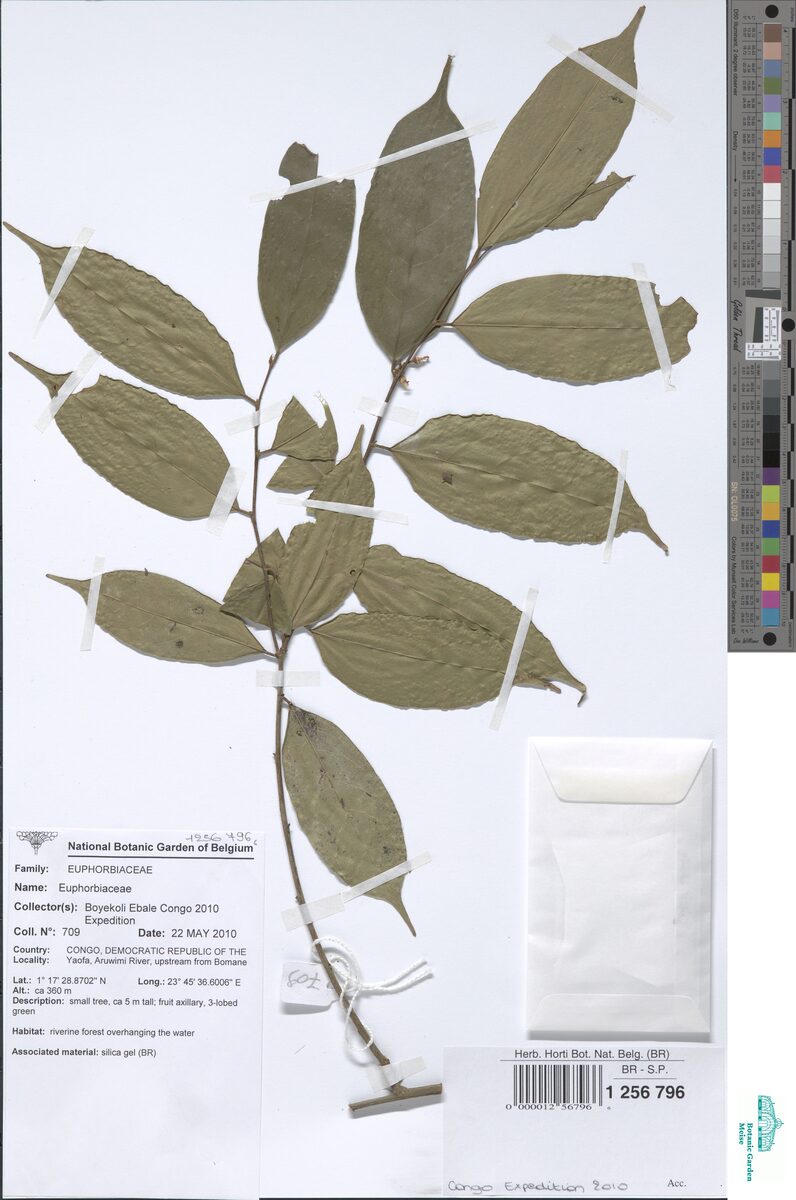
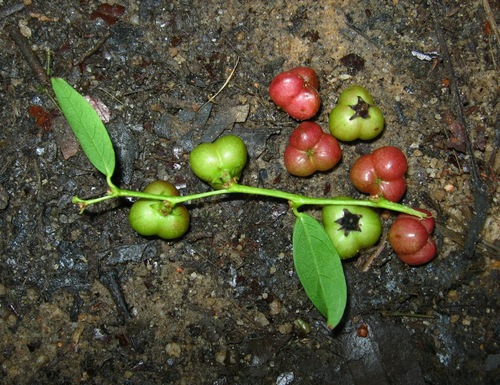
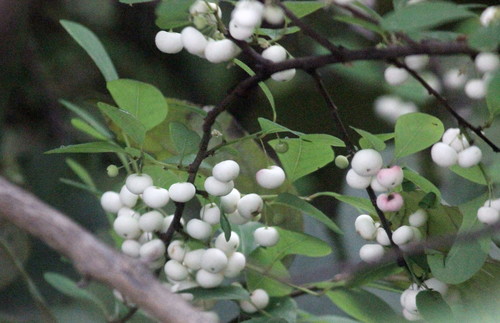
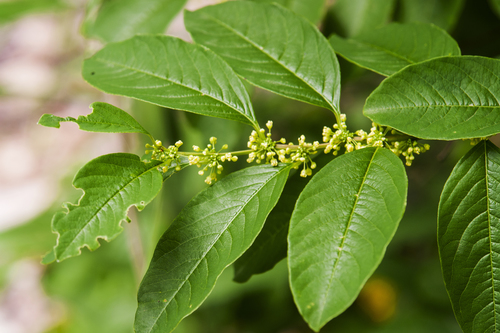
A shrub with many stems. It can scramble. It can also be a small tree 4-6 m high. The bark is brown or grey and smooth. The leaves are oblong and 3-9 cm long by 1.5-4.5 cm wide. They are dark green and shiny above and pale green below. The edges are rolled under. The male and female flowers are very small. They are greenish to yellow. They occur in small tight clusters in the axils of leaves. The fruit is 9 mm long by 7 mm wide. They are black when mature. They are edible. There are 2 subspecies and 3 varieties.
Edible Uses
The fruit are eaten raw when mature and black. The leaves are chewed with water to produce a sweet taste.
Traditional Uses
The fruit are eaten raw. The leaves are chewed with water to produce a sweet taste.
This uses section is brief — help expand it
Distribution
A tropical plant. They grow along stream banks. It grows along the coast. It grows in hot arid places with a marked dry season. It needs well-drained soil. It is rare in humid soils. It grows from sea level to 2,000 m above sea level. It is more common in the lowlands. It can grow in arid places. In Zimbabwe it grows in areas with a rainfall between 700-800 mm per year. In Brisbane Botanical Gardens.
Where It Grows
Africa, Australia, Botswana, Central Africa, Congo, East Africa, Eswatini, Ethiopia, Kenya, Malawi, Mozambique, Namibia, Somalia, South Africa, Southern Africa, Sudan, Swaziland, Tanzania, Zambia, Zimbabwe,
Cultivation
Plants can be grown from seed. The seeds are cleaned and soaked then planted
Notes
There are about 60 Bridelia species. Also as family Euphorbiaceae.
Synonyms
Also Known As
Makarakara, Mkalakala, Mumbarembare, Muningunga, Munohya-menda, Mupambare, Mupurungu, Musimbiju, Mutsvitsvirondo, Mwambeberu, Umnwangasi
References (23)
- Facciola, S., 1998, Cornucopia 2: a Source Book of Edible Plants. Kampong Publications, p 100
- Fowler, D. G., 2007, Zambian Plants: Their Vernacular Names and Uses. Kew. p 25
- Fox, F. W. & Young, M. E. N., 1982, Food from the Veld. Delta Books. p 191
- Grivetti, L. E., 1980, Agricultural development: present and potential role of edible wild plants. Part 2: Sub-Saharan Africa, Report to the Department of State Agency for International Development. p 71
- Long, C., 2005, Swaziland's Flora - siSwati names and Uses http://www.sntc.org.sz/flora/
Show all 23 references Hide references
- Maroyi, A., 2011, The Gathering and Consumption of Wild Edible Plants in Nhema Communal Area, Midlands Province, Zimbabwe. Ecology of Food and Nutrition 50:6, 506-525
- Maroyi, A. & Cheikhyoussef, A., 2017, Traditional knowledge of wild edible fruit in southern Africa: A comparative use patterns in Namibia and Zimbabwe. Indian Journal of Traditional Knowledge. 16(3): 385-392
- Maundu, P. et al, 1999, Traditional Food Plants of Kenya. National Museum of Kenya. 288p
- Mem. Reale Accad. Sci. Ist. Bologna 5:476, t. 28. 1854
- Mutie, F. M., et al, 2023, Important Medicinal and Food Taxa (Orders and Families) in Kenya, Based on Three Quantitative Approaches. Plants 2023, 12, 1145
- Pakia, M., 2000, Plant Ecology and Ethnobotany of two sacred forests (Kayas) at the Kenya Coast. M. Sc. Thesis.
- Palgrave, K.C., 1996, Trees of Southern Africa. Struik Publishers. p 412
- Peters, C. R., O'Brien, E. M., and Drummond, R.B., 1992, Edible Wild plants of Sub-saharan Africa. Kew. p 108
- Prins, H. & Maghembe, J. A., 1994, Germination studies on seed of fruit trees indigenous to Malawi. Forest Ecology and Management 64:111-125
- Royal Botanic Gardens, Kew (1999). Survey of Economic Plants for Arid and Semi-Arid Lands (SEPASAL) database. Published on the Internet; http://www.rbgkew.org.uk/ceb/sepasal/internet [Accessed 16th April 2011]
- Ruiters-Welcome, A. K., 2019, Food plants of southern Africa. Ph.D. thesis. Univ. of Johannesburg p 86
- Schmidt, E., Lotter, M., & McCleland, W., 2007, Trees and shrubs of Mpumalanga and Kruger National Park. Jacana Media p 266
- Scudder, 1971,
- Swaziland's Flora Database http://www.sntc.org.sz/flora
- Tredgold, M.H., 1986, Food Plants of Zimbabwe. Mambo Press. p 90
- Welcome, A. K. & Van Wyk, B.-E., 2019, An inventory and analysis of the food plants of southern Africa. South African Journal of Botany 122 (2019) 136–179
- World Checklist of Useful Plant Species 2020. Royal Botanic Gardens, Kew
- www.zimbabweflora.co.zw 2011