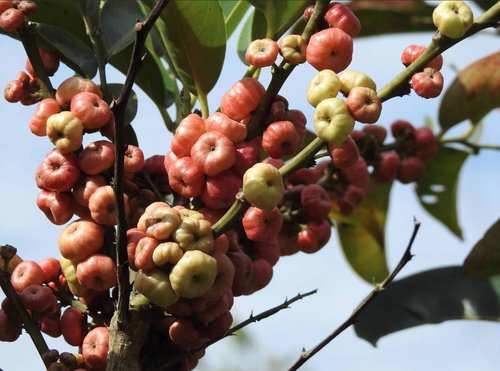
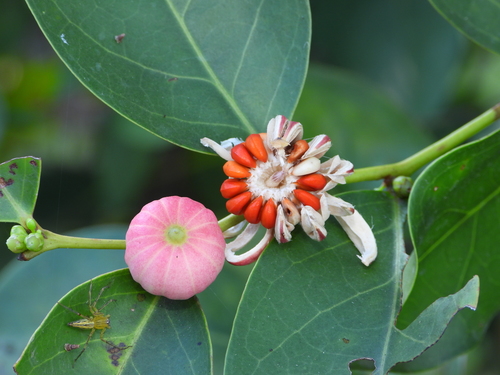
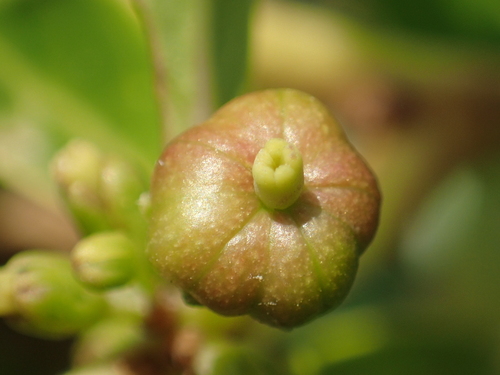
Breynia rhamnoides
(Retz.) Muell.-Arg.
wikimedia· cc-by-sa
Wikimedia Commons - Ajtjohnsingh
wikimedia· cc-by-sa
Wikimedia Commons - Vinayaraj
Description
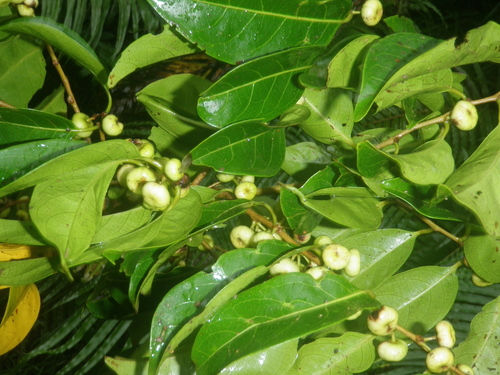
A shrub or small tree. The leaves are narrowly oval. The leaf stalks are short. The flowers occur singly on short stalks. The fruit are small and purple.
Edible Uses
The leaves are eaten as a vegetable and the ripe fruit are eaten, particularly by children.
Traditional Uses
The leaves are eaten as a vegetable. The ripe fruit are eaten.
This uses section is brief — help expand it
Known Hazards
Breynia vitis-idaea poisoning causes hepatocellular liver injury.
Distribution
A tropical plant.
Where It Grows
Asia, Cambodia, India, Indochina, Malaysia, Myanmar, Pacific, Philippines, SE Asia, Thailand,
Other Information
The fruit are especially eaten by children.
Notes
There are about 25 Breynia species. Also put in the family Euphorbiaceae.
Also Known As
Gonnyin-ya, Hujan panas, Jajan, Kali setki, Kali-sitki, Kamkata, Kang pla, Mak-nung-hpyeng, Manilpulnati, Pavala-pulah, Phnek preap, Purugudu, Semonah, Seruyan, Tikhar, Yellari
References (4)
- Ambasta S.P. (Ed.), 2000, The Useful Plants of India. CSIR India. p 86
- Bandyopadhyay, S., et al, 2012, A Census of Wild Edible Plants from Howrah District, West Bengal, India. Proceedings of UGC sponsored National Seminar 2012
- Bircher, A. G. & Bircher, W. H., 2000, Encyclopedia of Fruit Trees and Edible Flowering Plants in Egypt and the Subtropics. AUC Press. p 66
- Burkill, I.H., 1966, A Dictionary of the Economic Products of the Malay Peninsula. Ministry of Agriculture and Cooperatives, Kuala Lumpur, Malaysia. Vol 1 (A-H) p 368