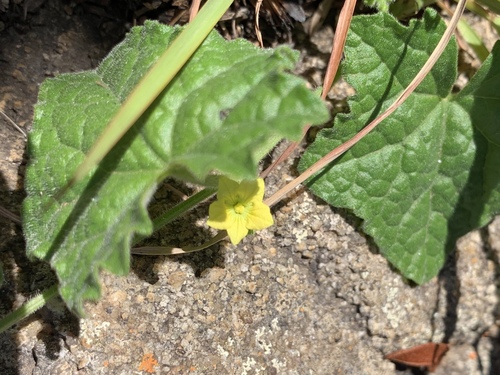
Acanthosicyos horridus
Welw. ex Benth. & Hook.f.
Butterpips
iNaturalist· cc-by-nc
(c) Bart Wursten, some rights reserved (CC BY-NC), uploaded by Bart Wursten
iNaturalist· cc-by
(c) ajott, some rights reserved (CC BY), uploaded by ajott
iNaturalist· cc-by-nc
(c) Bird Explorers, some rights reserved (CC BY-NC), uploaded by Bird Explorers
Summary
Source: WikipediaAcanthosicyos horridus is an unusual melon that is endemic to the Namib desert. In English it is known as Nara, butter-nuts, or butterpips; in one of the Khoisan languages it is locally called ǃnaras or ǃnara ("!" is pronounced with a click, somewhat like the "tsk" when English people are tutting, tsk-tsk).
Description
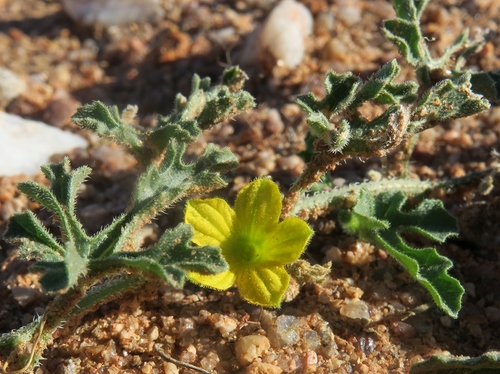
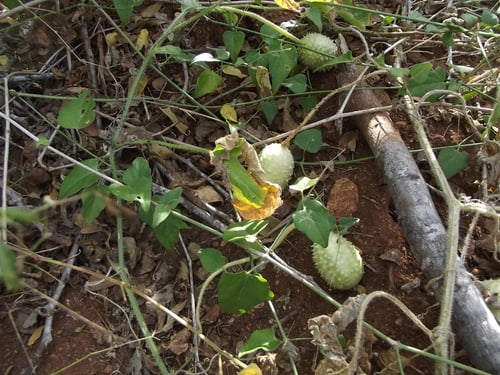
A shrub or small tree. It grows 5 m tall. There are prickles along the stem. The leaves are twice divided and there are 8-18 pairs of pinnae. There are up to 50 pairs of pinnules on each pinnae. The flowers are yellow. They are in large clusters at the ends of branches. The pods are flattened.
Edible Uses
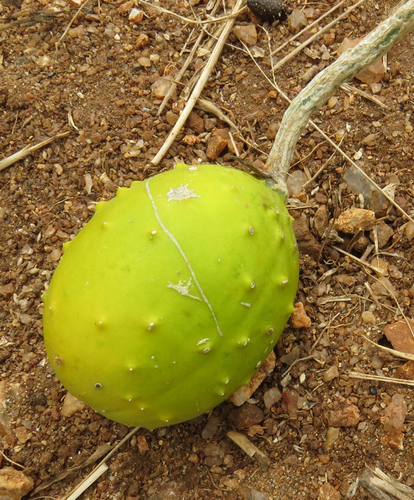
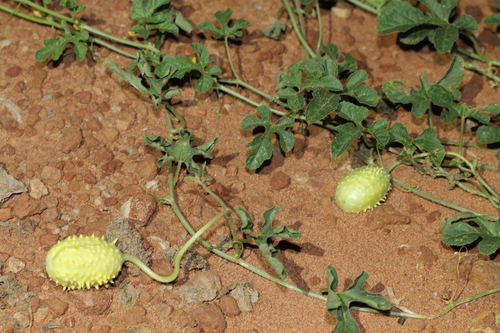
The fruit can be eaten raw, cooked, or preserved. It is juicy with a pleasant sweet-acid flavour, grows up to 7cm long, and can weigh up to 900g. Ripe fruits are collected and either buried in soil or left in the sun to soften, then peeled and boiled until the seeds loosen. The pulp is allowed to thicken and turns dark orange; after the seeds are separated, the remaining thick pulp is poured out and dried in the sun. It solidifies within a few days into flat, leathery cakes that can be cut into strips or rolled up for storage. These fruity rolls keep well and can be chewed or added to porridge throughout the year. The seeds can be eaten raw or cooked — roasted or boiled — and stored for later use. Ground into flour, they can be cooked with other dishes. They are a good substitute for almonds and have been exported to bakeries in Cape Town for use in confectionery. The kernel has a soft, butter-like consistency. Seeds contain about 45% oil and are up to 15mm long. An edible oil is also extracted from the seed.
Traditional Uses
The fruit are eaten fresh or preserved. The fruits are buried to soften, then peeled and boiled and the pulp allowed to thicken and then dried in the sun. It is then eaten or added to porridge. The seeds are eaten roasted or boiled. They are also stored for later use. The seeds also yield an edible oil. The pulp of the fruit is used to separate casein from milk after it is heated.
Medicinal Uses
The bitter roots are used medicinally, either chewed or made into a decoction, to treat nausea, stomach-ache, venereal diseases, kidney problems, arteriosclerosis, and chest pains. Fresh fruit is said to relieve stomach pains. The crushed root mixed with fat is applied to heal wounds. Oil from raw or boiled seeds is used as a skin moisturizer and to protect the skin from sunburn.
Distribution
It is a tropical plant. It grows on sand in the Namib desert. It can survive in a hot arid, desert climate. It grows in areas with an annual rainfall of 150 mm. It can survive during years without rainfall. It grows in areas with temperatures between 16°C and 21°C. It can grow in very poor soils. It can grow in salty soils. It grows between 25-150 m above sea level. It can grow in arid places.
Where It Grows
Africa, Angola, Botswana, Central Africa, Namibia*, South Africa, Southern Africa, USA,
Cultivation
It grows best in areas where annual daytime temperatures are within the range 15 - 30c, but can tolerate 10 - 40c. It prefers a mean annual rainfall in the range 125 - 250mm, but tolerates 75 - 450mm. Plants require a well-drained sandy soil on the poor side and a position in full sun. They can succeed in dry, saline soils, often growing where underground water is available. Prefers a pH in the range 6 - 7, tolerating 5.5 - 7.5. The leaves have been modified into thorns, which acts to give protection against grazing animals and also to minimize water-loss, making the plant very drought tolerant. A deep-rooting plant, the roots can go down 40 metres into the soil in search of water. A dioecious species, male and female plants must be grown if fruits and seed are required.
Propagation
Seed
Other Uses
The plant can be grown in shifting sand dunes. An oil is obtained from the seed. It is also used in carbon farming.
Production
Plants can live for very long periods. Fruits ripen seasonally. Fruit can be 900 g weight. 1,000 seeds weigh 300g. In Namibia fruit are harvested between November and May.
Other Information
It is an important food in very arid areas. It is cultivated.
Notes
There are 2 Acanthosicyos species. The seeds are very nutritious.
Nutrition
| Part | Moisture | kJ | kcal | Protein | Vit A | Vit C | Iron | Zinc |
|---|---|---|---|---|---|---|---|---|
| Seed | 5.3 | 2754 | 659 | 30.7 | — | — | 4 | 5.5 |
| Fruit | 84 | 234 | 56 | 1.4 | — | — | 0.5 | 0.6 |
Synonyms
Also Known As
Inara, Mnara, Naia, Nara, Naras, Narasplante, Narram, Narra melon
References (29)
- Arnold, T.H., Wells, M.J. & Wehmeyer, A.S., Khoisan food plants: taxa with potential for future economic exploitation, in Wickens, G.E., Goodin, J.R., and Field, D.V.,(Eds.) 1985, Plants for Arid Lands. Unwin Hyman, London, p 73
- Biocyclopedia Edible Plant Species
- Bircher, A. G. & Bircher, W. H., 2000, Encyclopedia of Fruit Trees and Edible Flowering Plants in Egypt and the Subtropics. AUC Press. p 5
- Cole, D. et al, 2014, Indigenous Plant Products in Namibia. Venture Publications Windhoek, Namibia. p 21
- Facciola, S., 1998, Cornucopia 2: a Source Book of Edible Plants. Kampong Publications, p 84
Show all 29 references Hide references
- Fox, F. W. & Young, M. E. N., 1982, Food from the Veld. Delta Books. p 164
- Gen. pl. 1:824. 1867
- Grubben, G. J. H. and Denton, O. A. (eds), 2004, Plant Resources of Tropical Africa 2. Vegetables. PROTA, Wageningen, Netherlands. p 31
- Hedrick, U.P., 1919, (Ed.), Sturtevant's edible plants of the world. p 21
- Heywood, V.H., Brummitt, R.K., Culham, A., and Seberg, O. 2007, Flowering Plant Families of the World. Royal Botanical Gardens, Kew. p 117
- Huxley, A. ed. The new Royal Horticultural Society dictionary of gardening. 1992
- INFOODS:FAO/INFOODS Databases
- Jardin, C., 1970, List of Foods Used In Africa, FAO Nutrition Information Document Series No 2.p 38, 118
- Mannheimer, C. A. & Curtis. B.A. (eds), 2009, Le Roux and Muller's Field Guide to the Trees and Shrubs of Namibia. Windhoek: Macmillan Education Namibia. p 474
- Menninger, E.A., 1977, Edible Nuts of the World. Horticultural Books. Florida p 104
- Plowes, N. J. & Taylor, F. W., 1997, The Processing of Indigenous Fruits and other Wildfoods of Southern Africa. in Smartt, L. & Haq. (Eds) Domestication, Production and Utilization of New Crops. ICUC p 184
- Royal Botanic Gardens, Kew (1999). Survey of Economic Plants for Arid and Semi-Arid Lands (SEPASAL) database. Published on the Internet; http://www.rbgkew.org.uk/ceb/sepasal/internet [Accessed 15th April 2011]
- Ruiters-Welcome, A. K., 2019, Food plants of southern Africa. Ph.D. thesis. Univ. of Johannesburg p 47
- Sandelowsky, B. H. 1990. Biology and utilization of the Cucurbitaceae. (Biol Cucurb) 349-355.
- USDA, ARS, National Genetic Resources Program. Germplasm Resources Information Network - (GRIN). [Online Database] National Germplasm Resources Laboratory, Beltsville, Maryland. Available: www.ars-grin.gov/cgi-bin/npgs/html/econ.pl (10 April 2000)
- Usher, G., 1974, A Dictionary of Plants Used by Man. Constable. p 15
- Van Damme, P et al, 1922, Plant Uses by the Topnaar of the Kuiseb Valley Namib Desert. Afrika Focus Vol. 8(3-4):223-252
- van Wyk, Be, & Gericke, N., 2007, People's plants. A Guide to Useful Plants of Southern Africa. Briza. p 34
- Wehmeyer, A. S, 1986, Edible Wild Plants of Southern Africa. Data on the Nutrient Contents of over 300 species
- Wickens, G.E., 1995, Edible Nuts. FAO Non-wood forest products. FAO, Rome. p 119
- Wiersema, J. H. & Leon, B., 2013, World Economic Plants. A Standard Reference CRC Press. 2nd Ed. p 8
- Wikipedia
- Wilkins-Ellert, M.H., 2004. Acanthosicyos horridus Welw. ex Hook.f. [Internet] Record from Protabase. Grubben, G.J.H. & Denton, O.A. (Editors). PROTA (Plant Resources of Tropical Africa / Ressources végétales de l’Afrique tropicale), Wageningen, Netherlands. < http://database.prota.org/search.htm>. Accessed 13 October 2009.
- World Checklist of Useful Plant Species 2020. Royal Botanic Gardens, Kew