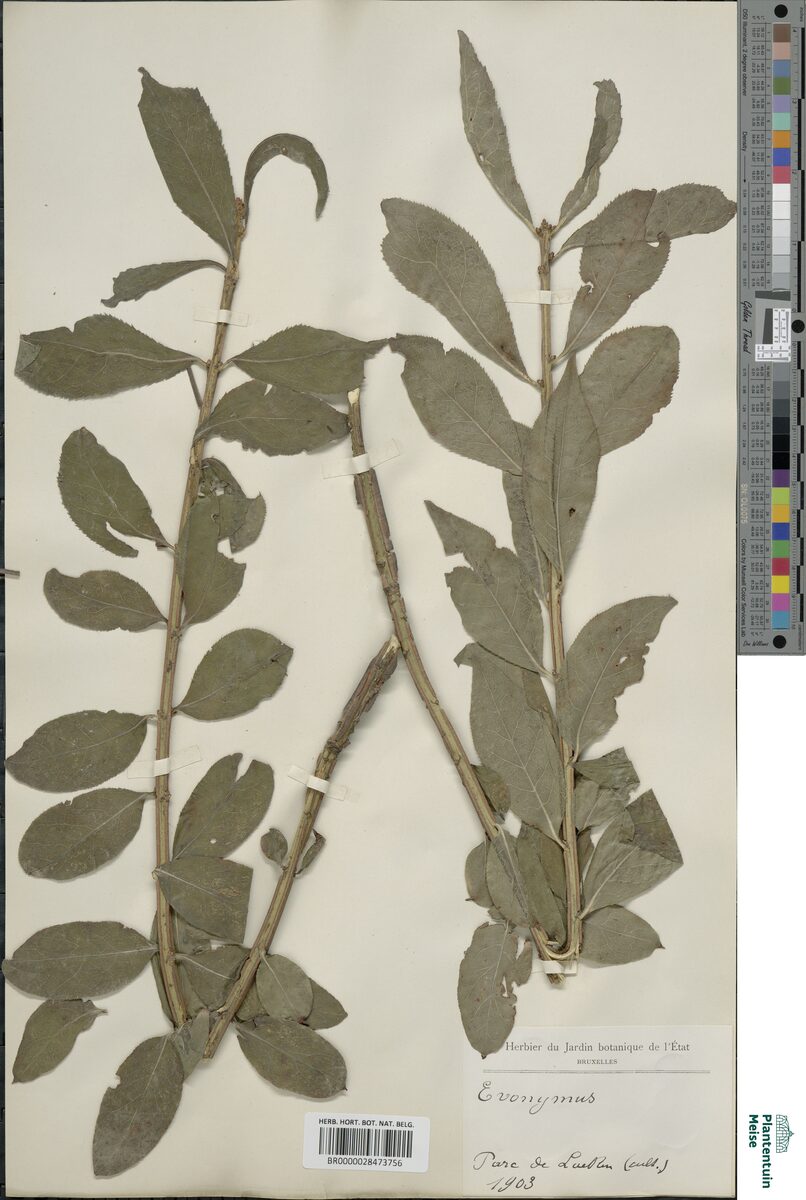
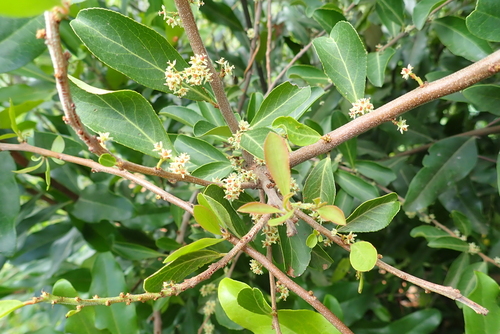
Brexia madagascariensis
(Lamarck) Thours ex Ker-Gawl.
Madagascar brexia
iNaturalist· cc-by-nc
(c) cheethaj, some rights reserved (CC BY-NC)
iNaturalist· cc-by-nc
(c) Troos van der Merwe, some rights reserved (CC BY-NC), uploaded by Troos van der Merwe
iNaturalist· cc-by-nc
(c) Tiana Randriamboavonjy, some rights reserved (CC BY-NC), uploaded by Tiana Randriamboavonjy
Description
An evergreen shrub or small tree. It is dense, with many branches. It is mostly only 2-3 m high. The bark is grey with stripes. The leaves are alternate and vary in shape. They are narrow and oblong. They are 3.5-14 cm long and thickly leathery. The flowers are white large and with 5 spreading petals. These tend to curve backwards. These can be 2 cm long. The flowers occur in loose clusters. They are mostly in leaf axils but sometimes on old wood. The fruit are long and narrow and woody. They are 9 cm long with 5 ridges. The fruit can float in the sea for months and the seed remain viable. They contain many seeds.
Edible Uses
Fruit - raw. The pulp of the fully ripe fruit is eaten. The fruit is a woody, rather fibrous tapering cylinder about 4 - 10cm long, with 5 definite ridges, said to become soft, pulpy and edible with age.
Traditional Uses
The fruit softens as it ripens to become edible.
This uses section is brief — help expand it
Medicinal Uses
The roots are boiled and the liquid drunk to treat stomach-ache and yaws.
Distribution
A tropical plant. It occurs in bush and scrub near the beach. It can also be at the edges of mangrove swamps. It can grow up to 100 m above sea level. It has been grown up to 1,500 m above sea level. It needs full sun and a reasonably fertile soil. It is best in a well-drained, moist soil. It can tolerate alkaline soils, salty soils and salt spray. It can grow in arid places.
Where It Grows
Africa, Asia, Comoros, East Africa, Hawaii, Indonesia, Madagascar*, Mozambique, Pacific, SE Asia, Seychelles, South Africa, Southern Africa, Tanzania, USA, Zimbabwe,
Cultivation
It is usually grown from seed. The fruit can float in sea water for many months and the seeds will still grow.
Other Uses
The wood is used for poles, yokes, spoons and tool handles. The wood is used for fuel and to make charcoal.
Production
In Tanzania ripe fruit are available in November and December.
Notes
There is only one Brexia although some scholars recognise nine or eleven. Some put this one in the Grossulariaceae, Brexiaceae, Escalloniaceae and other families.
Synonyms
Also Known As
Anagafuma, Mfukufuku, Mfurugudu, Mkurufu, Mpumbuti, Mutamonga, Pohon bresia madagaskar, Umatunga, Venana, Voatanga, Voatalany
References (10)
- Bot. Reg. 9: t. 730. 1823
- Jardin, C., 1970, List of Foods Used In Africa, FAO Nutrition Information Document Series No 2.p 123
- Lovett, J. C. et al, Field Guide to the Moist Forest Trees of Tanzania. p 30
- Palgrave, K.C., 1996, Trees of Southern Africa. Struik Publishers. p 202
- Royal Botanic Gardens, Kew (1999). Survey of Economic Plants for Arid and Semi-Arid Lands (SEPASAL) database. Published on the Internet; http://www.rbgkew.org.uk/ceb/sepasal/internet [Accessed 16th April 2011]
Show all 10 references Hide references
- Ruffo, C. K., Birnie, A. & Tengnas, B., 2002, Edible Wild Plants of Tanzania. RELMA p 170
- Schatz, G. E. and Lowry, P. P., 2004, A synoptic revision of Brexia (Celastraceae) in Madagascar. Adansonia 26(1) p67-81 (Also as Brexia humbertii)
- Staples, G.W. and Herbst, D.R., 2005, A tropical Garden Flora. Bishop Museum Press, Honolulu, Hawaii. p 349 (Drawing)
- Sukarya, D. G., (Ed.) 2013, 3,500 Plant Species of the Botanic Gardens of Indonesia. LIPI p 160
- World Checklist of Useful Plant Species 2020. Royal Botanic Gardens, Kew