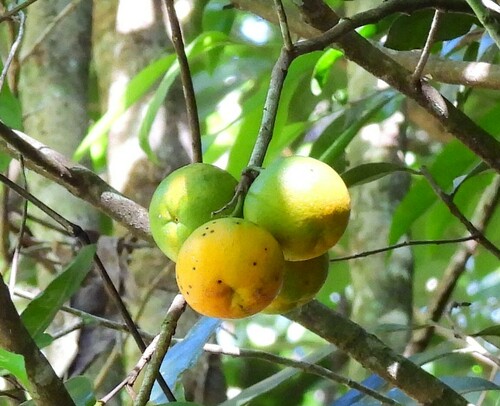
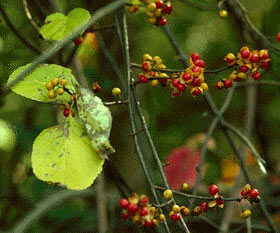
Gymnosporia heterophylla
(Eckl. & Zeyh.) Loes.
Spike thorn tree
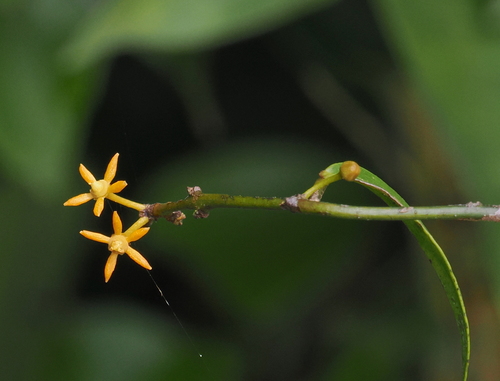
iNaturalist· cc-by-nc
(c) graemewolfaard, some rights reserved (CC BY-NC)
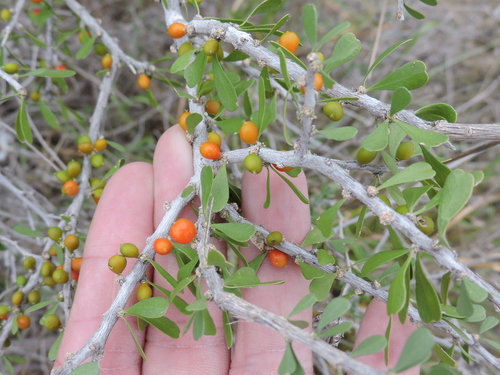
iNaturalist· cc-by-nc
(c) graemewolfaard, some rights reserved (CC BY-NC)
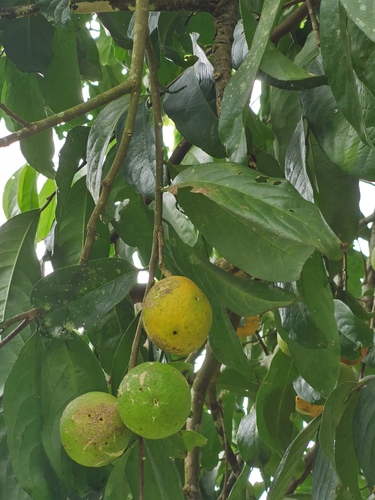
iNaturalist· cc-by-nc
(c) Jan-Hendrik Keet, some rights reserved (CC BY-NC)
Summary
Source: WikipediaGymnosporia heterophylla, the common spike-thorn, is a small, hardy, deciduous African tree up to 5 m tall, occurring in rocky places with a wide distribution from Ethiopia, the Sudan and the Congo, south to the Cape Province and west to Angola and Namibia, as well as the neighbouring islands of Madagascar and Saint Helena, with a closely related species from Mauritius. It has a straggly, but rigid habit and is armed with sharp straight thorns up to 100mm long, which are modified branches. Bark on the mature trunk is grey-brown and deeply fissured. The tree is dioecious, and clusters of white flowers are produced in profusion in spring and are borne on thicker twigs and branches. The flowers have a fetid, faecal smell and attract large numbers of pollinating insects, particularly carrion-loving flies such as members of the family Calliphoridae. The tree has a close relationship with a number of cicada species, such as Platypleura divisa, P. mijburghi and P. maytenophila. The specific name "heterophylla" means "variable leaves" and if the list of past synonyms is examined, it affords an interesting insight into the minds of botanists since 1753 when Linnaeus decided that the leaves reminded him of boxwood and named it Celastrus buxifolius. Since then it has been named ellipticus, heterophyllus, spathephyllus, empleurifolius, rhombifolius, parvifolius and buxifolioides - it would seem that the epithet heterophylla is appropriate. It makes a very effective, fast-growing security hedge. The wood is hard and durable, suitable for carving, though large pieces are not often available.
Description
A shrub. It grows 1-7 m tall. It can have green spines. Plants are separately male and female.
This description is brief — help expand it
Edible Uses
The roots are cooked as a vegetable, and the fruit is also eaten.
Traditional Uses
The roots are cooked as a vegetable.
This uses section is brief — help expand it
Medicinal Uses
Medicinal uses are reported throughout the range of the plant. Some research has been carried out into the medicinal activities of the plant. Maytenfolic acid, isolated from the plant, has moderate antimicrobial activity; it showed growth inhibition of Candida albicans, Cryptococcus neoformans, Staphylococcus aureus and Pseudomonas aeruginosa. Maytansinoids have been isolated from other Maytenus species, which have shown significant antitumour and antileukaemic activities. The leaves are used as a remedy for painful menstruation. The bark is emetic. An infusion is used to treat diarrhoea. A leaf and bark infusion is used against diarrhoea in cattle. The roots are anthelmintic. They are used as a treatment for hernia and as a cure for syphilis. Unspecified plant parts are used as a remedy for snakebite, epilepsy, abscesses and convulsions in children.
Distribution
It is a tropical plant.
Where It Grows
Africa, Agola, Congo DR, East Africa, Eritrea, Ethiopia, Kenya, Mozambique, South Africa, Southern Africa, Sudan, Tanzania, Zambia, Zimbabwe,
Cultivation
A dioecious species, both male and female forms need to be grown if fruit and seed are required.
Other Uses
The wood is very hard and heavy and resembles boxwood (Buxus species). It is generally only available in small dimensions, but is suitable for making small objects such as spoons and stools, for carving and for throwing sticks ('knobkerries').
Synonyms
References (3)
- Ferns Useful Tropical Plants
- Mutie, F. M., et al, 2023, Important Medicinal and Food Taxa (Orders and Families) in Kenya, Based on Three Quantitative Approaches. Plants 2023, 12, 1145
- World Checklist of Useful Plant Species 2020. Royal Botanic Gardens, Kew