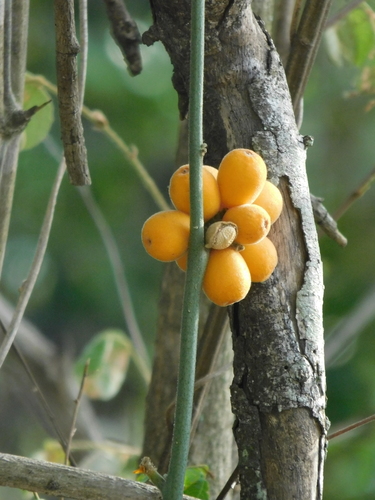
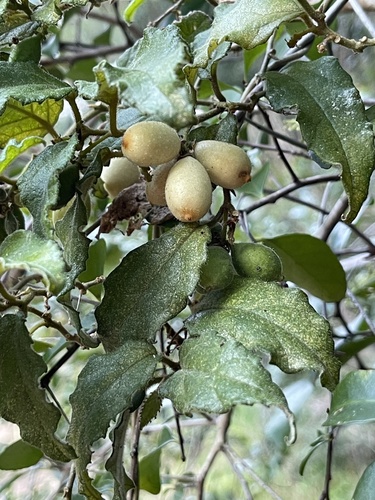
Rhaphiostylis beninensis
(Hook. f. ex Hook.) Planch. ex Benth.
iNaturalist· cc-by-nc
(c) Bart Wursten, some rights reserved (CC BY-NC), uploaded by Bart Wursten
iNaturalist· cc-by-nc
(c) Faya Julien Simbiano, some rights reserved (CC BY-NC)
iNaturalist· cc-by-nc
(c) Faya Julien Simbiano, some rights reserved (CC BY-NC)
Summary
Source: WikipediaRhaphiostylis beninensis is a woody, sprawling or scrambling glabrous, evergreen shrub or liane native to Tropical Africa, belonging to the family Metteniusaceae, and one of 3 species in the genus Rhaphiostylis. It is traditionally used as an anti-inflammatory by the Bantu people of Africa. Occasionally forming thickets, it is found in or on the margins of rain-forest, where, as a climber, it reaches 10-15m in height, and rarely as a free-standing tree 5-8m. Its bark is smooth and dark grey, while young branches are reddish-brown to purple. Leaves are alternate and elliptic-lanceolate in shape with acuminate apex. Flowers in axillary clusters, white and fragrant. Fruit flattened and sub-reniform, persistent lateral style, reticulate or wrinkled, bright red turning black when ripe. This species occurs in Liberia, Zambia, Zimbabwe, Mozambique, Senegal, Gambia, Congo and Angola.
Description
A twining shrub. It grows 2 m tall but can grow to a tree 10 m tall. It can be a woody climber. The bark is smooth and dark grey. Young branches are dark purple. The leaf blade is 7-15 cm long by 3-6 cm wide. It is dark glossy green but paler underneath. It is narrowly sword shaped. Many flowers occur in a group. They have a sweet scent. The petals are white. The fruit is wrinkled. It is red when ripe.
Edible Uses
The seeds and leaves are eaten.
Distribution
It is a tropical plant. It grows in closed forest in West Africa. It is common on sandy loam. It grows in forests along river banks. In Nigeria it is recorded at about 1,400 m above sea level.
Where It Grows
Africa, Angola, Burkina Faso, Cameroon, Central Africa, Central African Republic, CAR, Congo, Congo R, Côte d'Ivoire, East Africa, Gambia, Ghana, Guinea, Guinée, Guinea-Bissau, Ivory Coast, Liberia, Mozambique, Niger, Nigeria, Senegal, Sierra Leone, Southern Africa, Tanzania, Uganda, West Africa, Zambia, Zimbabwe,
Production
In Central African Republic flowers have been recorded in January.
Synonyms
Also Known As
Bogdrobo, Buru tiangol, Kpe-kpe, Lushila, Lusyila
References (14)
- Burkill, H. M., 1985, The useful plants of west tropical Africa, Vol. 2. Kew.
- Chapman, J. D. & Chapman, H. M., 2001, The Forest Flora of Taraba and Andamawa States, Nigeria. WWF & University of Canterbury. p 178
- Dalziel, 1937,
- Flora Zambesiaca. http://apps.kew.org/efloras
- Exell, A.W. et al, (Ed), 1963, Flora Zambesiaca Vol 2 Part 1 Crown Agents, London. p 347
Show all 14 references Hide references
- Fowler, D. G., 2007, Zambian Plants: Their Vernacular Names and Uses. Kew. p 51
- Jardin, C., 1970, List of Foods Used In Africa, FAO Nutrition Information Document Series No 2.p 47
- JSTOR Global Plants edible
- Malaisse, F., 1997, Se nourrir en floret claire africaine. Approche ecologique et nutritionnelle. CTA., p 67
- Menninger, E.A., 1977, Edible Nuts of the World. Horticultural Books. Florida p 121
- Nkeoua, G. & Boundzanga, G. C., 1999, Donnees sur les produits forestieres non ligneux en Republique du Congo. FAO. p 35
- Peters, C. R., O'Brien, E. M., and Drummond, R.B., 1992, Edible Wild plants of Sub-saharan Africa. Kew. p 117
- Vivien, J., & Faure, J.J., 1996, Fruitiers Sauvages d'Afrique. Especes du Cameroun. CTA p 169
- World Checklist of Useful Plant Species 2020. Royal Botanic Gardens, Kew