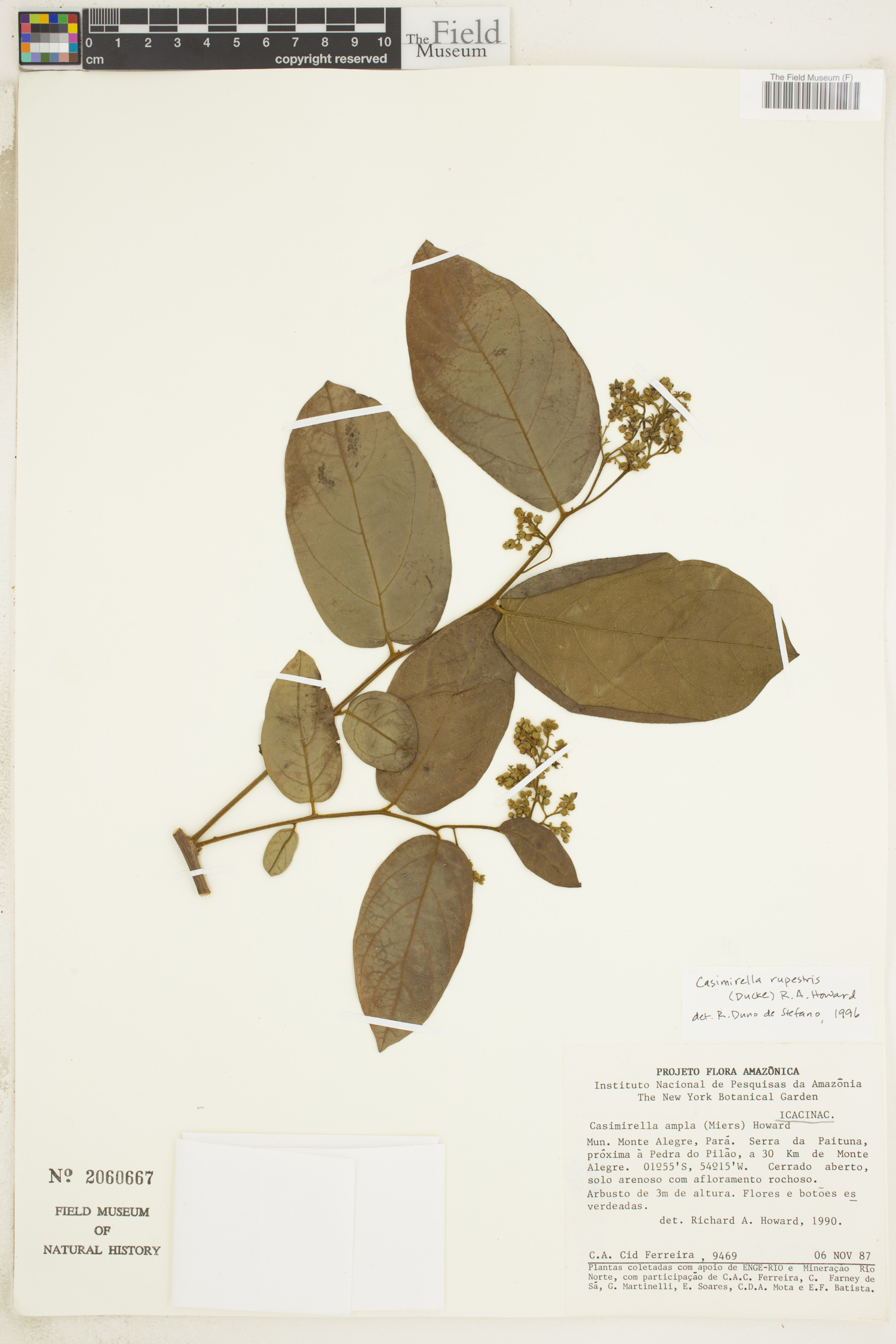
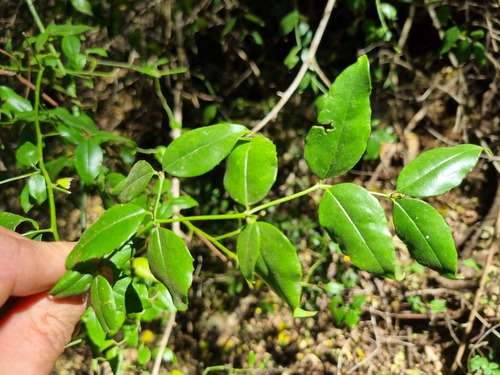
Pyrenacantha kaurabassana
Baill.
iNaturalist· cc-by-nc
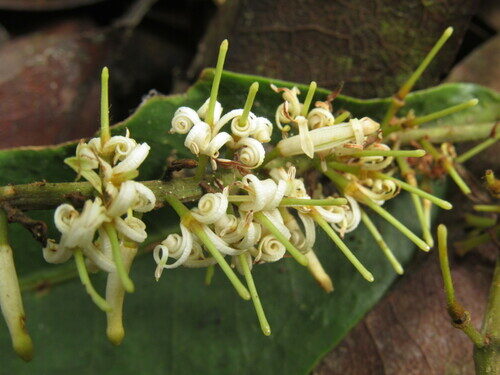
(c) qgrobler, some rights reserved (CC BY-NC), uploaded by qgrobler
iNaturalist· cc-by-nc
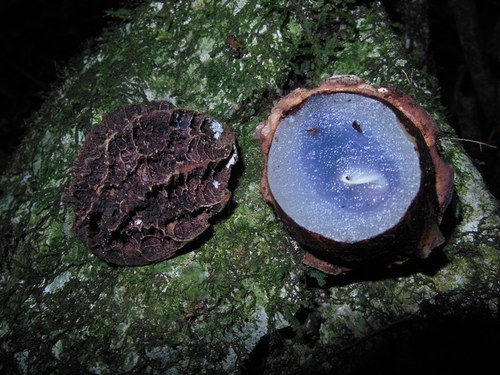
(c) Troos van der Merwe, some rights reserved (CC BY-NC), uploaded by Troos van der Merwe
iNaturalist· cc-by-nc
(c) Linda Loffler, some rights reserved (CC BY-NC)
Description
A climbing shrub. It has several trailing or twining stems. There is a tuberous rootstock. The leaf stalk is 4-6 cm long. The leaves are triangle shaped or 8 sided in outline. They can have 3-5 lobes. The base is heart shaped. The flowers are at the nodes. The male flowers are in 3-4 cm long spikes and the female flowers are in 1-1.5 flattened groups. There are many male flowers and fewer female flowers. The fruit are yellow to orange when ripe.
Edible Uses
The tubers are chopped, dried, burnt, filtered, and evaporated to produce salt. The leaves are cooked and eaten as a vegetable. The fruit is also edible.
Traditional Uses
The tubers are chopped, dried, burnt, filtered and evaporated to provide salt. The leaves are cooked and eaten as a vegetable.
This uses section is brief — help expand it
Medicinal Uses
The plant is used in traditional medicine.
Distribution
It is a tropical plant. It grows among rocks and on termite minds. It grows in dry woodland. In Ethiopia it grows between 600-1,300 m above sea level.
Where It Grows
Africa, East Africa, Eswatini, Ethiopia, Kenya, Malawi, Mozambique, Somalia, South Africa, Southern Africa, Swaziland, Tanzania, Zimbabwe,
Notes
It is used in medicine.
Synonyms
Also Known As
Appel, Dema, Guidi, Mathuma-mbiti, Phagh
References (10)
- Asfaw, Z. and Tadesse, M., 2001, Prospects for Sustainable Use and Development of Wild Food Plants in Ethiopia. Economic Botany, Vol. 55, No. 1, pp. 47-62
- Awas, T., 1997, A Study on the Ecology and Ethnobotany of Non-cultivated Food Plants and Wild Relatives of Cultivated crops in Gambella Region, Southwestern Ethiopia. Addis Ababa University. p 53
- East African Herbarium records, 1981,
- Lulekal, E., et al, 2011, Wild edible plants in Ethiopia: a review on their potential to combat food insecurity. Afrika Focus - Vol. 24, No 2. pp 71-121
- Mutie, F. M., et al, 2023, Important Medicinal and Food Taxa (Orders and Families) in Kenya, Based on Three Quantitative Approaches. Plants 2023, 12, 1145
Show all 10 references Hide references
- Peters, C. R., O'Brien, E. M., and Drummond, R.B., 1992, Edible Wild plants of Sub-saharan Africa. Kew. p 116
- Ruiters-Welcome, A. K., 2019, Food plants of southern Africa. Ph.D. thesis. Univ. of Johannesburg p 66
- Shumsky, S., et al, 2014, Institutional factors affecting wild edible plant (WEP) harvest and consumption in semi-arid Kenya. Land Use Policy 38(2014) 48-69
- Swaziland's Flora Database http://www.sntc.org.sz/flora
- Welcome, A. K. & Van Wyk, B.-E., 2019, An inventory and analysis of the food plants of southern Africa. South African Journal of Botany 122 (2019) 136–179