Erythrococca kirkii
(Muell. Arg.) Prain
gbif· cc-by-sa
GBIF
Description
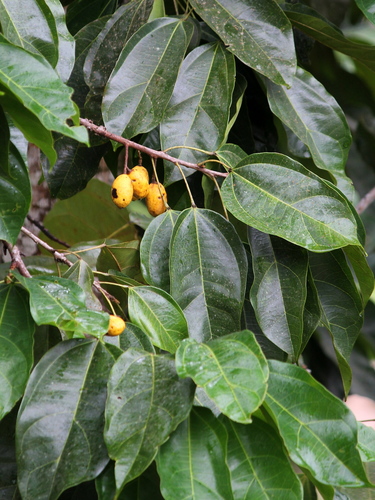
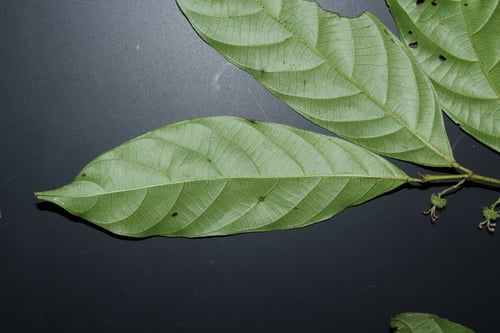
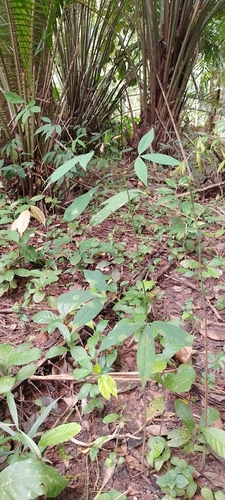
A straggling shrub. It can grow 4.5 m tall. The bark is rough. The leaves are alternate and simple. They are oval and 5-15 cm long by 2-8 cm wide. The base is wedge shaped and they taper to the tip. The flowers are in rounded groups 1-2 cm long. There are fewer female flowers than male flowers. The fruit are a 3 lobed capsule.
Edible Uses
Chopped leaves are cooked as a vegetable, often mixed with other vegetables. Ripe fruits are eaten raw. The leaves are popular and sold in local markets.
Traditional Uses
The chopped leaves are eaten cooked as a vegetable. They are often mixed with other vegetables. The ripe fruits are eaten raw.
This uses section is brief — help expand it
Distribution
It is a tropical plant. It grows in forests and along rivers and on the edges of woodland and lakes. It grows up to 1,250 m above sea level.
Where It Grows
Africa, East Africa, Kenya, Mozambique, Tanzania,
Cultivation
Plants can be grown from seeds.
Other Uses
The wood is used for fuel.
Production
In Tanzania leaves are collected from February to June.
Other Information
Leaves are sold in local markets. It is a popular vegetable.
Notes
There are about 50 Erythrococca species.
Synonyms
Also Known As
Lutini, Mnyembeue, Mnyembeuwe, Nyakibiki, Nyamtulo
References (11)
- Anon., 2000, The Role of Non Wood Forest products in Food Security and Income Generation. Report. Tanzania. p 18
- East African Herbarium records, 1981,
- Glover, et al, 1969
- Grubben, G. J. H. and Denton, O. A. (eds), 2004, Plant Resources of Tropical Africa 2. Vegetables. PROTA, Wageningen, Netherlands. p 298
- Harkonen, M. & Vainio-Mattila, K., 1998, Some examples of Natural Products in the Eastern Arc Mountains. Journal of East African Natural History 87:265-278
Show all 11 references Hide references
- Mutie, F. M., et al, 2023, Important Medicinal and Food Taxa (Orders and Families) in Kenya, Based on Three Quantitative Approaches. Plants 2023, 12, 1145
- Peters, C. R., O'Brien, E. M., and Drummond, R.B., 1992, Edible Wild plants of Sub-saharan Africa. Kew. p 110
- Reis, S. V. and Lipp, F. L., 1982, New Plant Sources for Drugs and Foods from the New York Botanical Garden herbarium. Harvard. p 157
- Ruffo, C. K., Birnie, A. & Tengnas, B., 2002, Edible Wild Plants of Tanzania. RELMA p 310
- Vainio-Mattila, K., 2000, Wild vegetables used by the Sambaa in the Usumbara Mountains, NE Tanzania. Ann. Bot. Fennici 37:57-67
- World Checklist of Useful Plant Species 2020. Royal Botanic Gardens, Kew