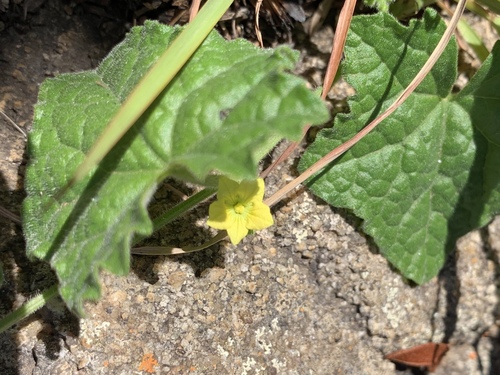
Trochomeria debilis
(Sond.) Hook. f.
iNaturalist· cc-by-sa
(c) Dave U, some rights reserved (CC BY-SA), uploaded by Dave U
iNaturalist· cc-by-nc
(c) jambobwana, some rights reserved (CC BY-NC)
iNaturalist· cc-by-nc
(c) jambobwana, some rights reserved (CC BY-NC)
Description
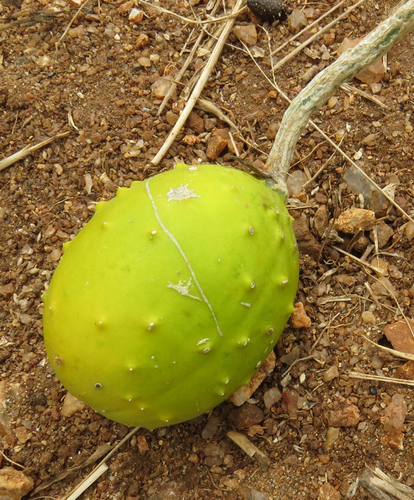
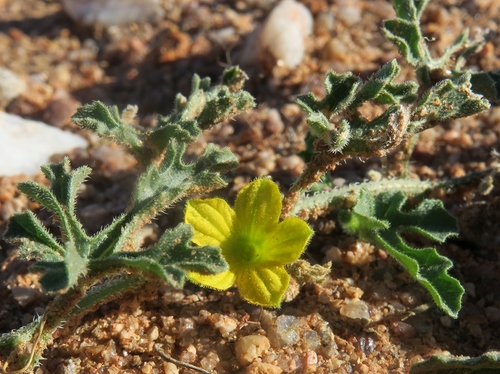
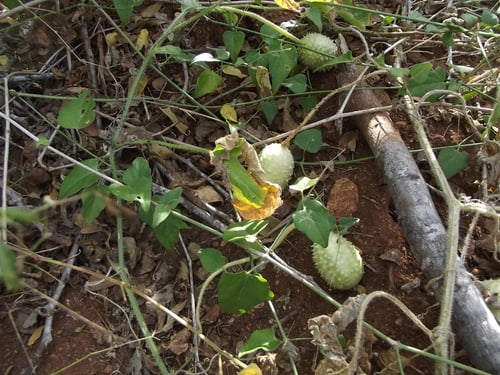
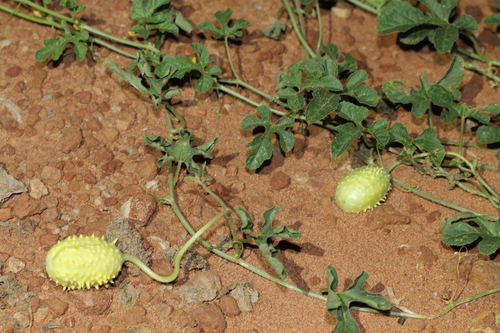
A herb. It is a pumpkin family plant. It can lie along the ground or be a climber. It grows 1 m high. It keeps growing from year to year. The stems can have short hairs. It has simple tendrils. It has a large underground tuber. The leaves are 2-6 cm long by 2-11 cm wide. They are broadly oval and often have lobes. Male and female flowers are separate. Male flowers occur singly or in small groups and have short stalks. Female flowers have 1 cm long stalks. The seeds are 8-9 mm long by 5-6 mm wide and 3 mm thick.
Edible Uses
The large underground tuber is roasted and eaten, typically after being split in half and the bitter centre removed.
Traditional Uses
The large underground storage organ is roasted and eaten. The tuber is split in half and the bitter centre removed before roasting.
This uses section is brief — help expand it
Known Hazards
The tuber has a bitter centre that must be removed before roasting.
Distribution
It is a subtropical plant. It grows in deep well-drained soils. It can be amongst rocks or in sands or loams. It grows between 460-1,850 m above sea level. It can grow in arid places.
Where It Grows
Africa, Botswana, Namibia, South Africa, Southern Africa,
Synonyms
Also Known As
Laloentjie
References (5)
- Marshall, 1976,
- Peters, C. R., O'Brien, E. M., and Drummond, R.B., 1992, Edible Wild plants of Sub-saharan Africa. Kew. p 103
- Royal Botanic Gardens, Kew (1999). Survey of Economic Plants for Arid and Semi-Arid Lands (SEPASAL) database. Published on the Internet; http://www.rbgkew.org.uk/ceb/sepasal/internet [Accessed 16th April 2011]
- Ruiters-Welcome, A. K., 2019, Food plants of southern Africa. Ph.D. thesis. Univ. of Johannesburg p 50
- Welcome, A. K. & Van Wyk, B.-E., 2019, An inventory and analysis of the food plants of southern Africa. South African Journal of Botany 122 (2019) 136–179