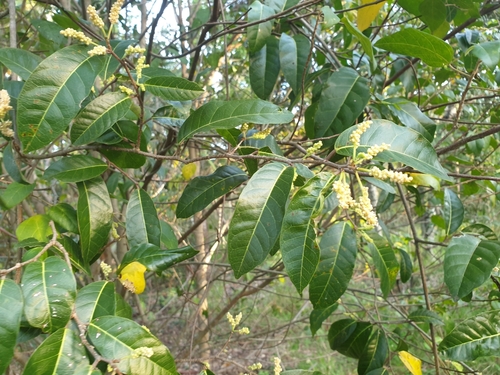
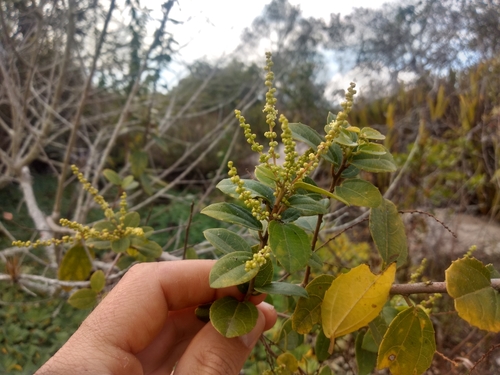
Balakata baccata
(Roxb.) Esser
Mousedeer's rubber tree
iNaturalist· cc-by-nc
(c) Arief Hamidi, some rights reserved (CC BY-NC), uploaded by Arief Hamidi
iNaturalist· cc-by-nc
(c) Aparajita Datta, some rights reserved (CC BY-NC), uploaded by Aparajita Datta
iNaturalist· cc-by-nc
(c) Arief Hamidi, some rights reserved (CC BY-NC), uploaded by Arief Hamidi
Description
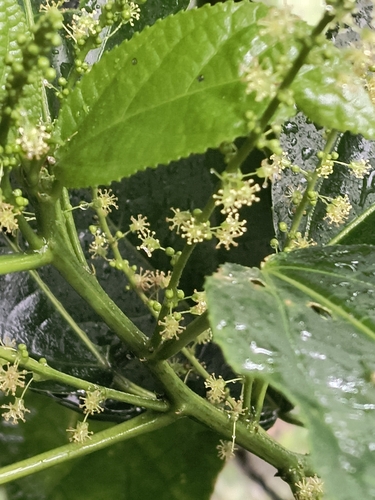
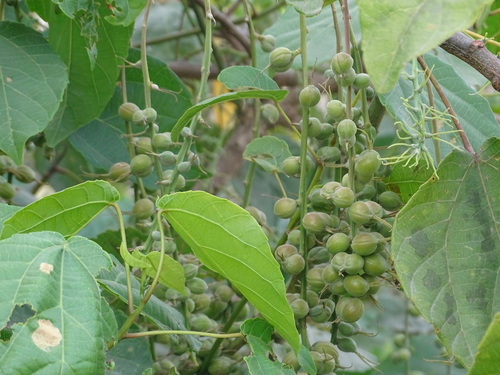
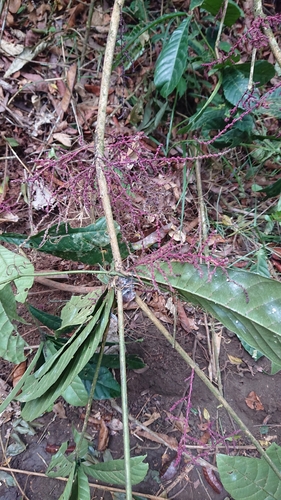
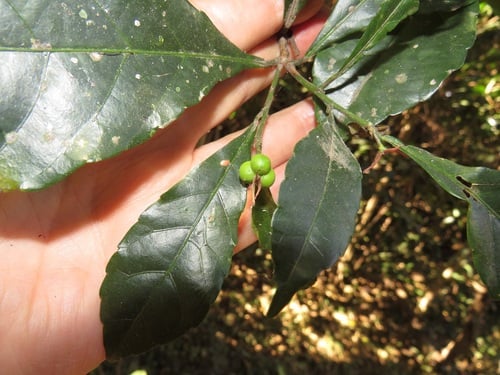
A large evergreen tree. It grows 30 m tall. The trunk is 60 cm across. The young branches are usually in rings. The leaves are oval and 8-22 cm long by 4-11 cm wide. They are pale underneath. The fruit are black. They have 1 or 2 seeds.
Edible Uses
Young fruit are boiled and eaten as a vegetable. Ripe fruit are sweet and eaten, sometimes used as a flavouring.
Traditional Uses
The fruit are mealy, sweet and sometimes eaten as a flavouring. The young fruit are boiled and eaten as a vegetable. The ripe fruit are sweet.
This uses section is brief — help expand it
Distribution
A tropical plant. It grows in forests and near streams between 600-700 m above sea level. In Yunnan.
Where It Grows
Andamans, Asia, Bangladesh, Cambodia, China, Himalayas, India, Indochina, Indonesia, Laos, Malaysia, Myanmar, Northeastern India, SE Asia, Thailand, Vietnam,
Cultivation
Plants can be grown by seeds.
Other Uses
Sapwood cream to white, soft, with a sour to sweet smell. It is not very durable. The wood is used as timber. The tree is planted as a pioneer species in northern Thailand in reforestation projects to restore native woodland - it is planted in degraded woodland and open areas in a mix with various other species that all have the ability to grow fast; produce dense, weed-suppressing crowns; and attract seed-dispersing wildlife, particularly birds and bats.
Production
In Nagaland fruit are available September to November.
Notes
There are about 100 Sapium species. Most are tropical.
Synonyms
Also Known As
Adamsali, Ankrataruwa, Bedi, Billa, Boloch, Budi, Dieng-ja-long-ehr, Kayu rulus, Lal kanijal, Larrna, Lawa, Lelun, Ludahi, Ludai, Mamas-mamas, Mayang, Memaya, Metong, Oohu, Pelandok, Pohon karet kancil, Pudlikat, Puligota, Samperai, Samsim, Seleng, Shigum, Thing-bok-pui, Thing-zawk-pui, Tobu
References (11)
- Ambasta S.P. (Ed.), 2000, The Useful Plants of India. CSIR India. p 548 (As Sapium baccatum)
- Burkill, I.H., 1966, A Dictionary of the Economic Products of the Malay Peninsula. Ministry of Agriculture and Cooperatives, Kuala Lumpur, Malaysia. Vol 2 (I-Z) p 1995 (As Sapium baccatum)
- Kar, A., et al, 2013, Wild Edible Plant Resources used by the Mizos of Mizoram, India. Kathmandu University Journal of Science, Engineering and Technology. Vol. 9, No. 1, July, 2013, 106-126 (As Sapium baccatum)
- Majumdar, K and Datta, N., 2009, Traditional wild edible fruits for the forest dwellers of Tripura, India. Pleione 3(2) 167-178 (As Sapium baccatum)
- Milow, P., et al, 2013, Malaysian species of plants with edible fruits or seeds and their evaluation. International Journal of Fruit Science. 14:1, 1-27 (As Sapium baccatum)
Show all 11 references Hide references
- Pradheep, K., et al, 2016, Wild edible plants used by Konyak tribe in Mon district of Nagaland: Survey and inventorisation. Indian Journal of Natural Products and Resources. Vol 7(1) pp 74-81
- Singh, V. B., et al, (Ed.) Horticulture for Sustainable Income and Environmental Protection. Vol. 1 p 219 (As Sapium baccatum)
- Srivastava, R. C., 2009, Traditional knowledge of Adi tribe of Arunachal Pradesh on plants. Indian Journal of Traditional Knowledge. 8(2): 146-153 (As Sapium baccatum)
- Srivastava, R. C., et al, 2010, Indigenous biodiversity of Apatani plateau: Learning on biolcultural knowledge of Apani tribe of Qrunachal Pradesh for sustainable livelihoods. Indian Journal of Traditional Knowledge 9(3): 432-442 (As Sapium baccatum)
- Sukarya, D. G., (Ed.) 2013, 3,500 Plant Species of the Botanic Gardens of Indonesia. LIPI p 147
- World Checklist of Useful Plant Species 2020. Royal Botanic Gardens, Kew