Agelaea pentagyna
(Lam.) Baill.
iNaturalist· cc-by-nc
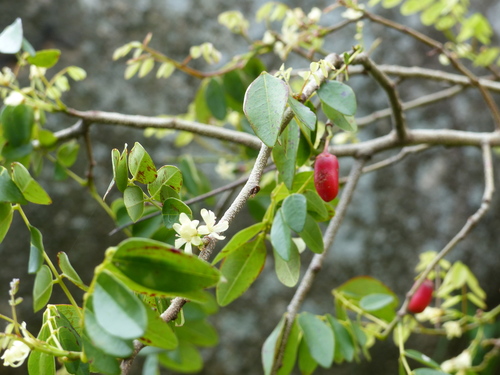
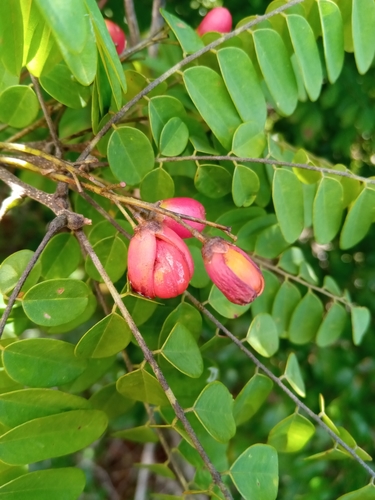
(c) mboat, some rights reserved (CC BY-NC), uploaded by mboat
iNaturalist· cc-by-nc
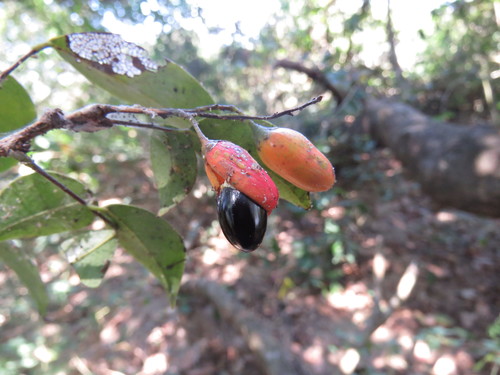
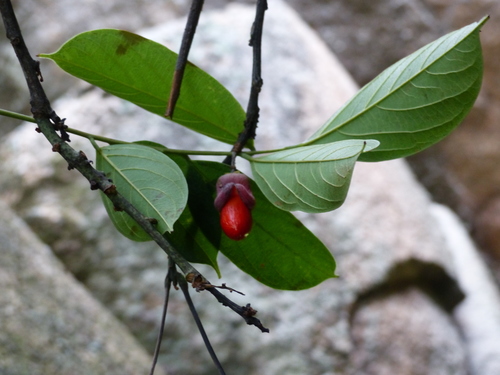
(c) Bart Wursten, some rights reserved (CC BY-NC), uploaded by Bart Wursten
iNaturalist· cc-by-nc
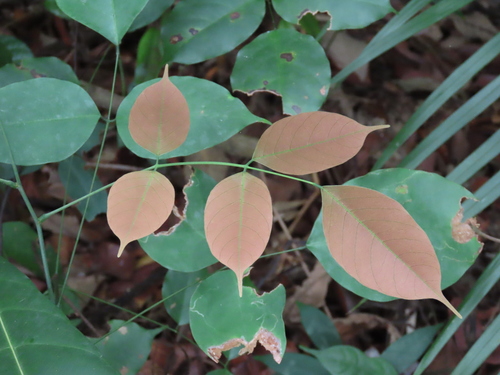
(c) Gabriel Michel MONTEIRO, some rights reserved (CC BY-NC), uploaded by Gabriel Michel MONTEIRO
Summary
Source: WikipediaAgelaea pentagyna is a species of flowering plant in the family Connaraceae. It is found in Africa. The larvae of the moth Paraccra mimesa feed on the fruits of A. pentagyna.
Description
A woody creeper. It climbs 25 m high. The stems are square in cross section and 15 cm across. The leaves are compound with a larger leaflet at the end. The flowers are at the end of the plant and 30 cm long. The flowers have a sweet scent. The petals are white. The fruit have 1-3 follicles. These are 1.6 cm long by 0.9 cm wide. They are reddish brown and have a dense covering. The seeds are purplish-black and shiny. They are 1.1 cm long by 0.7 cm wide. There is an orange layer around the seeds. It is fleshy.
Edible Uses
The leaves are cooked and eaten as a vegetable. The fruit, flowers, and sap (as a drink) are also edible portions.
Traditional Uses
The leaves are cooked and eaten as a vegetable.
This uses section is brief — help expand it
Medicinal Uses
The leaves are traditionally cooked and eaten as a vegetable.
Distribution
It is a tropical plant. It grows in mountain rainforest. It is often along river banks. It suits humid locations. In Malawi it occurs from 700-1,900 m altitude.
Where It Grows
Africa, Angola, Benin, Cameroon, Central Africa, Central African Republic, CAR, Comoros, Congo, Congo DR, Côte d'Ivoire, East Africa, Gabon, Ghana, Guinea, Guinée, Guinea-Bissau, Ivory Coast, Kenya, Madagascar, Malawi, Mozambique, Nigeria, Sao Tome and Principe, Senegal, Sierra Leone, Southern Africa, Tanzania, Togo, Uganda, West Africa, Zambia, Zimbabwe,
Notes
There are 8 Agelaea species. They are tropical.
Synonyms
Also Known As
Bebaka, Bokumbola, Bombete, Debaka, Kanhandi, Mubadi badi, Mukula na maye, Pwa kata, Ravinamainty, Sefaamainty, Vahimantina
References (14)
- Billong Fils, P. E., et al, 2020, Ethnobotanical survey of wild edible plants used by Baka people in southeastern Cameroon. Journal or Ethnobiology and Ethnomedicine. 16:64 p 7
- Chapman, J. D. & Chapman, H. M., 2001, The Forest Flora of Taraba and Andamawa States, Nigeria. WWF & University of Canterbury. p 172
- East African Herbarium records, 1981,
- Flora Zambesiaca. http://apps.kew.org/efloras (As Agelaea heterophylla)
- Fowler, D. G., 2007, Zambian Plants: Their Vernacular Names and Uses. Kew. p 79
Show all 14 references Hide references
- Heywood, V.H., Brummitt, R.K., Culham, A., and Seberg, O. 2007, Flowering Plant Families of the World. Royal Botanical Gardens, Kew. p 108 (As Agelaea hirsuta)
- Jardin, C., 1970, List of Foods Used In Africa, FAO Nutrition Information Document Series No 2.p 51 (As Agelaea hirsuta)
- Latham, P. & Mbuta, A. K., 2017, Plants of Kongo Central Province, Democratic Republic of Congo. Volume 1. 3rd ed p 29
- Malaisse, F., 1997, Se nourrir en floret claire africaine. Approche ecologique et nutritionnelle. CTA., p 57
- Malaisse, F., 2010, How to live and survive in Zambezian open forest (Miombo Ecoregion). Les Presses Agronomiques de Gembloux.
- Martin, F.W. & Ruberte, R.M., 1979, Edible Leaves of the Tropics. Antillian College Press, Mayaguez, Puerto Rico. p 186 (As Agelaea hirsuta)
- Peters, C. R., O'Brien, E. M., and Drummond, R.B., 1992, Edible Wild plants of Sub-saharan Africa. Kew. p 93
- White, F., Dowsett-Lemaire, F. and Chapman, J. D., 2001, Evergreen Forest Flora of Malawi. Kew. p 208
- World Checklist of Useful Plant Species 2020. Royal Botanic Gardens, Kew