Terminalia arjuna
(Roxb. ex DC.) Wight & Arn.
Arjuna, Indian-laurel
iNaturalist· cc-by-nc
(c) wild_wild_nature, some rights reserved (CC BY-NC)
iNaturalist· cc-by-nc
(c) britz, some rights reserved (CC BY-NC)
iNaturalist· cc-by-nc
(c) britz, some rights reserved (CC BY-NC)
Summary
Source: WikipediaTerminalia arjuna is a tree of the genus Terminalia. It is commonly known as arjuna or arjun tree in English. It is used as a traditional medicinal plant.
Description
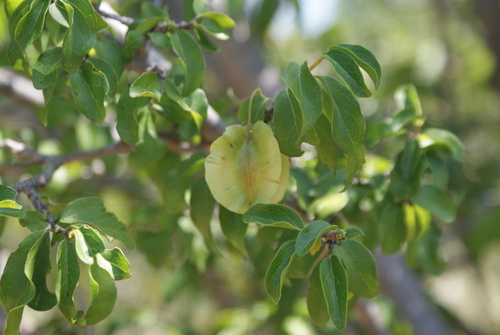
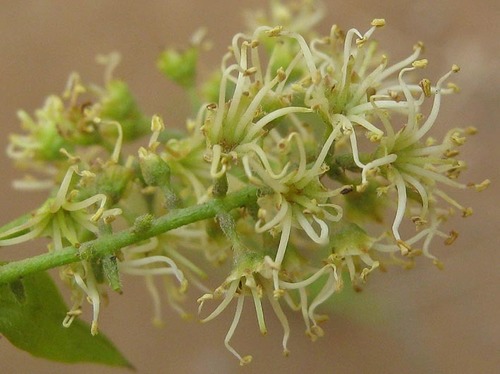
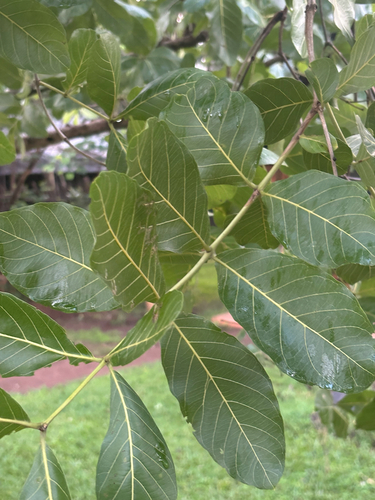
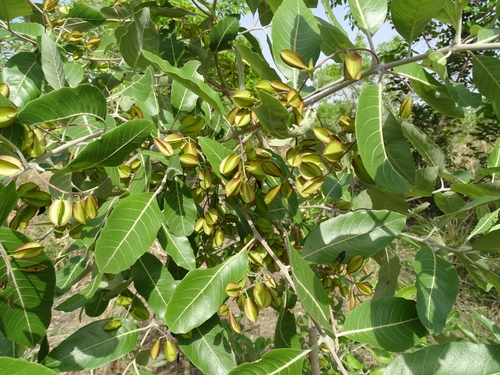
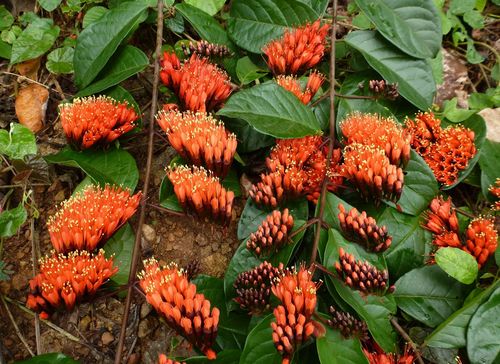
An evergreen tree. It can lose its leaves. It often has buttresses. The bark is smooth and grey. It flakes off in thin strips. It grows to 25 m tall and spreads to 4 m across. It has a dense matted fibrous root system. The stem is erect and branching. The branches and leaves hang over. The leaves are oval and broad. They are 8-15 cm long. They taper towards the tip and are green and glossy. There are a pair of glands near the leaf stalk. The flowers are greenish-white. They occur near the ends of branches and have a strong perfume. They are not easily seen. They are crowded on spikes 5-7 cm long in the axils of leaves. The fruit are large and round. They are woody and 6 cm long. They have 5 thin flat wings running along the side.
Edible Uses
The seed is edible. A beverage is made by preparing a decoction of the bark with milk. The tree also yields a gum.
Traditional Uses
A decoction of the bark is mixed with milk to make a drink. The bark is cut into small pieces and dried. The seeds are also eaten.
This uses section is brief — help expand it
Medicinal Uses
The bark contains tannins, flavonoids, sterols and triterpenoid saponins. It acts as a cardiac tonic, lowers blood pressure and reduces blood cholesterol levels. Modern research has fully supported its traditional use for treating heart disease. Taken internally, the bark is used to treat a range of heart conditions and appears most effective when blood supply to the heart is reduced, as in angina and ischaemic heart disease. It is also of value in maintaining a steady heartbeat. The gum is used medicinally. The juice of the bark is taken as a tonic, and juice pressed from the leaves is used traditionally to treat earache.
Distribution
A tropical plant. This plant originally comes from India. It prefers well composted, well drained, moist soils. It requires an open sunny position. It is damaged by drought and frost. It often occurs in drier regions but near river banks.
Where It Grows
Africa, Asia, Australia, Bangladesh, East Africa, Fiji, Hawaii, India, Indonesia, Maldives, Mozambique, Myanmar, Northeastern India, Pacific, Pakistan, SE Asia, Singapore, Sri Lanka, Thailand, USA,
Cultivation
Plants are grown from seed. They can also be grown from root suckers, stumps and air-layering.
Propagation
Seed can be stored at room temperature for up to three years before sowing.
Other Uses
The tree is planted to provide shade, especially in coffee plantations. The bark contains 20–24% tannin and is used commercially in India; when carefully removed without damaging the cambium layer, a new layer of bark will regrow. The fruits also contain tannin. A transparent gum is obtained from the tree. The heartwood is brown with darker streaks; the sapwood is reddish-white. The wood is very hard but tends to split during seasoning and is not easy to work. It is used for cart construction, boat building, general construction, agricultural implements and mine props.
Notes
There are about 200-250 Terminalia species. They are tropical. The fruit are used in medicine. It has anticancer properties.
Synonyms
Also Known As
Arjan, Arjhan, Arjun sadura, Arjun, Arjuno, Arolhi gas, Dharka, Holematti, Kalar-taukkyant, Kala-taukkyan, Koha, Kumbuk, Maddi, Orjun, Pohon ketapang arjuna, Sad, Sadad, Sadado, Sadaru, Sahajo, Sanmadat, Thella maddi, Vellamarda, Vellamatta, White murdah, Yerramaddi
References (24)
- Ambasta, S.P. (Ed.), 2000, The Useful Plants of India. CSIR India. p 627
- Bhatia, H., et al, 2018, Traditionally used wild edible plants of district Udhampur, J&K, India. Journal of Ethnobiology and Ethnomedicine (2018) 14:73
- Bodkin, F., 1991, Encyclopedia Botanica. Cornstalk publishing, p 971
- Facciola, S., 1998, Cornucopia 2: a Source Book of Edible Plants. Kampong Publications, p 80 (As Terminalia glabra)
- GAMMIE,
Show all 24 references Hide references
- Hearne, D.A., & Rance, S.J., 1975, Trees for Darwin and Northern Australia. AGPS, Canberra p 111
- Hedrick, U.P., 1919, (Ed.), Sturtevant's edible plants of the world. p 644
- Kintzios, S. E., 2006, Terrestrial Plant-Derived Anticancer Agents and Plant Species Used in Anticancer research. Critical Reviews in Plant Sciences. 25: pp 79-113
- Kiran, K. C., et al, 2019, Diversity and Seasonal Availability of Potential Wild Edible Plants from Vidarbha Region of Maharashtra State, India. Int.J.Curr.Microbiol.App.Sci (2019) 8(2): 1434-1446 (As Terminalia cuneata)
- Krishen P., 2006, Trees of Delhi, A Field Guide. DK Books. p 122
- Kumar, S. A., Manus, D. & Mallika, M., 2018, Impact of non-timber forest products on Forest and in Livelihood Economy of the People of Adjoining Areas of Jalpaiguri Forest Division, West Bengal, India. Int. J. of Life Sciences, 2018; 6 (2):365-385
- Menninger, E.A., 1977, Edible Nuts of the World. Horticultural Books. Florida p 61 (As Terminalia glabra)
- Pandy, R. K. & Saini, S. K., 2007, Edible plants of tropical forests among tribal communities of Madhya Pradesh. Indian Journal of Traditional Knowledge. 6(1), pp 185-190
- Patiri, B. & Borah, A., 2007, Wild Edible Plants of Assam. Geethaki Publishers. p 53
- Prodr. fl. Ind. orient. 314. 1834
- Sahni, K.C., 2000, The Book of Indian Trees. Bombay Natural History Society. Oxford. p 104
- Sarma, H., et al, 2010, Updated Estimates of Wild Edible and Threatened Plants of Assam: A Meta-analysis. International Journal of Botany 6(4): 414-423
- Smith, A.C., 1985, Flora Vitiensis Nova, Lawaii, Kuai, Hawaii, Volume 3 p 421
- Staples, G.W. and Herbst, D.R., 2005, A tropical Garden Flora. Bishop Museum Press, Honolulu, Hawaii. p 244
- Sujanapal, P., & Sankaran, K. V., 2016, Common Plants of Maldives. FAO & Kerala FRI, p 270
- Sukarya, D. G., (Ed.) 2013, 3,500 Plant Species of the Botanic Gardens of Indonesia. LIPI p 545
- Swaminathan, M.S., and Kochnar, S.L., 2007, An Atlas of Major Flowering Trees in India. Macmillan. p 153
- Watt, 1972 reprint, Dictionary of economic products of India. (As Terminalia glabra)
- World Checklist of Useful Plant Species 2020. Royal Botanic Gardens, Kew