Terminalia arenicola
N. Byrnes
Brown damson
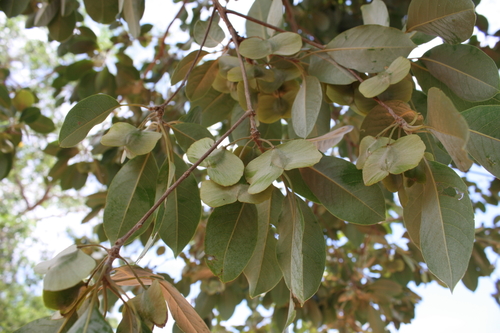
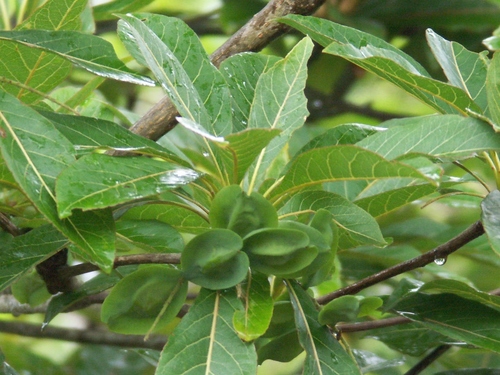
iNaturalist· cc-by
(c) elawrey, some rights reserved (CC BY), uploaded by elawrey
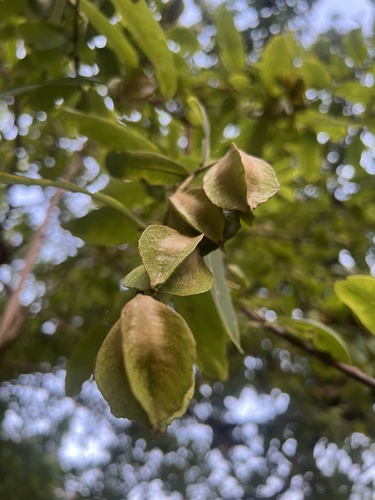
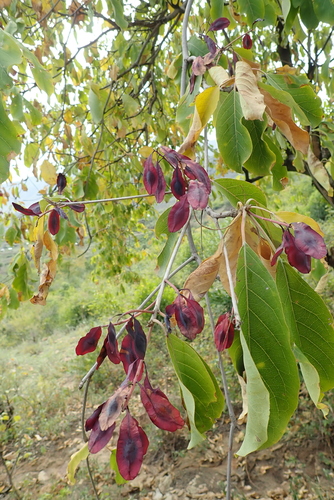
iNaturalist· cc-by-nc
(c) Russell Cumming, some rights reserved (CC BY-NC)
Summary
Source: WikipediaTerminalia arenicola, commonly known as beach almond or brown damson, is a tree in the family Combretaceae which is endemic to Queensland, Australia.
Description
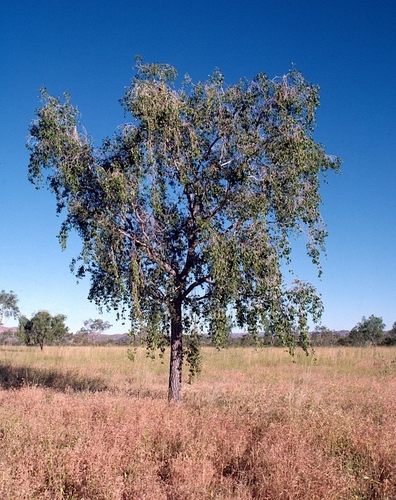
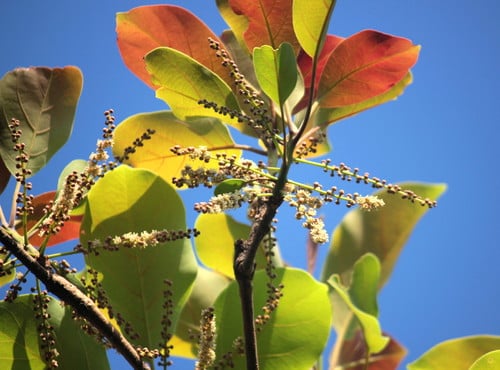
A tree which loses many of its leaves during the year. It grows to 6-12 m tall and spreads to 5 m across. The stem is erect and the branches are horizontal in layers. The bark has a checkered pattern. The crown of the tree is neat and compact. The leaves are simple, oval and broad. They are leathery and taper towards the point. The leaves are 10-20 cm long. They have a leaf stalk. There are small tufts of hairs near the veins. There are 2 nectar producing glands on the underside of the leaf near the leaf base. The flowers are white and not easily seen. The fruit are dark red or black and are oval berries. They are 2.5-5 cm long and about 3-4 cm across. They are carried on a simple unbranched stalk in the axils of leaves. The thin layer of flesh on the fruit is edible. There is one seed inside. The seed is edible.
Edible Uses
The thin flesh layer on the fruit is edible, and the seed inside is also edible.
Known Hazards
The tree is damaged by frost and is not suitable for cold climates.
Distribution
A tropical plant. It grows naturally in rainforest in north east Queensland in Australia. It prefers light to medium soils. Often it grows near the beach front. It suits an open sunny position. It is drought resistant and salt tolerant. It is damaged by frost. In Townsville Anderson BG.
Where It Grows
Australia*, Hawaii, Pacific, USA,
Cultivation
Plants can be grown from seed. The seed is slow to start to grow. It may take 10 weeks for seed to start to grow.
Production
In Australia the fruiting season is February to October. Seedlings grow rapidly. Trees start to produce fruit after 4 years.
Notes
There are about 150-200 Terminalia species. They are tropical.
References (10)
- Barwick, M., 2004, Tropical and Subtropical Trees. A Worldwide Encyclopedic Guide. Thames and Hudson p 408
- Bodkin, F., 1991, Encyclopedia Botanica. Cornstalk publishing, p 970
- Contr. Queensland Herb. 20:35. 1977
- Cooper W & Cooper W T, 1994, Fruits of the Rain Forest. RD Press p 282
- Cooper, W. and Cooper, W., 2004, Fruits of the Australian Tropical Rainforest. Nokomis Editions, Victoria, Australia. p 127
Show all 10 references Hide references
- Djunbunji Newsletter Edition 2 2011. p 5
- Hardwick, G., 2001, Economically Useful Plants for Northern Australia: Master Species List. Crusader eBooks.
- Hearne, D.A., & Rance, S.J., 1975, Trees for Darwin and Northern Australia. AGPS, Canberra p 35, 110
- Staples, G.W. and Herbst, D.R., 2005, A tropical Garden Flora. Bishop Museum Press, Honolulu, Hawaii. p 244
- Williams, K.A.W., 1999, Native Plants of Queensland Volume 4. Keith A.W. Williams North Ipswich, Australia. p 366