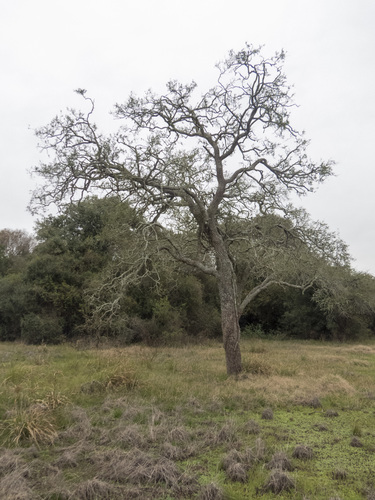
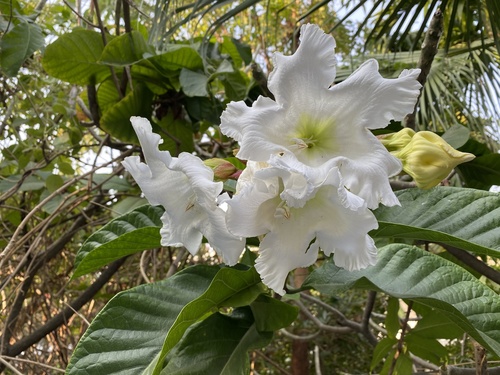
Ancylobothrys petersiana
(Klotzsch) Pierre
Mbohoya, Mwungo-wungo
iNaturalist· cc-by-nc
(c) Mark Hyde, Bart Wursten and Petra Ballings, some rights reserved (CC BY-NC)
iNaturalist· cc-by-nc
(c) Mark Hyde, Bart Wursten and Petra Ballings, some rights reserved (CC BY-NC)
iNaturalist· cc-by-nc
(c) Mark Hyde, Bart Wursten and Petra Ballings, some rights reserved (CC BY-NC)
Summary
Source: WikipediaAncylobothrys petersiana grows as a climbing shrub up to 6 metres (20 ft) tall. Its fragrant flowers feature a creamy or white corolla. Fruit is spherical, up to 6 centimetres (2.4 in) in diameter. Vernacular names include "climbing wild apricot". Habitat is woodland and rocky hillsides. A. petersiana is found in the Democratic Republic of Congo, Burundi, Somalia, Kenya, Tanzania, Malawi, Mozambique, Zimbabwe, South Africa, the Comoros and Madagascar. The fruit contains edible pulp with a sour taste around the many seeds. It can be eaten out of hand or prepared into a sweetened juice, and it is sold in local markets for this purpose.
Description
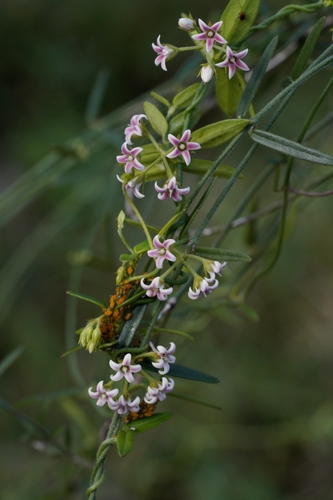
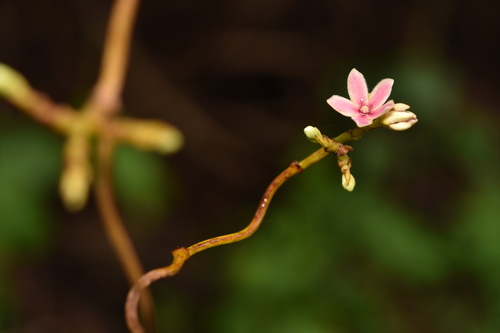
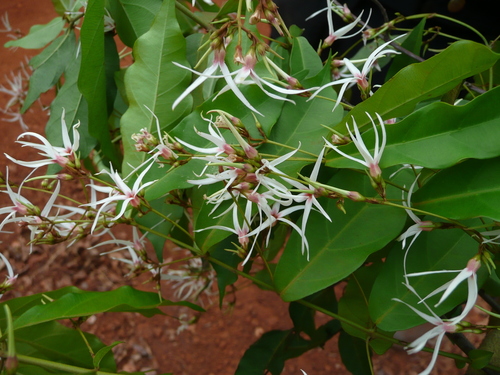
A climbing shrub. It grows over trees and bushes. It grows 6 m or more high. It has branched tendrils. The young branches are grey or brown. Young branches have rusty hairs. The leaves are hairy and opposite. They are simple and sword shape or oblong with a few hairs on both surfaces. The leaves are leathery. They are more pale underneath. The leaf blade is 5-12 cm long by 2-5 cm wide. They are narrowly oval. The flowers are 15 mm long and white or cream. They have a sweet scent. The fruit are round and 5 cm across. They are yellow or orange when ripe. The flesh is pulpy. It is edible. They have several seeds in a soft pulp.
Edible Uses
The pulpy fruit flesh is eaten ripe or nearly ripe, with skin removed from unripe fruit but not from ripe fruit. A refreshing drink is made by soaking the fruit in water, squeezing and filtering the juice, sweetening it with sugar, and sometimes freezing it as iced blocks. The fruit are sold in local markets.
Traditional Uses
The pulp of the fruit is edible. It is an attractive fruit. A drink is made by soaking the fruit is water and then squeezing an filtering the juice. This is sweetened with sugar. This is also frozen and eaten as iced blocks. The skin is removed from unripe fruit but not from ripe fruit. The fruit is eaten ripe or nearly ripe.
Distribution
It is a tropical plant. It grows in the lowlands. It grows in dune scrub and on rocky hillsides. In Tanzania it grows between sea level and 400 m above sea level.
Where It Grows
Africa, Central Africa, Congo DR, East Africa, Kenya, Madagascar, Malawi, Mozambique, Somalia, South Africa, Southern Africa, Tanzania, Zambia, Zimbabwe,
Cultivation
Plants can be grown from seeds. It can also be grown from root suckers.
Propagation
Seed - Root suckers.
Other Uses
The stem produces a white latex, which is tapped and used for making balls. The stems are flexible and used for ropes.
Production
Fruit in Tanzania are collected in April to June and then November and December. Fruit can be stored for about 2 weeks.
Other Information
The fruit are attractive. They are sold in local markets.
Nutrition
| Part | Moisture | kJ | kcal | Protein | Vit A | Vit C | Iron | Zinc |
|---|---|---|---|---|---|---|---|---|
| Fruit | 81.3 | 295 | 71 | 0.7 | — | 26.6 | 1 | 0.3 |
Synonyms
Also Known As
Kagatta, Macava, Macera, Matutungwa, Mbohoya, Mbooya, Mtoria, Mtowe, Muconja, Muhonga, Muhonga-udide, Mutiele, Mutongazi, Mutungazi, Muzambera, Ndoro, Ntondobonzi, Rava, Vibooya, Vitoja, Vitoria
References (25)
- Bruschi, P., et al, 2014, Traditional use of plants in a rural community of Mozambique and possible links with Miombo degradation and harvesting sustainability. Journal of Ethnobiology and Ethnomedicine. 2014, 10:59 (As Ancylobotrys)
- Cunningham, 1985,
- CROSS-UPCOTT (As Landolphia petersiana)
- Flora Somalia, 2006, Vol. 3
- Flora Zambesiaca. http://apps.kew.org/efloras
Show all 25 references Hide references
- Fowler, D. G., 2007, Zambian Plants: Their Vernacular Names and Uses. Kew. p 9
- Fox, F. W. & Young, M. E. N., 1982, Food from the Veld. Delta Books. p 91
- Global Plants JSTOR
- Glover et al, 1969,
- INFOODS:FAO/INFOODS Databases
- Jardin, C., 1970, List of Foods Used In Africa, FAO Nutrition Information Document Series No 2.p 144 (As Landolphia petersiana)
- Msuya, T. S., et al, 2010, Availability, Preference and Consumption of Indigenous Foods in the Eastern Arc Mountains, Tanzania, Ecology of Food and Nutrition, 49:3, 208-227
- Mutie, F. M., et al, 2023, Important Medicinal and Food Taxa (Orders and Families) in Kenya, Based on Three Quantitative Approaches. Plants 2023, 12, 1145
- Pakia, M., 2000, Plant Ecology and Ethnobotany of two sacred forests (Kayas) at the Kenya Coast. M. Sc. Thesis.
- Peters, C. R., O'Brien, E. M., and Drummond, R.B., 1992, Edible Wild plants of Sub-saharan Africa. Kew. p 57
- Reis, S. V. and Lipp, F. L., 1982, New Plant Sources for Drugs and Foods from the New York Botanical Garden herbarium. Harvard. p 242 (As Landolphia petersiana)
- Ruffo, C. K., Birnie, A. & Tengnas, B., 2002, Edible Wild Plants of Tanzania. RELMA p 130
- Ruiters-Welcome, A. K., 2019, Food plants of southern Africa. Ph.D. thesis. Univ. of Johannesburg p 20
- van Wyk, Be, & Gericke, N., 2007, People's plants. A Guide to Useful Plants of Southern Africa. Briza. p 34
- Walsh, M., 2009, The Use of Wild and Cultivated Plants as famine Foods on Pemba Island, Zanzibar. Études océan Indien. 42-43
- Wehmeyer, A. S, 1986, Edible Wild Plants of Southern Africa. Data on the Nutrient Contents of over 300 species. (As Landolphia petersiana)
- Welcome, A. K. & Van Wyk, B.-E., 2019, An inventory and analysis of the food plants of southern Africa. South African Journal of Botany 122 (2019) 136–179
- Williamson, J., 2005, Useful Plants of Malawi. 3rd. Edition. Mdadzi Book Trust. p 150 (As Landolphia petersiana)
- World Checklist of Useful Plant Species 2020. Royal Botanic Gardens, Kew
- Yamada, T., 1999, A report of the Ethnobotany of the Nyindu in the Eastern part of the former Zaire. African Study Monographs 20(1):1-72