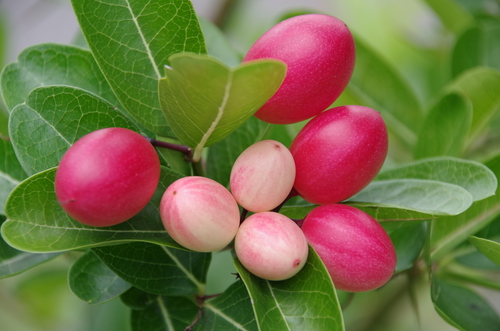
Dictyophleba lucida
(K. Schum.) Pierre
Milk apple
iNaturalist· cc-by-nc-sa
(c) Rob Palmer, some rights reserved (CC BY-NC-SA), uploaded by Rob Palmer
Description
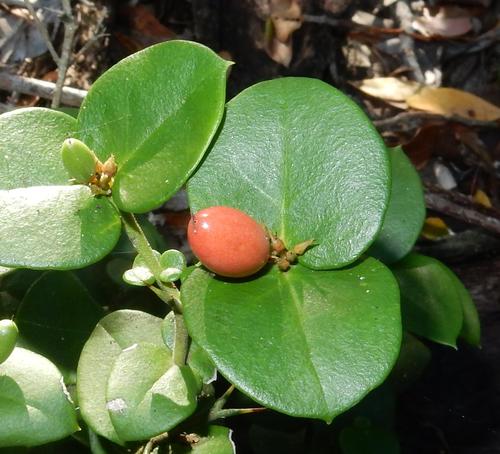
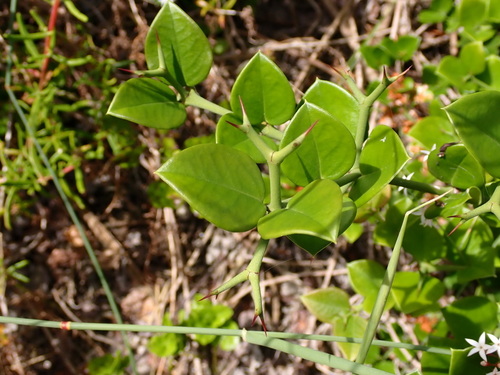
A woody creeper. It can grow 35 m long and be 50 cm around. It has many branches. It can climb by tendrils. The leaves are 6-14 cm long by 3-8 cm wide. They are narrowly oval. The veins are raised under the leaf. The veins curve forming a vein near the edge of the leaf. The flowers are in clusters at the top of the plant. The flowers have a sweet scent. The fruit can be 3 cm long by 4.5 cm wide and almost round. They are green, yellow or red. The pulp is yellow. They are edible. The seeds are up to 11 mm long.
Edible Uses
The fruit pulp is eaten raw or prepared as a drink by soaking the pulp from ripe fruit in water, then squeezing, adding sugar, and filtering. Fruit are occasionally sold in markets.
Traditional Uses
The pulp of the fruit is eaten raw. Ripe fruit are also cut, the pulp soaked in water, squeezed, sugar added and filtered then used as a drink.
This uses section is brief — help expand it
Medicinal Uses
A root-decoction is given to small children to drink as a vermifuge. A phytochemical assay of the plant has revealed the presence of chonemorphine, dictyodiamine and three other alkaloids.
Distribution
It is a tropical plant. In Malawi it is common in lake shore forests. In Tanzania it grows between 1 and 1,100 m above sea level. It grows in forest.
Where It Grows
Africa, Angola, Burundi, Central Africa, Central African Republic, CAR, Congo DR, East Africa, Gabon, Kenya, Malawi, Mozambique, Nigeria, Southern Africa, Tanzania, West Africa, Zambia, Zimbabwe,
Cultivation
Plants can be grown from seeds or cuttings.
Other Uses
A latex is obtained from the stems. The plant contains a white latex of variable quality, sparse or abundant, fluid or tacky, coagulating only to a poor quality rubber. The flexible stems can be used as tying material.
Production
In Tanzania ripe fruit are collected from February to June. In Congo fruit are available December to January.
Other Information
The fruit are occasionally sold in markets.
Nutrition
| Part | Moisture | kJ | kcal | Protein | Vit A | Vit C | Iron | Zinc |
|---|---|---|---|---|---|---|---|---|
| Fruit | 82 | 351 | 84 | 1.3 | — | — | — | — |
References (15)
- Burkill, H. M., 1985, The useful plants of west tropical Africa, Vol. 1. Kew.
- East African Herbarium records, 1981,
- Flora Zambesiaca. http://apps.kew.org/efloras
- Fowler, D. G., 2007, Zambian Plants: Their Vernacular Names and Uses. Kew. p 10
- Jardin, C., 1970, List of Foods Used In Africa, FAO Nutrition Information Document Series No 2.p 143 (As Landolphia dubreucqiana)
Show all 15 references Hide references
- Malaisse, F., 1997, Se nourrir en floret claire africaine. Approche ecologique et nutritionnelle. CTA., p 61
- Mpasiwakomu, R. A., 2017, The Diversity and Utilization of Wild Edible and Medicinal Plant Species found in Uvinza Miombo Woodlands, Tanzania. M. Sc. thesis University of Tanzania.
- Mutie, F. M., et al, 2023, Important Medicinal and Food Taxa (Orders and Families) in Kenya, Based on Three Quantitative Approaches. Plants 2023, 12, 1145
- Peters, C. R., O'Brien, E. M., and Drummond, R.B., 1992, Edible Wild plants of Sub-saharan Africa. Kew. p 58
- Tanno, T., 1981, Plant Utilization of the Mbuti Pygmies: With Special reference to their Material Culture and Use of Wild Vegetable Foods. Kyoto University Research. African Study Monographs 1:1-53
- Terashima, H., & Ichikawa, M., 2003, A comparative ethnobotany of the Mbuti and Efe hunter-gatherers in the Ituri Forest, Democratic Republic of Congo. African Study Monographs, 24 (1, 2): 1-168, March 2003
- Termote, C., et al, 2011, Eating from the wild: Turumbu, Mbole and Bali traditional knowledge of non-cultivated edible plants, District Tshopo, DRCongo, Gen Resourc Crop Evol. 58:585-618
- Termote, C., 2012, Wild edible plant use in Tshopo District, Democratic Republic of Congo. Universiteit Gent. p 69
- White, F., Dowsett-Lemaire, F. and Chapman, J. D., 2001, Evergreen Forest Flora of Malawi. Kew. p 138
- World Checklist of Useful Plant Species 2020. Royal Botanic Gardens, Kew