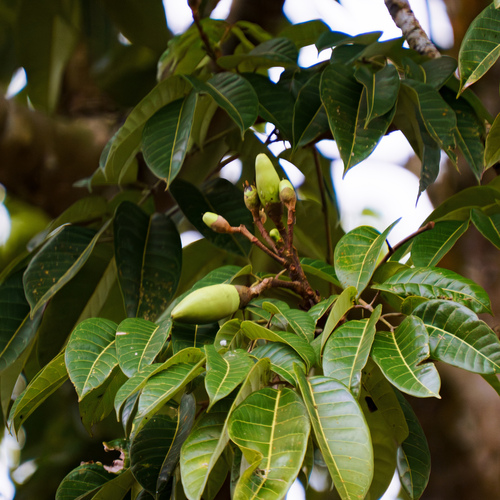
Spondias dulcis
Parkinson
Golden apple, Polynesian plum
iNaturalist· cc0
no rights reserved, uploaded by 葉子
iNaturalist· cc-by-nc
(c) camellialo, some rights reserved (CC BY-NC)
iNaturalist· cc-by-nc
(c) nandani_bridglal, some rights reserved (CC BY-NC), uploaded by nandani_bridglal
Summary
Source: WikipediaSpondias dulcis (syn. Spondias cytherea), known commonly as Polynesian plum or Tahiti apple, is a tropical fruit tree native to Melanesia, with edible fruit containing a fibrous pit. The tree was spread to neighboring regions as canoe plants in Island Southeast Asia and Polynesia in prehistoric times by seafaring Austronesians during the Austronesian expansion. It remains widely cultivated in Polynesia, where it is generally known under the names vī or wī, and variants thereof. It has also been introduced to other areas of the world in colonial times. In the English-speaking Caribbean it is typically known as golden apple and elsewhere in the Caribbean as pommecythere, April plum or June plum, or cythere.
Description
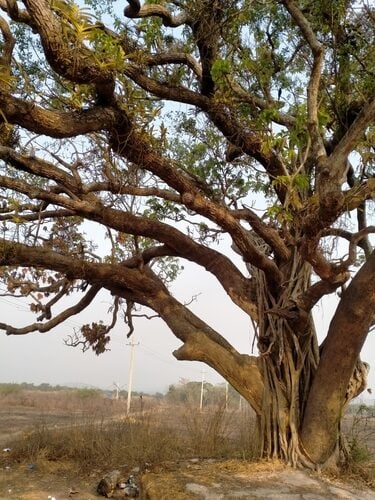
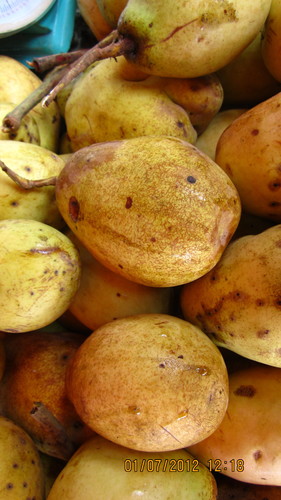
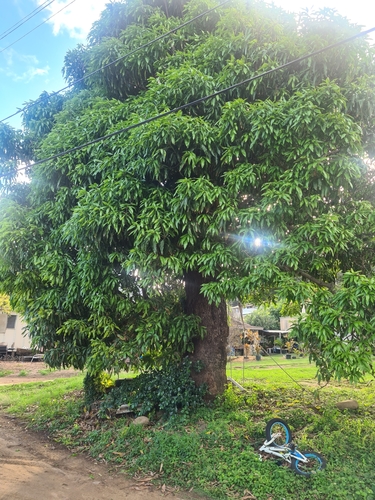
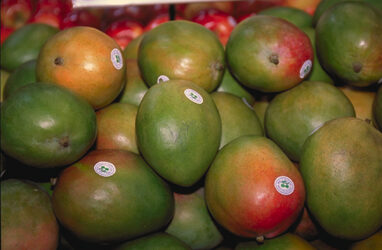
Often a Golden apple tree grows to a large tree which can be up to 30 m high but is more often 15 m high in cultivation. It has a trunk 60 cm across which can have buttresses. The bark on the trunk of the tree is fairly smooth. The twigs break off easily. The wood is soft and not much use. The leaf is made up of 4 to 12 pairs of leaflets which have fine teeth around the edge. The leaves are 20-30 cm long. The leaves are smooth and dark green on top and pale green underneath. The leaves are alternate. The leaves of the tree fall off for a part of the year. The old leaves wither to a bright yellow colour. The flowers are produced near the ends of the branches and mostly the flowers develop before the new young leaves grow. The flowers occur as several flowers on long stalks. The flower panicle is 15 to 30 cm long. The flowers are small and white. They look something like a mango flower. The fruit is yellow, oval and up to 7 cm long and 4 cm across. Sometimes the outside of the fruit has a mottled black colour. There is one large stone inside divided into 5 cells with a seed in each. The stone is branched and has fibres.
Edible Uses
The fruit can be eaten raw or cooked. Green fruit is crisp and subacid; as it ripens to yellow the flesh softens, the flavour changes, and fibres become more noticeable. Fully ripe, amber-coloured, plum-shaped fruits have a sweet to acid flavour with a slight turpentine note. The oblong fruit grows up to 10cm long by 8cm wide. Ripe fruit can be made into jams and marmalade. Unripe fruits are commonly used as a sour flavouring in sauces and soups, and contain around 10% pectin. Young leaves are pleasantly acid and can be eaten raw or steamed as a vegetable.
Traditional Uses
Fruit are eaten after peeling. They are eaten raw or pickled. The fruit are also dried and used in curries. The young leaves are edible raw or cooked. They are used as a souring agent. The kernel of the seed may be edible. (Some fruit are poor size and very sour.) The fruit are also used for sweet drinks and made into jams and chutneys. Green fruit are pickled.
Medicinal Uses
The fruits, leaves, and bark have diverse traditional medicinal applications worldwide. The plant is used to treat wounds, sores, and burns across several countries. A fermented drink made from parts of the plant is used as a remedy for diarrhoea. Plant juice is applied as eye drops to reduce inflammation, and a few drops of pressed bark fluid are used to treat cataracts. The shoots are used to treat haemorrhaging after childbirth. Pressed liquid from the stem is given after a false pregnancy and for weakness following childbirth. A leaf infusion treats sore throats and mouth infections. Pressed bark liquid is taken to cleanse the bowels, and the bark filtrate is used as an abortifacient, to promote sterility, and to treat fish poisoning. The bark is also used to treat diarrhoea and dysentery. The inner bark addresses coughs, fever, stomach aches, and mouth and body sores. The fruit is mildly diuretic; grated fruit mixed with water is used for high blood pressure. Young fruit is used to treat stomach trouble and to assist a woman in labour.
Known Hazards
Care should be taken when eating the fruit since the seeds have very sharp spines.
Distribution
It is a tropical plant. They occur in well drained soils or in dry forests. It occurs in the lowland rainforest and in valleys up to about 950 m altitude in the equatorial tropics. It suits humid locations. They suit warm tropical and subtropical climates and are frost tender. Flowering is normally during the dry season. This may be important for fruit set. The trees also grow in Indonesia, the Philippines, Thailand and a number of other Pacific countries. It has also been taken to other tropical countries. This species covers a full range from being a wild un-utilised tree in some areas to a planted, pruned and highly regarded village fruit tree in other areas. It is better suited to deeper alluvial soils and rarely occurs on limestone with a thin clay soil cover. Trees often grow as a pioneer tree on landslides. The wild trees are probably spread around by birds, pigs and people.
Where It Grows
Africa, Amazon, American Samoa, Andamans, Antigua and Barbuda, Asia, Australia, Bangladesh, Bougainville, Brazil, Cambodia, Cameroon, Central Africa, Central America, Christmas Island, Colombia, Congo DR, Cook Is., Costa Rica, Côte d'Ivoire, Cuba, Dominican Republic, East Africa, Ecuador, Fiji, French Polynesia, FSM, Gabon, Ghana, Grenada, Guam, Guinea-Bissau, Guyana, Haiti, Hawaii, Himalayas, India, Indochina, Indonesia*, Ivory Coast, Jamaica, Laos, Madagascar, Malaysia, Marquesas, Myanmar, Nauru, Nepal, Nicaragua, Niue, North America, Northeastern India, Pacific*, Papua New Guinea*, PNG, Peru, Philippines, Pohnpei, Polynesia, Puerto Rico, Reunion, Rotuma, Samoa, Sao Tome and Principe, SE Asia, Sierra Leone, Singapore, Solomon Islands, South America, Sri Lanka, Tahiti, Tanzania, Thailand, Timor-Leste, Tonga, USA, Vanuatu, Vietnam, Wallis & Futuna, West Africa, West Indies,
Cultivation
Trees are mostly grown from seed and often grows wild. Flowers are bisexual and there are no apparent pollination problems. The seeds do not produce true to type so that poor and sour fruit are often produced. Seed normally germinate within one month. It is possible to grow plants from cuttings although it is difficult. Large cuttings should be used. Doing this would enable better types of fruit to be re-grown. It can also be grown using budding. Seedling trees are larger and more vigorous than budded or grafted trees. Tree spacing varies from 7.5 m to 12 m. Young trees benefit by shade during their first year. The top can be cut off trees to give a lower and more spreading tree. Large cuttings can be used with difficulty. Trees can be topped to give a lower tree with spreading branches.
Propagation
Seed germinates within one month. The plant can be grown from quite large cuttings. Large stumps stuck in the ground are used to produce live fence posts. Air layers root easily. Grafting or shield budding onto Spondias rootstocks is possible, though seedling trees tend to be more vigorous than budded or grafted ones.
Other Uses
The plant is grown as a living fence. Its heartwood is light brown and the sapwood whitish to light yellow. The wood is light in weight, moderately soft, and not durable.
Production
Trees may bear from 4-5 years old from seed. Cuttings take 2-3 years. Fruiting occurs seasonally from Jan. to April in the southern hemisphere. Fruit matures in about 200 days.
Other Information
Moderately common in lowland rainforests in Papua New Guinea and also grown in villages. Fruit quality varies. It is common and popular in Vietnam. Fruit are sold in local markets. It is cultivated.
Notes
In Cairns Botanical Garden as Eva dulcis.
Nutrition
| Part | Moisture | kJ | kcal | Protein | Vit A | Vit C | Iron | Zinc |
|---|---|---|---|---|---|---|---|---|
| Fruit | 87.7 | 135 | 33 | 1.1 | — | 129 | 7.6 | 1.2 |
| Leaves | — | — | — | — | — | — | — | — |
Synonyms
Also Known As
Aceitero, Ainakori, Aio, Aioo kwai, Alabbyud, Ambarella, Amra, Auri, Bi, Bilati amra, Bogwia, Cajamanga, Cajarana, Caju-manga, Ciruela dulce, Citero, Doismango, Emberrela, Gnoe, Gway, Gwe-cho, Hevi, Hog plum, Jew plum, Kalok, Kedongdong jawa, Kedongdong, Kedongdong manis, Makaw farang, Makok-farang, Ma kok waan, Malai, Mkak, Moimbakam, Ngongoe, Noli, Nyia tevi, Opiti, Otaheite apple, Piraka, Polynesian vi apple, Sangop, Taperiba, Tevi, Trai coc, Ughi, Uhigai, Uli, Uuli auki, Vi, Vi-apple, Viteletele, Vivisi, Wi-tree, Wi, Yuplon
References (165)
- Golden apple references - often as Spondias cytherea.
- Abbiw, D.K., 1990, Useful Plants of Ghana. West African uses of wild and cultivated plants. Intermediate Technology Publications and the Royal Botanic Gardens, Kew. p 42
- Adelb, 1948, Blumea 6:326.
- Airy Shaw and Forman, 1967, Kew Bulletin 21:10 f2:3 & 4
- Altschul, S.V.R., 1973, Drugs and Foods from Little-known Plants. Notes in Harvard University Herbaria. Harvard Univ. Press. Massachusetts. no. 2496
Show all 165 references Hide references
- Ambasta, S.P. (Ed.), 2000, The Useful Plants of India. CSIR India. p 594
- Anderson, E. F., 1993, Plants and people of the Golden Triangle. Dioscorides Press. p 222
- Arora, R. K., 2014, Diversity in Underutilized Plant Species - An Asia-Pacific Perspective. Bioversity International. p 87
- Aryal, K. P. et al, 2009, Uncultivated Plants and Livehood Support - A case study from the Chepang people of Nepal. Ethnobotany Research and Applications. 7:409-422
- Ashton, M. S., et al 1997, A Field Guide to the Common Trees and Shrubs of Sri Lanka. WHT Publications Ltd. p 97
- Backer, 1907, Spondias dulcis Flora van Batavia p 374
- Backer, 1911, Spondias dulcis Schoolflora voor Java p 281
- Backer, and Bakhuisen, 1965, Fl Java 2:251.
- Barwick, M., 2004, Tropical and Subtropical Trees. A Worldwide Encyclopedic Guide. Thames and Hudson p 379
- Batet, K., Koil, U., and Hertel, H., 1998, Traditional Plant Use by the Didipa Clan, Baitabag, Papua New Guinea. GDS. p 35
- Blench, R., 2004, Fruits and Arboriculture in the Indo-Pacific Region. Indo-Pacific Prehistory Association Bulletin 24. (Taipei Papers Volume 2) p 40
- Blume, 1826, Poupartia dulcis (Forst.f) Bl.Bijdr.1161
- Bodkin, F., 1991, Encyclopedia Botanica. Cornstalk publishing, p 945
- Bourke, R. M., Altitudinal limits of 230 economic crop species in Papua New Guinea. Terra australis 32.
- J. B. Boutelje. 1980. Encyclopedia of world timbers, names and technical literature.
- Burkill, H. M., 1985, The useful plants of west tropical Africa, Vol. 1. Kew.
- Burkill ,W.H., 1935, A Dictionary of the Economic Products of the Malay Peninsula. p 2103.
- Cabalion, P. and Morat, P., 1983, Introduction le vegetation, la flore et aux noms vernaculaires de l'ile de Pentcoste (Vanuatu), In: Journal d'agriculture traditionnelle et de botanique appliquee JATBA Vol. 30, 3-4
- Campbell, D., et al, 2021, Wild Food Harvest in Jamaica. Frontiers in Sustainable Food Systems. Vol. 5 Article 663863
- Chatterjee, A. S., 1997, Fruit Trees in Cambodian Home Gardens. Trainers' training manual. Home garden series No.3 p 11
- Chayamarit, K., 1994, Preliminary Checklist of the Family Anacardiaceae in Thailand. Thai For. Bull. 22:1-25 (As Spondias cytherea)
- Chin, H.F., & Yong, H.S., 1996, Malaysian Fruits in Colour. Tropical press, Kuala Lumpur p 40
- Comm., 1850, Evia dulcis Mus. Bot. 1:233.
- Corner, E.J.H.,1940, Wayside Trees of Malaya. p 114.
- Craib, 1926, Fl. Siam En. 1:355-
- Crevost and Lemarie,1917, Catalogue produit l'Indochine
- Coronel, R.E., 1982, Fruit Collections in the Philippines. IBPGR Newsletter p 8
- D'Ambrosio, U., & Puri, R. K., 2016, Foodways in transition: food plants, diet and local perceptions of change in a Costa Rican Ngäbe community. Journal of Ethnobiology and Ethnomedicine (2016) 12:3 p 22
- Darley, J.J., 1993, Know and Enjoy Tropical Fruit. P & S Publishers. p 117 (As Spondias cyntherea)
- Dassan. & Fosb. 1980-. A revised handbook to the flora of Ceylon.
- De Clerq, 1927, Spondias dulcis Nieuw Plantk. Woordenb. 2nd ed p206 No 3756.
- De Lanessan,J.L., 1886, Les Plantes Utiles oles Colonies Francaises.
- Delang, C. O., 2007, Ecological Succession of Usable Plants in an Eleven-Year Fallow Cycle in North Lao P.D.R., Ethnobotany Research and Applications. Vol. 5:331-350
- De Wit, 1959, Rumph. Mem. Vol 406.
- Ding Hou, 1978, Anacardiaceae, in Flora Malesiana Ser 1 Vol 8(3) p 479-486. p 481
- Ellis, 1984,
- Engler, 1883,DC Mon.Phan. 4:286, 249.
- Facciola, S., 1998, Cornucopia 2: a Source Book of Edible Plants. Kampong Publications, p 11 (As Spondias dulcis) (Also as Spondias mangifera)
- Filet, 1888, Evia acida Bl. Plantk Woordenb. 2nd ed p128 No 3143
- Food Composition Tables for use in East Asia FAO http://www.fao.org/infoods/directory No. 811
- French, B.R., 1986, Food Plants of Papua New Guinea, A Compendium. Asia Pacific Science Foundation p 219
- French, B.R., 2010, Food Plants of Solomon Islands. A Compendium. Food Plants International Inc. p 220
- Furusawa, T., et al, 2014, Interaction between forest biodiversity and people's used of forest resources in Roviana, Solomon Islands: implications for biocultural conservation under socioeconomic changes. Journal of Ethnobiology and Ethnomedicine, 10:10
- Gaertner, 1791, Fruct. 2,101, t103.
- Grubben, G. J. H. and Denton, O. A. (eds), 2004, Plant Resources of Tropical Africa 2. Vegetables. PROTA, Wageningen, Netherlands. p 565
- GTZ 1996, A Guide to some Indigenous Fijian Trees. GTZ Suva. p 221 (As Spondias dulcis)
- Hardwick, G., 2001, Economically Useful Plants for Northern Australia: Master Species List. Crusader eBooks. (As Spondias cytherea)
- Hartley, T.G., 1973, A Survey of New Guinea Plants for Alkaloids. Lloydia 36(3):267.
- Havel, J.J., 1975, Forest Botany, Volume 3 Part 2 Botanical taxonomy. Papua New Guinea Department of Forests, p 153 (As Spondias dulcis)
- Hazarika, B. et al. (2020). An overview of the unexplored underutilized fruit crops of Assam, India. Journal of Applied and Natural Science, 12(3): 442 - 453 (As Spondias cytherea)
- Henderson, C.P. and Hancock, I.R., 1988, A Guide to the Useful Plants of Solomon Islands. Res. Dept. Ministry of Agriculture and Lands, Honiara, Solomon Islands, p 47
- Heyne, 1927, Nutt. Planten. 2nd ed p 974.
- Hibbert, M., 2002, The Aussie Plant Finder 2002, Florilegium. p 293 (As Spondias dulcis)
- Hooker, 1876, Spondias dulcis Fl. Br. India 2:42.
- Howard, R., 1974-. Flora of the lesser Antilles.
- http://www.botanic-gardens-ljubljana.com/en/plants
- IBPGR Genetic Resources of Tropical and Sub Tropical Fruits and Nuts. p18,19.
- INFOODS:FAO/INFOODS Databases (As Spondias cytherea)
- Jahan, S. et al, 2011, Nutritional Profile of Some Tropical Fruits in Bangladesh: Specially Anti-Oxidant Vitamins and Minerals. Bangladesh Journal of Medical Science Vol. 10 No. 2 (As Spondias mangifera)
- Janick, J. & Paul, R. E. (Eds.), 2008, The Encyclopedia of Fruit & Nuts. CABI p 29 (As Spondias cytherea)
- Jardin, C., 1970, List of Foods Used In Africa, FAO Nutrition Information Document Series No 2.p 162
- J. voy. South Seas 39. 1773
- JSTOR Global Plants edible (As Spondias cytherea)
- Juliano, J.B., 1932, The cause of sterility of Spondias purpurea L. Philipp. Agriculturalist 21:15-24.
- Kermath, B. M., et al, 2014, Food Plants in the Americas: A survey of the domesticated, cultivated and wild plants used for Human food in North, Central and South America and the Caribbean. On line draft. p 832
- Kiple, K.F. & Ornelas, K.C., (eds), 2000, The Cambridge World History of Food. CUP p 1779
- Koorders and Valeton, 1896, Booms. Java IV p108.
- Koorders, 1898, Minah:412.
- Koorders, 1912, Exkflora von Java 11 p 517.
- Kraemer, 1951, Trees W.Pac.Reg. 206.
- Latham, P., 2004, Useful Plants of Bas-Congo province. Salvation Army & DFID p 263 (As Spondias cytherea)
- Laut., 1920, Bot.Tahrb. 56:355.
- Leal, M. L. et al, 2018, Knowledge, use, and disuse of unconventional food plants. Journal of Ethnobiology and Ethnomedicine (2018) 14:6
- Lecomte, 1908, Fl.Gen. I-C 2:29
- Lane-Poole, 1925, Forest Resources 108.
- Leach, G. J., 1988, Bush Food Plants of the Blackwater and Karawari Rivers Area, East Sepik Province, Papua New Guinea. Science in New Guinea 14(2). p 104 (As Spondias cytherea)
- Lebot, V. & Sam, C., Green desert or ‘all you can eat’? How diverse and edible was the flora of Vanuatu before human introductions?. Terra australis 52 p 409 (Also as Spondias cytherea)
- Lepofsky, D., 1992, Arboriculture in the Mussau Islands, Bismarck Archipelago. Economic Botany, Vol 46, No. 2, pp. 192-211
- Le Maout, E., and Decaisne, T., 1873, General System of Botany.
- Lembaga Biologi Nasional, 1977, Buah-Buahan, Balai Pustaka, Jakarta. p 64
- Leon, J., 1968, Fundamentos Botanicos de Los Cultivos Tropicales p 262
- Liefting, A., et al, Samoan plant names. http://en.wikipedia.org
- Lorenzi, H., Bacher, L., Lacerda, M. & Sartori, S., 2006, Brazilian Fruits & Cultivated Exotics. Sao Paulo, Instituto Plantarum de Estuados da Flora Ltda. p 355 (As Spondias dulcis)
- Macmillan, H.F. (Revised Barlow, H.S., et al) 1991, Tropical Planting and Gardening. Sixth edition. Malayan Nature Society. Kuala Lumpur. p 308
- Maghirang, R. G., et al, 2018. Ethnobotanical Studies of Some Plants Commonly Used as Vegetables in Selected Provinces of the Philippines. Journal of Nature Studies. 17(2), 30-43.
- Magness, J. R.; G. M. Markle & C. C. Compton, 1971, Food and feed crops of the United States.
- Martin, F.W. & Ruberte, R.M., 1979, Edible Leaves of the Tropics. Antillian College Press, Mayaguez, Puerto Rico. p 55
- Martin, F. W., et al, 1987, Perennial Edible Fruits of the Tropics. USDA Handbook 642 p 15
- Merrill, 1917, Interpretation Rumphius 332.
- Merrill, 1954, Chron. Bot. 14:360.
- Miguel, E., et al, 1989, A checklist of the cultivated plants of Cuba. Kulturpflanze 37. 1989, 211-357 (As Spondias cythera)
- Milow, P., et al, 2013, Malaysian species of plants with edible fruits or seeds and their evaluation. International Journal of Fruit Science. 14:1, 1-27 (As Spondias cytherea)
- Milsum, 1919, Bull 29 F.M.S. Dep. Agric. p 95.
- Miquel, 1859, Fl.Ind. Bat. 1,2:641
- Moll and Jansonnius, 1908, Mikrogr.d Holzes Java, 2 p 487
- Morton, J. F., 1987, Fruits of Warm Climates. Wipf & Stock Publishers p 240
- Nakamura,M., 1943, Tropical Fruits of Southern Area Taiwan Engei Kyokai, Taipei.
- Neal,M.C., 1965, In Gardens of hawaii.p 523.
- Ochse, J.J., 1927, Indische Vruchten p 21 fig 10
- Ochse, J.J., 1931, Fruits and Fruit Culture in the Dutch East Indies.
- Ochse, J.J. et al, 1931, Vegetables of the Dutch East Indies. Asher reprint. p 43
- Ochse, J.J., Dijkman, M.J.,et al 1961, Tropical and Subtropical Agriculture Vol.2:249
- Omawale, 1973, Guyana's edible plants. Guyana University, Georgetown p 18
- Overbeck, 1938, Trop Natuur 27:93.
- Owen, S., 1993, Indonesian Food and Cookery, INDIRA reprints. p 67
- Parham, B. E. V., 1972, Plants of Samoa. New Zealand Department of Scientific and Industrial Research. Information Series. No. 85 p 148
- Parkinson, 1773, Spondias dulcis Solander (ex Parkinson). J. Voy S.Seas 39.
- Pasha, M. K. & Uddin, S. B., 2019, Minor Edible Fruits of Bangladesh. Bangladesh J. Plant Taxon. 26(2): 299–313
- Paul, A., 2013, Minor and uncultivated fruits of Eastern India, 2nd International Symposium on Minor Fruits and Medicinal Plants (As Spondias cytherea)
- Pawera, L., et al, 2020, Wild Food Plants and Trends in Their Use: From Knowledge and Perceptions to Drivers of Change in West Sumatra, Indonesia, Foods. 2020, 9, 1240
- Payne,S.,and W.J.A.,1979, Otaheite-Apple. Cooking with Exotic fruit. p 99. Batsford Ltd., London.
- Paz, F. S., et al, 2021, Edible Fruit Plant Species in the Amazon Forest Rely Mostly on Bees and Beetles as Pollinators. Journal of Economic Entomology, XX(XX), 2021, 1–13
- Peekel, P.G., 1984, (Translation E.E.Henty), Flora of the Bismarck Archipelago for Naturalists, Division of Botany, Lae, PNG. p 326, 327
- Phon, P., 2000, Plants used in Cambodia. © Pauline Dy Phon, Phnom Penh, Cambodia. p 567
- Plants of Haiti Smithsonian Institute http://botany.si.edu
- Poponoe,W.,1920, Manual of Tropical and Subtropical fruits.
- Powell, J.M., Ethnobotany. In Paijmans, K., 1976, New Guinea Vegetation. Australian National University Press. p 112 (As Spondias dulcis)
- Priyadi, H., et al, Five hundred plant species in Gunung Halimun Salak National Park West Java. A checklist including Sundanese names, distribution and use. CIFOR, FFPRI, SLU p 78 (As Spondias cytherea)
- Purseglove, J.W., 1968, Tropical Crops Dicotyledons, Longmans. p 18
- Raponda-Walker, A & Sillans, R., 1961, Les Plantes Utiles du Gabon. Editions Paul Lechevalier, Paris. p 61
- Ridley, 1902, Ag. Bull. Straits and F.M.S. 1 p 434
- Ridley, 1906, J. Str. Br. R. As. Soc. n45:186.
- Roa, J. A. G. & Boada, D. S. G., 2018, Fundación para el Fortalecimiento de la Fruticultura y Plantas Alimenticias no Convencionales en Colombia.
- Royen, van, 1964, Manual Forest Trees of Papua and New Guinea. 4:39, f15
- Rumphius, 1741, Condondum Herb Amb. 1.161 t60 Condondum malaccense 162 t 61
- Schumann, K., 1898, Natixbl. Berl.-Dahl 2:125.
- Schumann, K and Lauterbach, 1900 Fl. Schultzgeb 411
- Solomon, C., 2001, Encyclopedia of Asian Food. New Holland. p 8
- Sonnerat, 1782, Voy Ind Or. and Chine 3:242.
- Staples, G.W. and Herbst, D.R., 2005, A tropical Garden Flora. Bishop Museum Press, Honolulu, Hawaii. p 107
- Sukarya, D. G., (Ed.) 2013, 3,500 Plant Species of the Botanic Gardens of Indonesia. LIPI p 517
- Suwardi, A. B., et al, 2020, Ethnobotany and conservation of indigenous edible fruit plants in South Aceh, Indonesia. Biodiversitas Vol. 21, No. 5, pp 1850-1860
- Tanaka, T., 1976, Tanaka's Cyclopedia of Edible Plants of the World p 700
- Tankard, G., 1990, Tropical fruit. An Australian Guide to Growing and using exotic fruit. Viking p 104
- Teixeira de Fonseca, 1922, Indicedor de Madeirans e Plantas Utois da Brasil. Rio de Janeiro.
- Terra, G.J.A., 1973, Tropical Vegetables. Communication 54e Royal Tropical Institute, Amsterdam, p 76
- Terrell et al. 1986. Agric. Handb. no. 505.
- Thaman, R.R., 1976, The Tongan Agricultural System, University of the South Pacific, Suva, Fiji. p 424 (As Spondias dulcis)
- Thoa P. T. K., et al, 2013, Biodiversity indices and utilization of edible wild plants: a case study of the Cham Island in Quang Nam Province, Vietnam. Journal of Research in Environmental Science and Toxicology 2(9) :167-174
- Tohir, 1970,
- Tominaga, T., 1992, Fruits and Vegetables in Markets in Bintulu, Sarawak, Malaysia. Journ. Fac. Agri. Shinshu Univ. 29:137-147
- Torre, de la L., et al, 2008, Enciclopedia de las Plantas Útiles del Ecuador. Herbario QCA. Pontificia Universidad Católica del Ecuador. p 162
- Ulian, T., et al, 2020, Unlocking plant resources to support food security and promote sustainable agriculture. Plants, People, Planet. 2020;2:421–445.
- Uphof, J.S.T., 1968, Dictionary of Economic Plants. Sterchert-Hafner Service Agency, New York.
- USDA, ARS, National Genetic Resources Program. Germplasm Resources Information Network - (GRIN). [Online Database] National Germplasm Resources Laboratory, Beltsville, Maryland. Available: www.ars-grin.gov/cgi-bin/npgs/html/econ.pl (10 April 2000) (As Spondias dulcis)
- van Wyk, B., 2005, Food Plants of the World. An illustrated guide. Timber press. p 355
- Vasquez, R. and Gentry, A. H., 1989, Use and Misuse of Forest-harvested Fruits in the Iquitos Area. Conservation Biology 3(4): 350f
- Verheij, E. W. M. and R. E. Coronel, eds. 1991. Edible fruits and nuts. In: E. W. M. Verheij & R. E. Coronel (eds.), Plant Resources of South-East Asia (PROSEA). (Pl Res SEAs) 2:287.
- Versteegh, C., 1971, Key to the most important native trees of Irian Barat (Indonesia) based on field characters. Mend. Landb. Hogesch., Wageningen 71-19:p56 No 92.
- Vivien, J., & Faure, J.J., 1996, Fruitiers Sauvages d'Afrique. Especes du Cameroun. CTA p 37
- Walter, A. & Sam C., 2002, Fruits of Oceania. ACIAR Monograph No. 85. Canberra. p 243, 281
- Warb., 1891, Bot. Jahrb. 13:362.
- White and Francis, 1927, Proc. R.Soc. Queensl. 38:237.
- Wiersema, J. H. & Leon, B., 2013, World Economic Plants. A Standard Reference CRC Press. 2nd Ed. p 656
- Wong, K. C., 1995, Collection and Evaluation of Under-Utilized Tropical and Subtropical Fruit Tree Genetic Resources in Malaysia. JIRCAS International Symposium Series No. 3: 27-38 (As Mangifera cytherea and Spondias cytherea)
- World Checklist of Useful Plant Species 2020. Royal Botanic Gardens, Kew
- Yen, D.E., Arboriculture in the Subsistence of Santa cruz, Solomon Islands. Econ. Bot. 28:252 & 264.
- Yuncker, T.G., 1959, Plants of Tonga, Bernice P. Bishop Museum, Hawaii, Bulletin 220. p 170
- Zaldivar, M. E., et al, 2002, Species Diversity of Edible Plants Grown in Homegardens of Chibehan Amerindians from Costa Rica. Human Ecology, Vol. 30, No. 3, pp. 301-316
- Zawiah, N. & Othaman, H., 2012, 99 Spesies Buah di FRIM. Institut Penyelidikan Perhutanan Malaysia. p 218