Searsia chirindensis
(Baker f.) Moffett
Red currant rhus
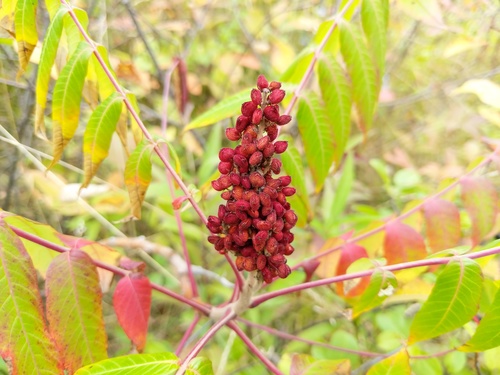
iNaturalist· cc-by-nc
(c) Craig Peter, some rights reserved (CC BY-NC), uploaded by Craig Peter
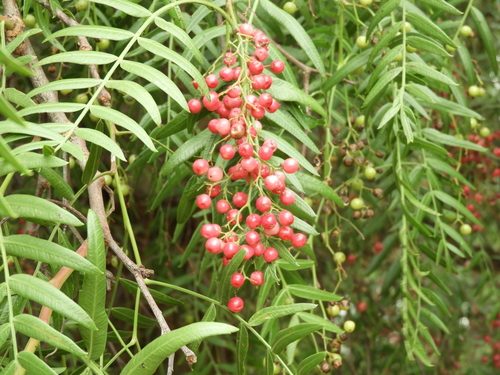
iNaturalist· cc-by-nc
(c) Craig Peter, some rights reserved (CC BY-NC), uploaded by Craig Peter
Summary
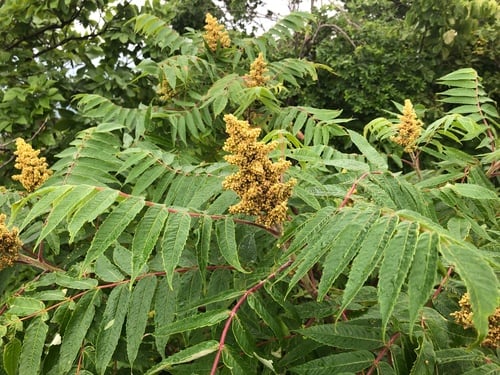
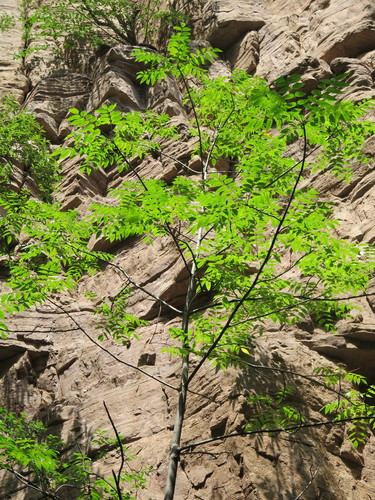
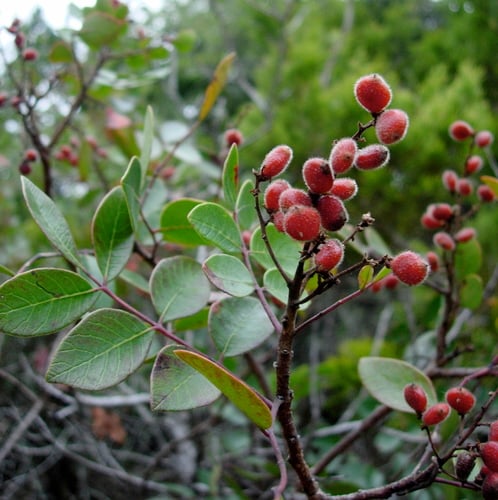
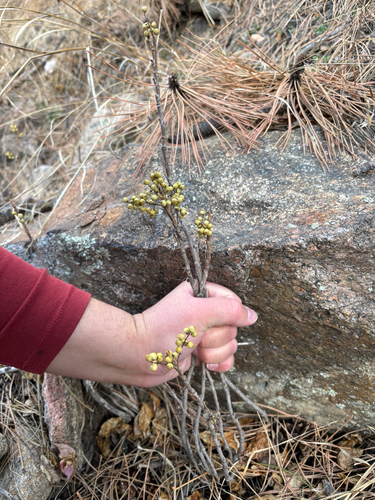
Source: WikipediaSearsia chirindensis is a medium-sized, semi-deciduous, trifoliate Southern African dioecious tree of up to 10 m tall, rarely 20 m, often multi-stemmed, occurring along the coastal belt from the Cape, through KwaZulu/Natal, Eswatini, Zimbabwe and Mozambique as far north as Tanzania, and growing in a wide variety of habitats such as open woodlands, in forests, along forest margins, in the open, among rocks and on mountain slopes. It was named by Swynnerton from a specimen collected by him near the Chirinda Forest in the Chipinge District of Southern Rhodesia. This is one of more than a hundred southern African species in the genus. It is commonly known as red currant because of a fancied resemblance of the fruit to that of the European redcurrant. Branches dull brown or blackish (when dried), cylindric, pubescent or glabrous. Petiole 1·5–6·5 cm. long, almost cylindric, narrowly canaliculate and marginate above, pubescent or glabrous. Leaflets ± dull red-brown, ovate or ovate-lanceolate, acuminate (acumen flat or sometimes falcate, very acute, apiculate), entire and ± undulate at the margin, membranous to ± rigid or subcoriaceous, glabrous or ± pubescent on the margin, midrib and nerves; median leaflet (3)6–13(16) × (1·2)2·5–4(7) cm., cuneate and frequently petiolulate at the base, the lateral ones (2)2·5–7(12) × (0·8)1·3–3·5(5·5) cm., asymmetric and slightly cuneate or somewhat rounded at the base, very shortly petiolulate to sessile; midrib slightly raised in the upper surface, very prominent below; lateral nerves arcuate, slender, raised on both sides, reticulation lax, almost invisible or sometimes conspicuous. Panicles terminal and axillary, ample, pyramidal, much branched, multiflorous, the terminal ones longer than the leaves, the axillary ones as long as the latter or somewhat longer; pedicels 1–2·5 mm. long. Male flowers: calyx-segments 0·5 mm. long, ovate, obtuse, glabrous; petals c. 1·5 mm. long, elliptic, obtuse; filaments c. 1 mm. long. Female flowers: ovary ovoid; styles reflexed; disk cupuliform, 5-lobulate; staminodes present. Drupe pinkish-yellow to reddish-brown, shining, (4)5(6) mm. in diam., globose, glabrous.
Description
A shrub. It grows 7 m high. The branches are often hanging. The leaf stalks are slender. They are 8 cm long. The leaflets have short stalks. They are oval and narrow to the tip. The edge is often wavy. They are 10 cm long by 4 cm wide. The flowers are at the ends of branches. They are in open branched groups. The fruit are round and 4 mm across. They are shiny red.
Edible Uses
The ripe fruit is eaten raw.
Traditional Uses
The ripe fruit is eaten raw.
This uses section is brief — help expand it
Medicinal Uses
Laboratory studies of bark extracts from this species show properties that may be useful in the treatment of convulsions and epilepsy, supporting its traditional use in ethnic medicine in some rural communities of South Africa.
Distribution
It is a subtropical and tropical plant. Young plants need protection from frost. It is best in well drained soil. It is tolerant to drought. It can grow in arid places. It often grows in open woodland and on rocky hillsides.
Where It Grows
Africa, East Africa, Eswatini, Malawi, Mozambique, South Africa, Southern Africa, Swaziland, Tanzania, Zimbabwe,
Cultivation
It can be grown from fresh seeds. It can also be grown from large sections of branches. Sections 10 cm across and 2 m long are suitable.
Production
It is fast growing.
Synonyms
Also Known As
Bostaaibos, Inhlangishane-lenkhulu, Mubikasadza, Mutshakutshaku, Mutsodzo
References (15)
- Fox, F. W. & Young, M. E. N., 1982, Food from the Veld. Delta Books. p 78 (As Rhus chirindensis)
- Joffe, P., 2007, Creative Gardening with Indigenous Plants. A South African Guide. Briza. p 64 (As Rhus chirindensis)
- Long, C., 2005, Swaziland's Flora - siSwati names and Uses http://www.sntc.org.sz/flora/ (As Rhus chirindensis)
- Magwede, K., van Wyk, B.-E., & van Wyk, A. E., 2019, An inventory of Vhavenḓa useful plants. South African Journal of Botany 122 (2019) 57–89
- Moffett, R. O., 2007, Name changes in the Old World Rhus and recognition of Searsia (Anacardiaceae). Bothalia 37,2: 165-175 (2007)
Show all 15 references Hide references
- Ogle & Grivetti, 1985, (As Rhus chirindensis)
- Peters, C. R., O'Brien, E. M., and Drummond, R.B., 1992, Edible Wild plants of Sub-saharan Africa. Kew. p 50 (As Rhus chirindensis)
- Royal Botanic Gardens, Kew (1999). Survey of Economic Plants for Arid and Semi-Arid Lands (SEPASAL) database. Published on the Internet; http://www.rbgkew.org.uk/ceb/sepasal/internet [Accessed 28th March 2011] (As Rhus chirindensis)
- Ruiters-Welcome, A. K., 2019, Food plants of southern Africa. Ph.D. thesis. Univ. of Johannesburg p 15
- Swaziland's Flora Database http://www.sntc.org.sz/flora (As Rhus chirindensis)
- Venter, F & J., 2009, Making the most of Indigenous Trees. Briza. p 260 (As Rhus chirindensis)
- Welcome, A. K. & Van Wyk, B.-E., 2019, An inventory and analysis of the food plants of southern Africa. South African Journal of Botany 122 (2019) 136–179
- White, F., Dowsett-Lemaire, F. and Chapman, J. D., 2001, Evergreen Forest Flora of Malawi. Kew. p 123 (As Rhus chirindensis)
- World Checklist of Useful Plant Species 2020. Royal Botanic Gardens, Kew
- www.zimbabweflora.co.zw 2011 (As Rhus chirindensis)