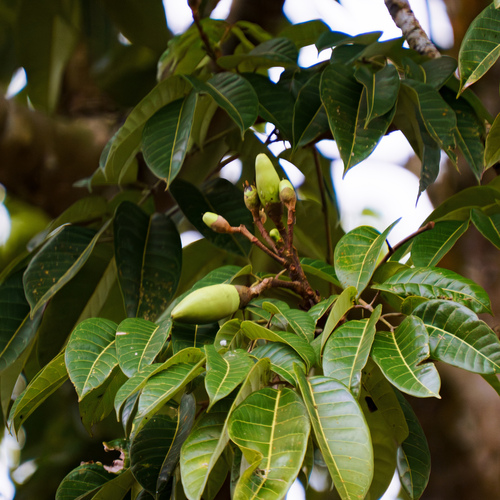
Rhus vulgaris
Meikle
iNaturalist· cc-by-nc
(c) Sequoia Janirella Wrens, some rights reserved (CC BY-NC)
iNaturalist· cc-by-nc
(c) Joel Gilb, some rights reserved (CC BY-NC)
iNaturalist· cc-by-nc
(c) Joel Gilb, some rights reserved (CC BY-NC)
Description
A bush or shrub. It grows 1-7 m high. The leaves have 3 leaflets. They are softly hairy. The leaves are dull green and can be rounded with a notched tip. The flowers are greenish-yellow. The fruit are round but flat disks. They are 3-5 mm across. They are brownish-red when dry. The fruit is edible.
Edible Uses
The ripe fruit are eaten raw and are sweet, while unripe fruit are slightly acidic and also edible. The fruit are particularly enjoyed by children.
Traditional Uses
The ripe fruit are eaten raw. They can be eaten ripe or unripe. Unripe fruit are slightly acidic but ripe fruit are sweet.
This uses section is brief — help expand it
Distribution
It is a tropical plant. It grows in the lowlands and the highlands. It grows in wooded grassland. It is often on rocky sites and the edges of forests. In East Africa it grows between 1,200-2,700 m altitude. It grows in areas with a rainfall between 700-1,500 mm per year. It can grow in arid places.
Where It Grows
Africa, Cameroon, Central Africa, Congo, East Africa, Ethiopia, Kenya, Malawi, Mozambique, Southern Africa, Tanzania, Uganda, Zambia, Zimbabwe,
Cultivation
Plants can be grown using fresh seeds.
Production
Fruit are collected at the end of the rainy season.
Other Information
They are eaten especially by children.
Notes
There are about 200 Rhus species.
Synonyms
Also Known As
Atyendwinyo, Awayo, Aweeya, Bakitela, Bicha oraya, Busojole, Dabobessaa, Datei, Datlaii, Debobesa, Ewaya, Ithia, Kemmo, Kitumbi, Mkeri, Monjororioyat, Msehelele, Msulu, Mtunumbi, Mutheo, Mutheu, Muthigi, Muthigiu, Njowaruwa, Olmungushi, Ol-munyushi, Ormisigiyoi, Sangla-madongo, Wuhehefu, Xaaxessaa, Ye-ahiya-talo
References (33)
- Acipa, A. et al, 2013, Nutritional Profile of some Selected Food Plants of Otwal and Ngai Counties, Oyam District, Northern Uganda. African Journal or Food, Agriculture, Nutrition and Development. 13(2)
- Addis, G., Asfaw, Z & Woldu, Z., 2013, Ethnobotany of Wild and Semi-wild Edible Plants of Konso Ethnic Community, South Ethiopia. Ethnobotany Research and Applications. 11:121-141
- Addis, G., et al, 2013, The Role of Wild and Semi-wild Edible Plants in Household Food Sovereignty in Hamer and Konso Communities, South Ethiopia. Ethnobotany Research & Applications. 11:251-271
- Asfaw, Z. and Tadesse, M., 2001, Prospects for Sustainable Use and Development of Wild Food Plants in Ethiopia. Economic Botany, Vol. 55, No. 1, pp. 47-62
- Bahru, T., et al, 2013, Wild Edible Plants: Sustainable Use and Management by Indigenous Communities in and the Buffer Area of Awah National Park, Ethiopia. Ethiop. J. Sci., 36(2): 93-108
Show all 33 references Hide references
- Bekele-Tesemma A., Birnie, A., & Tengnas, B., 1993, Useful Trees and Shrubs for Ethiopia. Regional Soil Conservation Unit. Technical Handbook No 5. p 394
- Berihun, T., & Molla, E., 2017, Study on the Diversity and Use of Wild Edible Plants in Bullen District Northwest Ethiopia. Hindawi Journal of Botany.Article ID 8383468
- Dale, I. R. and Greenway, P. J., 1961, Kenya Trees and Shrubs. Nairobi. p 29
- Demise, S. & Asfaw, Z., 2020, Ethno Botanical Study of Wild Edible Plants in Adola District, Southern, Ethiopia. International Journal of Research and Analytical Reviews (IJRAR) 7(2).
- Dharani, N., 2002, Field Guide to common Trees & Shrubs of East Africa. Struik. p 259
- Emire, A., et al, 2021, Ethnobotanical Study of Wild Edible Fruit Tree and Shrub Species in Adola Rede and Odo Shakiso Midland Districts of Guji Zone, Southern Ethiopia. Int. J. Adv. Res. Biol. Sci. (2021). 8(12): 96-109
- Fowler, D. G., 2007, Zambian Plants: Their Vernacular Names and Uses. Kew. p 75
- Goode, P., 1989, Edible Plants of Uganda. FAO p 30
- Goode, P., 1989, Edible Plants of Uganda. FAO p 40
- Grivetti, L. E., 1980, Agricultural development: present and potential role of edible wild plants. Part 2: Sub-Saharan Africa, Report to the Department of State Agency for International Development. p 43, 44
- http://www.fao.org/forestry/25323-096344a3de335832e8f363c3ac5184a66.pdf
- Jardin, C., 1970, List of Foods Used In Africa, FAO Nutrition Information Document Series No 2.p 158
- Johns, T., and Kokwaro, J.O., 1991, Food Plants of the Luo of Siayo District, Kenya. Economic Botany 45(1), pp 103-113
- Makonda, F. B. S., & Ruffo, C. K., 2011, Species List. NAFORMA, Tanzania
- Kokwaro, J. O. and Johns. T., Luo Biological Dictionary. p 27
- Lulekal, E., et al, 2011, Wild edible plants in Ethiopia: a review on their potential to combat food insecurity. Afrika Focus - Vol. 24, No 2. pp 71-121
- Maundu, P. et al, 1999, Traditional Food Plants of Kenya. National Museum of Kenya. 288p
- Mbuvi, M. T. E., et al, 2019, Annonated checklist of plant species of Loita Forest Narok County, Kenya. Int. J. Adv. Res. Biol. Sci. (2019). 6(3): 54-110
- Mengistu, F. & Hager, H., 2008, Wild Edible Fruit Species Cultural Domain, Informant Species Competence and Preference in Three Districts of Amhara Region, Ethiopia. Ethnobotany Research & Applications 6:487-502\
- Mpasiwakomu, R. A., 2017, The Diversity and Utilization of Wild Edible and Medicinal Plant Species found in Uvinza Miombo Woodlands, Tanzania. M. Sc. thesis University of Tanzania.
- Msola, D. K., 2007, The role of Wild Foods in Household Income and Food Security in Mufundi District, Tanzania. Morogoro, Tanzania. p 44
- Msuya, T. S., et al, 2010, Availability, Preference and Consumption of Indigenous Foods in the Eastern Arc Mountains, Tanzania, Ecology of Food and Nutrition, 49:3, 208-227
- Musinguzi, E., et al, 2006, Utilization of Indigenous Food Plants in Uganda: A Case Study of South-Western Uganda. AJFAND Vol. 6(2):
- Peters, C. R., O'Brien, E. M., and Drummond, R.B., 1992, Edible Wild plants of Sub-saharan Africa. Kew. p 52
- Regassa, T., et al, 2014, Ethnobotany of Wild and Semi-Wild Edible Plants of Chelia District, West-Central Ethiopia. Science, Technology and Arts Research Journal. 3(4): 122-134
- Royal Botanic Gardens, Kew (1999). Survey of Economic Plants for Arid and Semi-Arid Lands (SEPASAL) database. Published on the Internet; http://www.rbgkew.org.uk/ceb/sepasal/internet [Accessed 28th March 2011]
- Ruffo, C. K., Birnie, A. & Tengnas, B., 2002, Edible Wild Plants of Tanzania. RELMA p 562
- White, F., Dowsett-Lemaire, F. and Chapman, J. D., 2001, Evergreen Forest Flora of Malawi. Kew. p 125