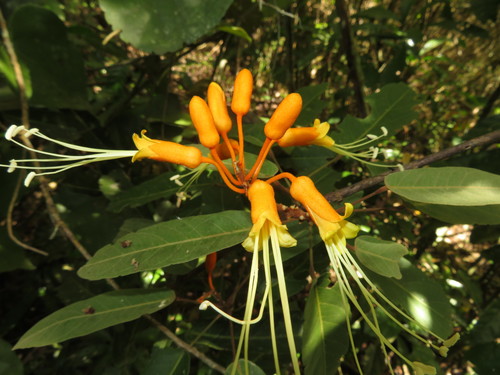
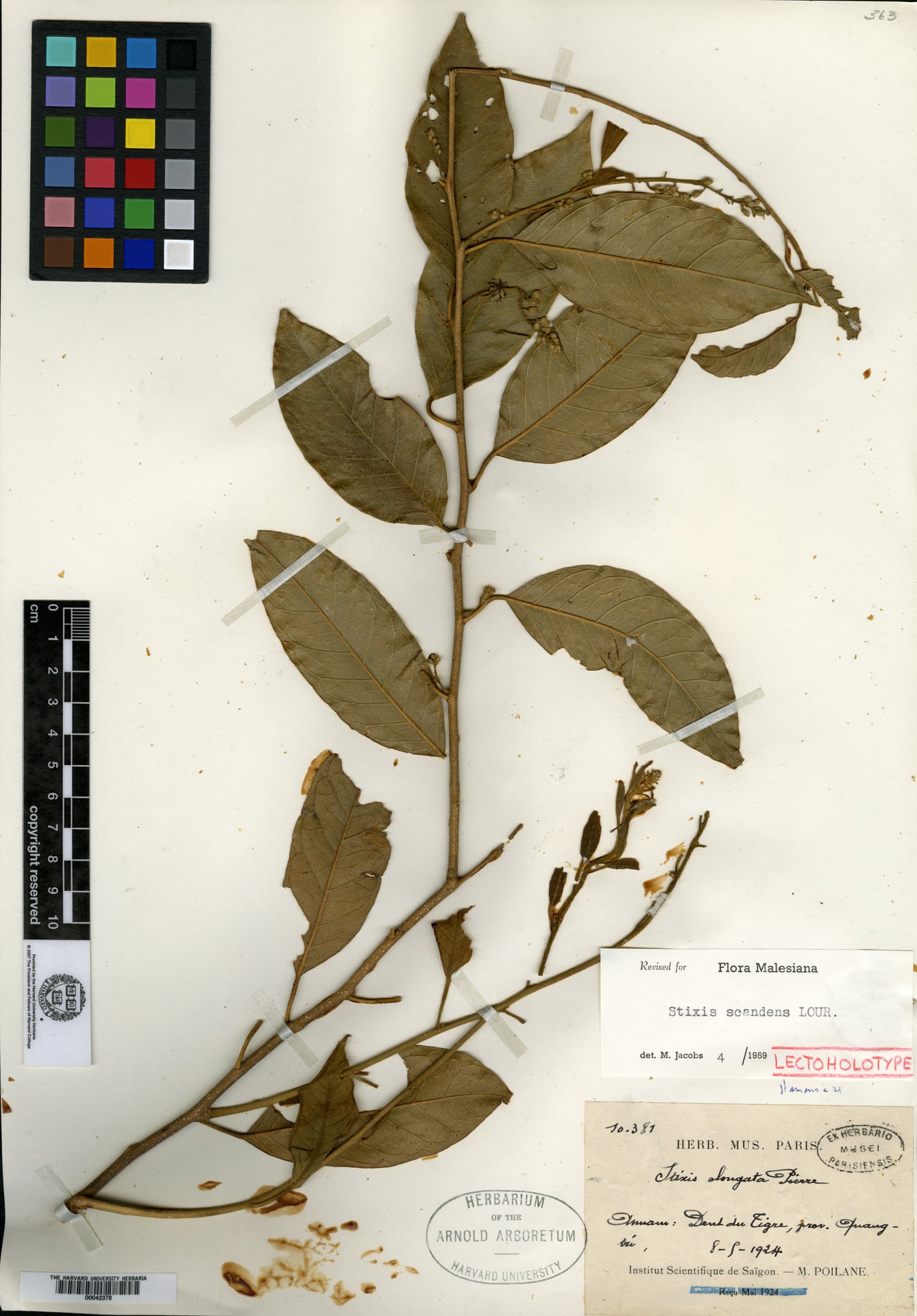
Boscia salicifolia
Oliv.
Willowed-leaved Boscia
iNaturalist· cc-by-nc
(c) Jakob Fahr, some rights reserved (CC BY-NC), uploaded by Jakob Fahr
iNaturalist· cc-by-nc
(c) Scamperdale, some rights reserved (CC BY-NC)
iNaturalist· cc-by-nc
(c) Bart Wursten, some rights reserved (CC BY-NC), uploaded by Bart Wursten
Summary
Source: WikipediaBoscia salicifolia is a deciduous tree with narrowly ovate to linear leaves that grows up to 12 meters in height, it is within the Capparaceae family.
Description
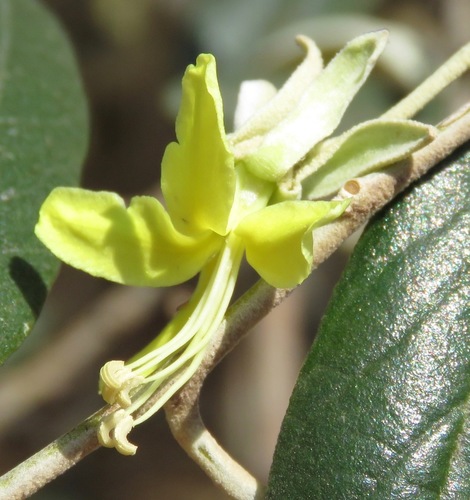
A medium sized tree. It can grow to 15 m high. It loses its leaves during the year. The bark is dark grey, rough and flaky. The leaves are alternate, long and narrow. They are 7-15 cm long by 1.5-2.5 cm wide. They are dull green and leathery. They remain finely hairy underneath. They taper to both ends. The flowers do not have petals. The stamens are yellowish-green. The fruit is round and 2 cm across. They are smooth and yellow when ripe. They have 1-3 seeds. The seeds are brown and 1 cm across.
Edible Uses
The fruit is occasionally eaten after long boiling, seeds are eaten cooked or added to soups, young leaves are occasionally eaten, and roots are occasionally eaten after frying.
Traditional Uses
The fruit are occasionally eaten. They need to be boiled for a long time. The seeds are eaten after cooking. They are also added to soups. The young leaves are occasionally eaten. The roots are occasionally eaten after being fried.
Medicinal Uses
In some parts of Africa, the leaves of Boscia salicifolia are prepared as a vegetable soup. In traditional medical practice, plant extracts are utilized to help heal wounds, used as a dewormer and as a decoction to treat tuberculosis, joint pains and ear infections. Root bark extracts is used as an aphrodisiac.
Distribution
A tropical plant. It grows in the lowlands and the highlands. It grows on termite mounds and in dry types of woodland. It grows in the Sahel. It grows in areas with a rainfall between 200-400 mm per year and it is resistant to drought. It grows between 200-1,800 m above sea level. It can grow in arid places.
Where It Grows
Africa, Botswana, Burkina Faso, Cameroon, Central Africa, Chad, Congo, East Africa, Eritrea, Ethiopia, Gambia, Ghana, Kenya, Malawi, Mali, Mozambique, Namibia, Niger, Nigeria, Sahel, Senegal, South Africa, Southern Africa, Sudan, Tanzania, Uganda, West Africa, Zambia, Zimbabwe,
Cultivation
It can be grown from seeds. Seedlings have a tendency to damp off.
Propagation
Seed - it has a short viability and needs to be sown as soon as possible. Does not require pre-treatment, germinating quickly and well.
Other Uses
The wood is used as poles in traditional buildings. The wood is used for fuel.
Notes
There are 37 Boscia species.
Nutrition
| Part | Moisture | kJ | kcal | Protein | Vit A | Vit C | Iron | Zinc |
|---|---|---|---|---|---|---|---|---|
| Leaves raw | 3.1 | 343 | 82 | 1.6 | — | — | — | — |
| Fruit | — | — | — | — | — | — | — | — |
| Root | — | — | — | — | — | — | — | — |
| Bark | — | — | — | — | — | — | — | — |
| Flowers | — | — | — | — | — | — | — | — |
Synonyms
Also Known As
Kitshagass, Legel, Mbwebzebze, Mguluka, Mguruka, Mniniado, Mtukuli, Mudaqelle, Mudemarara, Muguka, Muluka, Mungezi, Murunganyama, Musasa, Musauti, Mutalako, Mutiri, Mvuuti, Tientirgaye
References (27)
- Abbiw, D.K., 1990, Useful Plants of Ghana. West African uses of wild and cultivated plants. Intermediate Technology Publications and the Royal Botanic Gardens, Kew. p 41
- Addis, G., et al, 2013, The Role of Wild and Semi-wild Edible Plants in Household Food Sovereignty in Hamer and Konso Communities, South Ethiopia. Ethnobotany Research & Applications. 11:251-271
- Bahru, T., et al, 2013, Wild Edible Plants: Sustainable Use and Management by Indigenous Communities in and the Buffer Area of Awah National Park, Ethiopia. Ethiop. J. Sci., 36(2): 93-108
- Belem, M., et al, 2017, Strategy of Conservation and Protection of Wild Edible Plants Diversity in Burkina Faso. ANADOLU 27 (2) 2017, 82- 90
- Bircher, A. G. & Bircher, W. H., 2000, Encyclopedia of Fruit Trees and Edible Flowering Plants in Egypt and the Subtropics. AUC Press. p 62
Show all 27 references Hide references
- Burkill, H. M., 1985, The useful plants of west tropical Africa, Vol. 1. Kew.
- Dalziel, J. M., 1937, The Useful plants of west tropical Africa. Crown Agents for the Colonies London.
- Drummond, R. B., 1981, Common Trees of the Central Watershed Woodlands of Zimbabwe, National Herbarium Salisbury. p 36
- Fowler, D. G., 2007, Zambian Plants: Their Vernacular Names and Uses. Kew. p 16
- Grivetti, L. E., 1980, Agricultural development: present and potential role of edible wild plants. Part 2: Sub-Saharan Africa, Report to the Department of State Agency for International Development. p 24
- Hahn, K., et al, 2018, The Use of Wild Plants for Food: a National Scale Analysis for Burkina Faso (West Africa) Flora et Vegetatio Sudano-Sambesica 21, 25-33
- http://www.fao.org/forestry/25323-096344a3de335832e8f363c3ac5184a66.pdf
- Jardin, C., 1970, List of Foods Used In Africa, FAO Nutrition Information Document Series No 2.p 12, 60
- Kidane, B., et al, 2014, Wild and semi-wild leafy vegetables used by the Maale and Ari ethnic communities in southern Ethiopia. Genetic Resour Crop Evol. Springer. p 8
- Lulekal, E., et al, 2011, Wild edible plants in Ethiopia: a review on their potential to combat food insecurity. Afrika Focus - Vol. 24, No 2. pp 71-121
- Malaisse, F., 1997, Se nourrir en floret claire africaine. Approche ecologique et nutritionnelle. CTA., p 59
- Malaisse, F., 2010, How to live and survive in Zambezian open forest (Miombo Ecoregion). Les Presses Agronomiques de Gembloux.
- Martin, F.W. & Ruberte, R.M., 1979, Edible Leaves of the Tropics. Antillian College Press, Mayaguez, Puerto Rico. p 181
- Maydell, H. von, 1990, Trees and shrubs of the Sahel: their characteristics and uses. Margraf. p 198
- Mbuya, L.P., Msanga, H.P., Ruffo, C.K., Birnie, A & Tengnas, B., 1994, Useful Trees and Shrubs for Tanzania. Regional Soil Conservation Unit. Technical Handbook No 6. p 130
- MORTIMORE
- Palgrave, K.C., 1996, Trees of Southern Africa. Struik Publishers. p 190
- Peters, C. R., O'Brien, E. M., and Drummond, R.B., 1992, Edible Wild plants of Sub-saharan Africa. Kew. p 76
- Royal Botanic Gardens, Kew (1999). Survey of Economic Plants for Arid and Semi-Arid Lands (SEPASAL) database. Published on the Internet; http://www.rbgkew.org.uk/ceb/sepasal/internet [Accessed 7th April 2011]
- Tredgold, M.H., 1986, Food Plants of Zimbabwe. Mambo Press. p 89
- World Checklist of Useful Plant Species 2020. Royal Botanic Gardens, Kew
- www.zimbabweflora.co.zw 2011