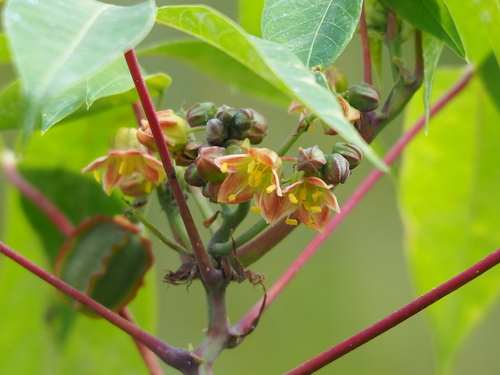
Acalypha ciliata
Forssk.
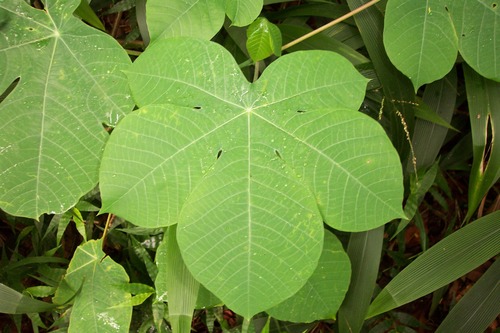
iNaturalist· cc-by-nc
(c) Dewald du Plessis, some rights reserved (CC BY-NC), uploaded by Dewald du Plessis
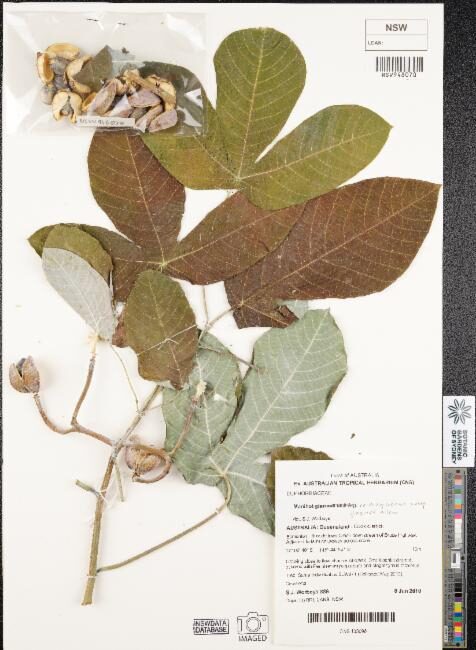
iNaturalist· cc-by-nc
(c) Royal Botanic Garden Edinburgh, some rights reserved (CC BY-NC)
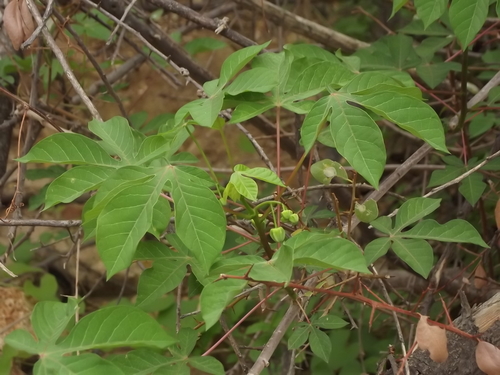
iNaturalist· cc-by-nc
(c) Royal Botanic Garden Edinburgh, some rights reserved (CC BY-NC)
Summary
Source: WikipediaAcalypha ciliata is a species in the botanical family Euphorbiaceae. It occurs widely in Africa where it is eaten as a vegetable, or fed to animals. In West Africa and East Africa it is used as a medicinal plant.
Description
A shrub or small tree. It grows 5 m tall. There are prickles along the stem. The leaves are twice divided and there are 8-18 pairs of pinnae. There are up to 50 pairs of pinnules on each pinnae. The flowers are yellow. They are in large clusters at the ends of branches. The pods are flattened.
Edible Uses
The leaves are picked, washed, cut into small pieces, and then boiled or fried for use in porridge and soup.
Traditional Uses
The leaves are picked and washed and cut into small pieces then boiled or fried. They are used in porridge and soup.
This uses section is brief — help expand it
Medicinal Uses
This species is used in traditional medicine.
Distribution
It is a tropical plant. It grows best in good soils and damp conditions. It can grow in hot arid conditions with a marked dry season. It grows along rivers. In southern Africa it grows between 300-1,000 m altitude. It can grow in arid places. In Pakistan it grows between 600-1,800 m altitude.
Where It Grows
Africa, Benin, Botswana, Burkina Faso, Cameroon, East Africa, Ethiopia, Himalayas, India, Malawi, Middle East, Mozambique, Namibia, Nigeria, Pakistan, Sao Tome and Principe, Senegal, Saudi Arabia, Somalia, South Africa, Southern Africa, Sri Lanka, Uganda, West Africa, Yemen, Zambia, Zimbabwe,
Cultivation
The plant avoids the wettest regions of tropical Africa. The plant is a common weed of cultivation, and is reported as a weed of rice-fields in Nigeria.
Notes
There are over 450 Acalypha species. They are tropical. There are 225 in tropical America. This one is used in medicine.
Also Known As
Cacayeou, Cipopo, Dadaro, Inchane, Koikoi
References (19)
- Achigan-Dako, E, et al (Eds), 2009, Catalogue of Traditional Vegetables in Benin. International Foundation for Science.
- Achigan-Dako, E. G., et al, (Eds.), 2010, Traditional vegetables in Benin. Institut National des Recherches Agricoles du Bénin. Imprimeries du CENAP, Cotonou.
- Ambasta S.P. (Ed.), 2000, The Useful Plants of India. CSIR India. p 8
- Bonou, A., et al, 2013, Valeur economique des Produits Forestiers Non Ligneux (PFNL) au Benin. Editions Universitaires Europeennes p 96
- Burkill, H. M., 1985, The useful plants of west tropical Africa, Vol. 2. Kew.
Show all 19 references Hide references
- Dansi, A., et al, 2008, Traditional leafy vegetables and their use in the Benin Republic. Genet Resour Crop Evol (2008) 55:1239–1256
- East African Herbarium records, 1981,
- Fowler, D. G., 2007, Zambian Plants: Their Vernacular Names and Uses. Kew. p 24
- Gallagher, D. E., 2010, Farming beyond the escarpment: Society, Environment, and Mobility in Precolonial Southeastern Burkina Faso. PhD University of Michigan.
- Goode, P., 1989, Edible Plants of Uganda. FAO p 41
- Grubben, G. J. H. and Denton, O. A. (eds), 2004, Plant Resources of Tropical Africa 2. Vegetables. PROTA, Wageningen, Netherlands. p 559
- Jansen, P.C.M., 2004. Acalypha bipartita Müll.Arg. [Internet] Record from Protabase. Grubben, G.J.H. & Denton, O.A. (Editors). PROTA (Plant Resources of Tropical Africa / Ressources végétales de l’Afrique tropicale), Wageningen, Netherlands. < http://database.prota.org/search.htm>. Accessed 13 October 2009.
- Peters, C. R., O'Brien, E. M., and Drummond, R.B., 1992, Edible Wild plants of Sub-saharan Africa. Kew. p 107
- Royal Botanic Gardens, Kew (1999). Survey of Economic Plants for Arid and Semi-Arid Lands (SEPASAL) database. Published on the Internet; http://www.rbgkew.org.uk/ceb/sepasal/internet [Accessed 16th April 2011]
- Tallantire & Goode, 1975,
- Vernon, R., 1983, Field Guide to Important Arable Weeds of Zambia. Dept of Agriculture, Chilanga, Zambia. p 42
- World Checklist of Useful Plant Species 2020. Royal Botanic Gardens, Kew
- Zapfack, L., et al, 2001, Ethnobotanical Survey of the Takamanda Forest Reserve. Consultancy Report PROFA, Cameroon. p 25
- Zon, A.P.M. van der, Grubben, G.J.H., 1976, Les legumes-feuilles spontanes et cultives du Sud-Dahomey, Communication 65, Royal Tropical Institute, Amsterdam, p 25