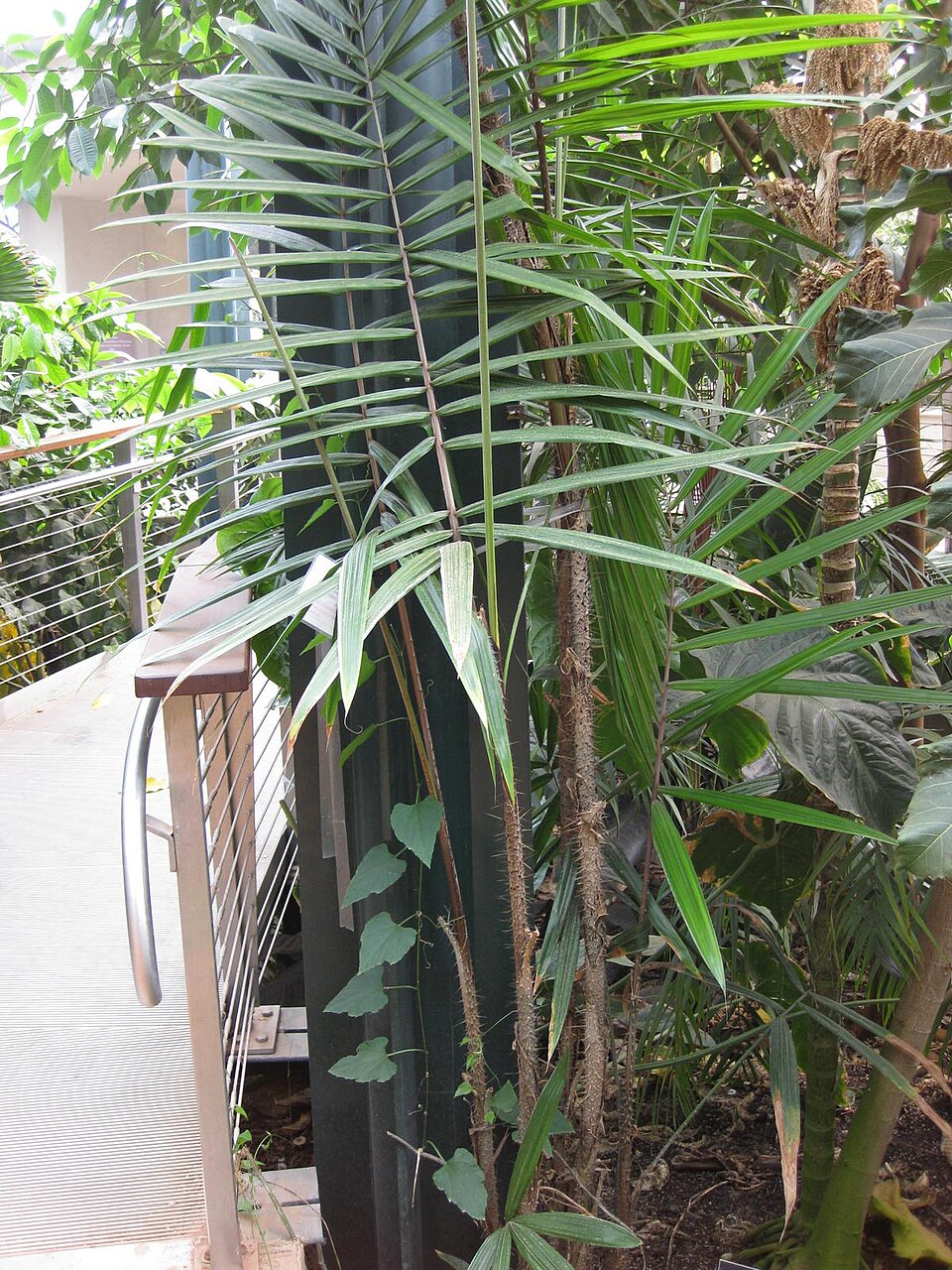
Butia odorata
(Barb. Rodr.) Noblick & Pirani
Southern jelly palm, Butia-branco, Butia-miudo, Butia-azedo
iNaturalist· cc-by
(c) Rafael Tosi, some rights reserved (CC BY)
iNaturalist· cc-by-nc
(c) Matías Zarucki, some rights reserved (CC BY-NC)
iNaturalist· cc-by-nc
(c) Matías Zarucki, some rights reserved (CC BY-NC)
Summary
Source: WikipediaButia odorata, also known as the South American jelly palm, jelly palm, or pindo palm, is a Butia palm native to southernmost Brazil and Uruguay. This slow-growing palm grows up to 10m, although it is often less tall. It is identifiable by its feather palm pinnate leaves that arch inwards towards a thick stout trunk.
Description
A solitary palm. It is erect and grows 3-6 m tall. The stem is ringed by persistent leaf bases. There are 7-3 leaves. The edges have teeth. There are 35-60 leaflets on each side. The form a V shape. The fruiting stalk comes from within the leaves. The fruit have a juicy pulp.
Edible Uses
It is cultivated as a fruit tree in Brazil and Uruguay, and especially the larger-fruited, semi-domesticated, pulposa-type plants are reasonably common in local orchards. In the type most often grown in the USA, the ripe fruit are about the size of large cherry, and yellowish/orange in colour, but can also include a blush towards the tip. The taste is a mixture of pineapple, apricot, and vanilla. Taste can vary depending on soil conditions, and the tastes of apple, pineapple, and banana together is also common. It is tart and sweet at the same time, with a flesh similar to a loquat, but slightly more fibrous.
Traditional Uses
The fruit are used for juice.
This uses section is brief — help expand it
Distribution
It is a subtropical plant.
Where It Grows
Brazil*, South America, Uruguay,
Cultivation
Plants are grown from seed.
Propagation
Seed - best sown as soon as it is ripe in containers. Stored seed is very slow to germinate. Pre-soaking the seed for 24 hours in warm water prior to sowing may shorten the germination time. Plants form a long tap-root some time before forming a shoot. Germination of fresh seed usually takes place in 3 - 4 months at 25°c. Plant out into deep pots or the open ground either as soon as root growth is noticed or as soon as top growth appears.
Other Information
It is a cultivated fruit tree. The fruit are popular.
Notes
There are about 9 Butea species.
Nutrition
| Part | Moisture | kJ | kcal | Protein | Vit A | Vit C | Iron | Zinc |
|---|---|---|---|---|---|---|---|---|
| Fruit | 80 | — | — | 0.6 | — | — | — | — |
Synonyms
Also Known As
Butiazeiro-da-praia
References (3)
- Barbieri, R. L., et al, 2014, Agricultural Biodiversity in Southern Brazil: Integrating Efforts for Conservation and Use of Neglected and Underutilized Species. Sustainability 6:741-757
- Brack, P., et al, 2020, Frutas nativas do Rio Grande do Sul, Brasil: riqueza e potencial alimentício. Native fruits of Rio Grande do Sul, Brazil: richness and potential as food. Rodriguésia 71: e03102018.
- Lorenzi, H., Bacher, L., Lacerda, M. & Sartori, S., 2006, Brazilian Fruits & Cultivated Exotics. Sao Paulo, Instituto Plantarum de Estuados da Flora Ltda. p 74