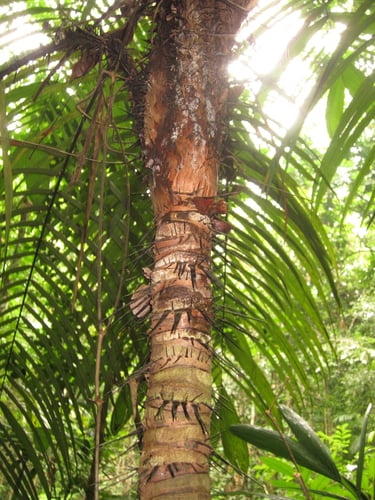
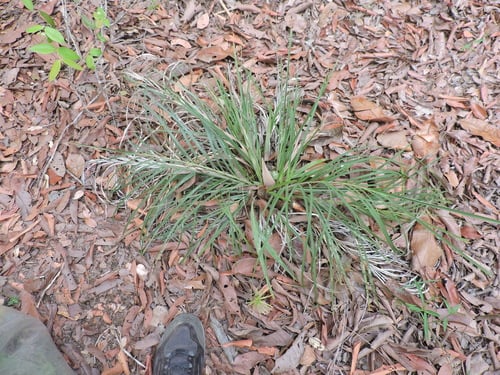
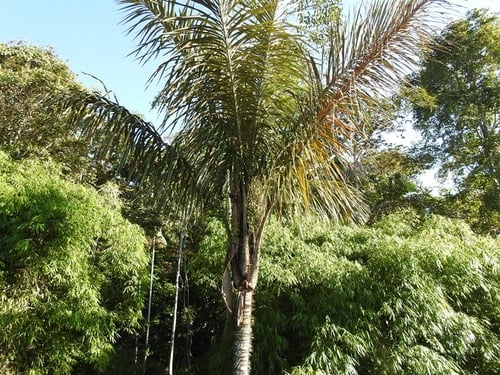
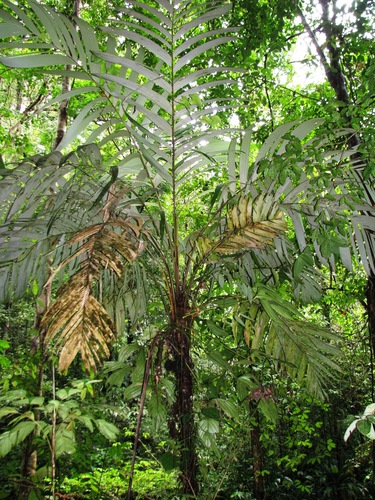
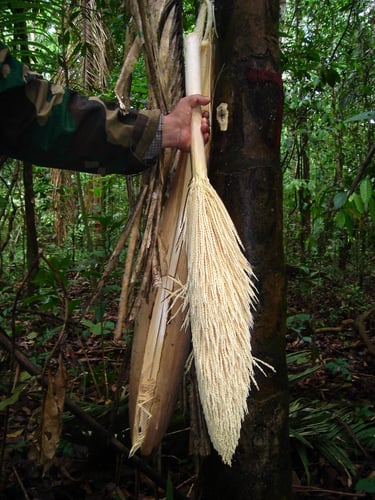
Bactris acanthocarpa
Mart.
Spiny fruit spiny clubpalm
iNaturalist· cc-by-nc
(c) Riley Fortier, some rights reserved (CC BY-NC), uploaded by Riley Fortier
iNaturalist· cc-by-nc
(c) Marcus Athaydes, some rights reserved (CC BY-NC)
iNaturalist· cc-by-nc
(c) Marcus Athaydes, some rights reserved (CC BY-NC)
Description
A palm. It is spiny and grows 3 m tall. It has short stems that are usually underground. The stems have 5-15 leaves and these are 4 m long. The fruit are green but become red.
Edible Uses
Bactris gasipaes, the peyibaye or peach palm, was domesticated in pre-Columbian times and is cultivated for its starchy fruit and palm heart throughout the Neotropics, especially in Brazil, Colombia, Peru and Costa Rica. Other species used for food include B. brongniartii, B. campestris, B. concinna and B. major. Bactris acanthophora and B. campestris are used medicinally, while B. barronis, B. pilosa and B. setulosa are used in construction.
Medicinal Uses
The mesocarp has medicinal uses.
Distribution
A tropical plant. It is usually in lowlands on non flooded soils and can be up to 1,000 m above sea level. It grows in wet rainforest.
Where It Grows
Amazon, Bolivia, Brazil, Colombia, Ecuador, Guiana, Guianas, Guyana, Peru, South America, Suriname, Venezuela,
Cultivation
Grows best in a warm, sheltered, moist position.
Other Uses
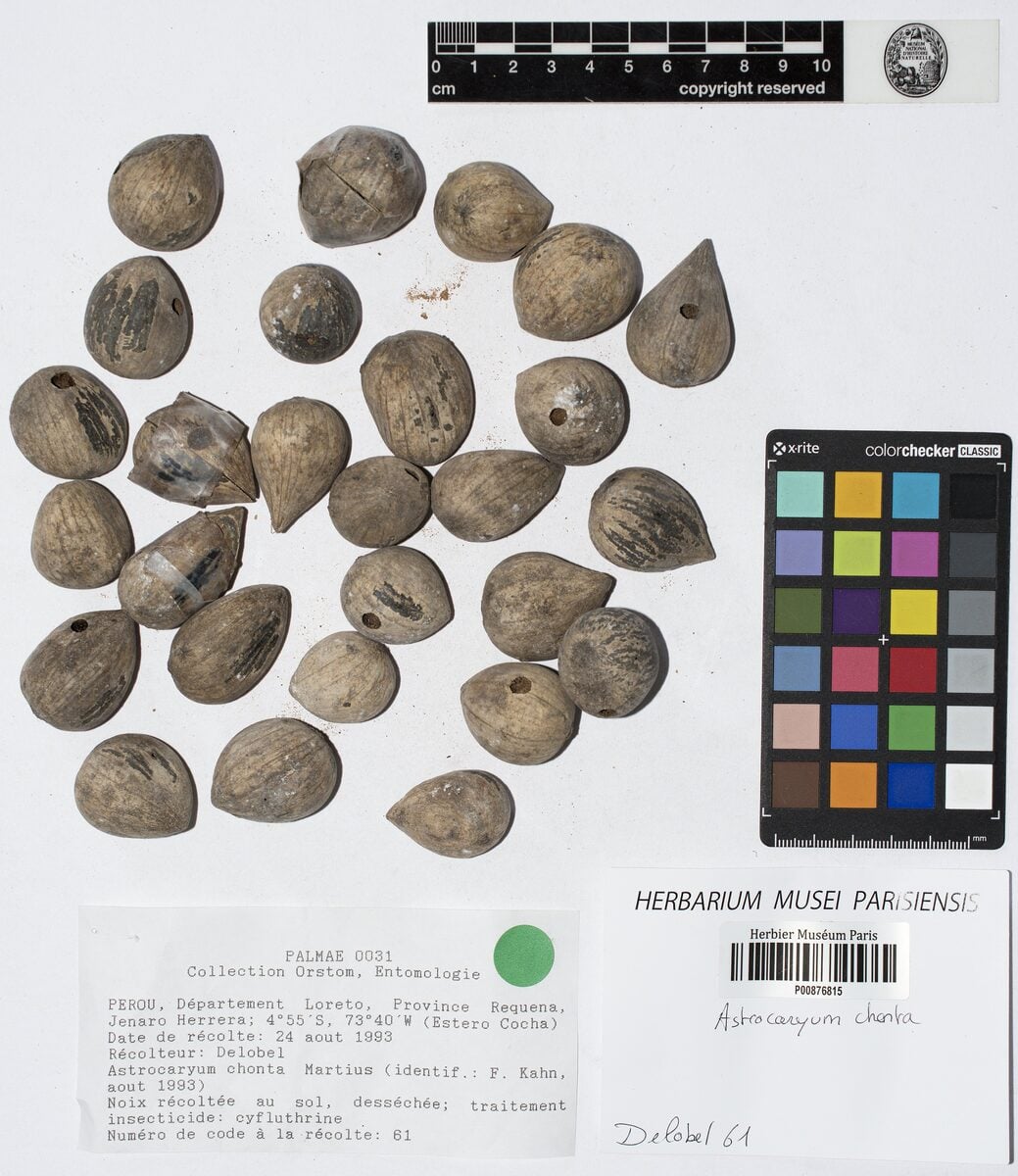
The seeds are used as beads.
Notes
There are 239 Bactris species. There are 75 species in tropical America. Most Bactris have fruit that are edible but many are not attractive. It is used as medicine.
Synonyms
Also Known As
Bahy, Canahuanima, Njilla, Pupunha da mata, Pupunha-de-macaco
References (8)
- Balick, M.J. and Beck, H.T., (Ed.), 1990, Useful palms of the World. A Synoptic Bibliography. Colombia p 561 (As Bactris humilis),
- Daly, D. C., An Index of Common Names of Plants in Acre, Brazil. New York Botanical Garden Universidade Federal do Acre.
- A. D. d'Orbigny, Voy. Amerique mer. 7(3). Palmiers 70. 1844 (Palmetum orbignianum)
- Grandtner, M. M. & Chevrette, J., 2013, Dictionary of Trees, Volume 2: South America: Nomenclature, Taxonomy and Ecology. Academic Press p 56
- Marcia, M. J., et al, 2011, Palm Uses in Northwestern South America: A Quantitative Review. Bot. Rev. (2011) 77:462-570
Show all 8 references Hide references
- Roa, J. A. G. & Boada, D. S. G., 2018, Fundación para el Fortalecimiento de la Fruticultura y Plantas Alimenticias no Convencionales en Colombia.
- World Checklist of Useful Plant Species 2020. Royal Botanic Gardens, Kew
- Zambrana, P, et al, 2017, Traditional knowledge hiding in plain sight – twenty-first century ethnobotany of the Chácobo in Beni, Bolivia. Journal of Ethnobiology and Ethnomedicine (2017) 13:57