Astrocaryum aculeatum
G. Mey.
Tukum palm, Awara palm
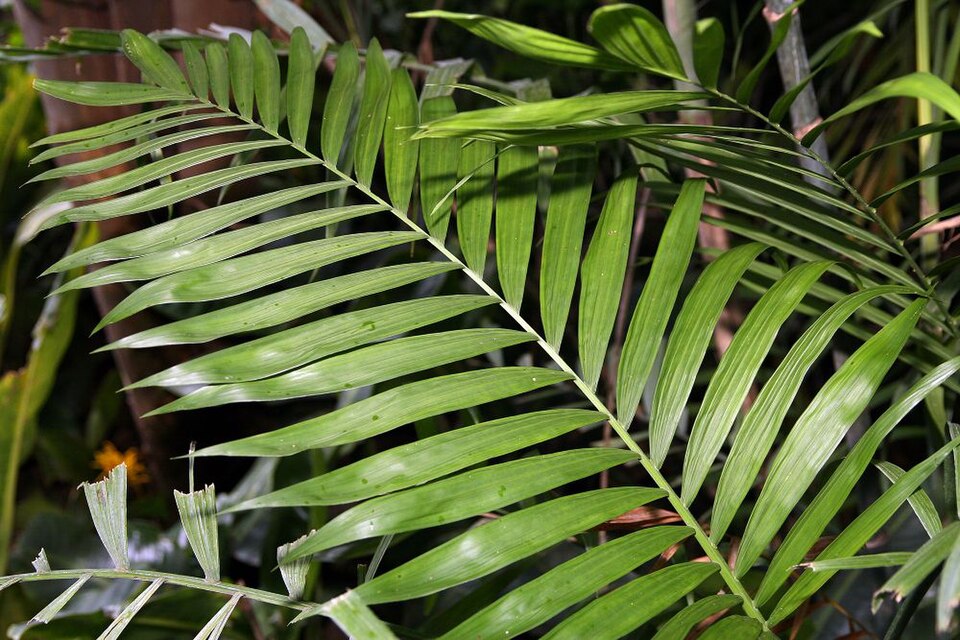
iNaturalist· cc-by-nc-sa
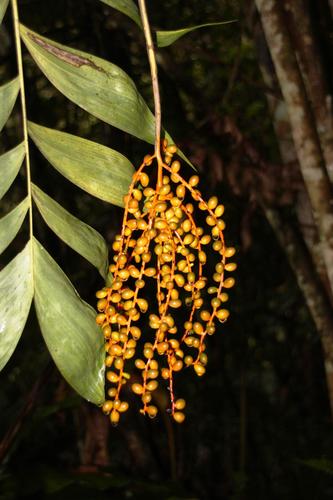
(c) Rich Hoyer, some rights reserved (CC BY-NC-SA), uploaded by Rich Hoyer
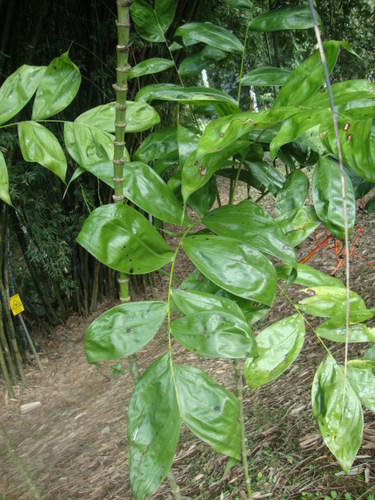
iNaturalist· cc-by-nc
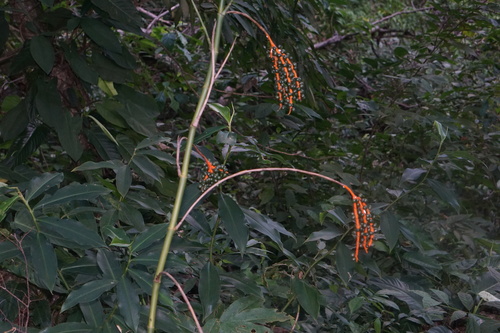
(c) Ruben D. Layme, some rights reserved (CC BY-NC), uploaded by Ruben D. Layme
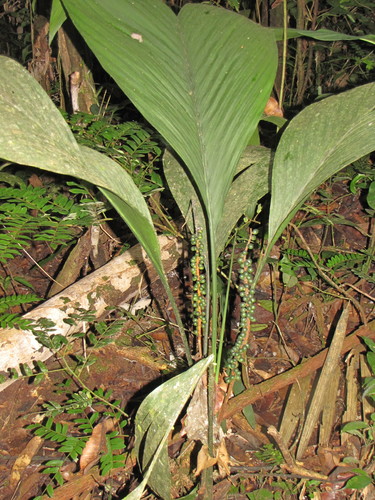
iNaturalist· cc-by-nc
(c) Renata Xavier, some rights reserved (CC BY-NC), uploaded by Renata Xavier
Summary
Source: WikipediaAstrocaryum aculeatum (known in Brazilian Portuguese as tucumã, acaiúra, acuiuru, coco-tucumã, tucum, tucumã-açu, tucumã-macaw, tucum-açu, tucumaí-da-terra-firme, tucumãí-uaçu, tucumã-piririca, tucumã-purupuru or tucumã-do-mato) is a palm native to tropical South America and Trinidad. It grows up to 15 m (49 ft) tall and is usually solitary. It has ascending leaves, erect inflorescence, and yellow fruit.
Description
A single stemmed, spiny palm. It can form clusters. It has a slender grey trunk. It grows to 25 m high and is 20-30 cm across. The crown is almost round. It has feather-like leaves. They are bright green. The leaves are about 5 m long and finely divided. The leaflets are arranged in groups. There are black spines on the trunk, leaf stalks and midrib of the leaves. The fruiting stalks are 2 m long. They have branches. The flowers are cream. The fruit occur in clusters. They are oval and 4-5 cm across. They are yellowish-orange when ripe. They are edible.
Edible Uses
This plant has edible fruit which may be used for making a kind of juice. It is also used to make a symbolic ring called a tucum ring. Tucum ring is mainly used in Catholic church as a symbol of commitment in social justice, peace building and ecology. A fiber is extracted from the leaves for making hammocks and ropes that resist salt water.
Traditional Uses
The flesh of the fruit is eaten fresh. The leaves are burnt to make vegetable salt. The soft spongy layer of germinated seeds is eaten.
This uses section is brief — help expand it
Distribution
It is a tropical plant. It usually grows in deforested areas. It grows in dry forests in the Amazon in Brazil.
Where It Grows
Amazon, Asia, Australia, Bolivia, Brazil*, Central America, Columbia, French Guiana, Guianas, Guyana, Indonesia, Peru, SE Asia, South America, South America, Suriname, Tobago, Trinidad, Venezuela,
Cultivation
Plants are grown from seed. Seed are often difficult to germinate. Soaking or cracking the seed helps germination.
Other Uses
The hard endocarp of various Amazonian species is commonly used to make beads and ornaments for necklaces
Other Information
The fruit are sold in markets. They are popular.
Notes
There are about 40-50 Astrocaryum species. The fruit are very rich in Vitamin A. The kernels contain 23% fat.
Nutrition
| Part | Moisture | kJ | kcal | Protein | Vit A | Vit C | Iron | Zinc |
|---|---|---|---|---|---|---|---|---|
| Fruit | 44.9 | 1392 | 337 | 3.4 | 808 | 24.2 | 1.1 | 0.94 |
| Fruit | — | — | 3.5 | — | — | — | — | — |
Synonyms
Also Known As
Acquero, Akhoyoro, Akorlorlo arau, Akuyuru, Amana, Arapipi, Chambira, Chonta, Cumare, Hericungo, Huana, Jabarana, Kiajuaya, Kumay, Kuru, Murumuru, Palem tukuma, Palma coco, Panima, Star nut palm, Tackoeman, Toekoemaw, Tucuma, Tuinfa, Uyenkague, Waran
References (29)
- Bircher, A. G. & Bircher, W. H., 2000, Encyclopedia of Fruit Trees and Edible Flowering Plants in Egypt and the Subtropics. AUC Press. p 46 (Also as Astrocaryum princeps)
- Blomberry, A. & Rodd, T., 1982, Palms. An informative practical guide. Angus & Robertson. p 58
- Brazil: Biodiversity for Food and Nutrition. http://www.b4fn.org/countries/brazil/
- Burkill, I.H., 1966, A Dictionary of the Economic Products of the Malay Peninsula. Ministry of Agriculture and Cooperatives, Kuala Lumpur, Malaysia. Vol 1 (A-H) p 266
- Grandtner, M. M. & Chevrette, J., 2013, Dictionary of Trees, Volume 2: South America: Nomenclature, Taxonomy and Ecology. Academic Press p 49
Show all 29 references Hide references
- Useful plants of Guyana. Non-Timber Forest Products of the North-West District of Guyana Part 1. p 103
- Haynes, J., & McLaughlin, J., 2000, Edible palms and Their Uses. University of Florida Fact sheet MCDE-00-50-1 p 2
- Henderson, A., Galeano, G and Bernal, R., 1995, Field Guide to the Palms of the Americas. Princeton. p 203
- Hunter, D., et al, 2019, The potential of neglected and underutilized species for improving diets and nutrition. Planta (2019) 250:709-729
- Janick, J. & Paul, R. E. (Eds.), 2008, The Encyclopedia of Fruit & Nuts. CABI p 88
- Johnson, D.V., 1998, Tropical palms. Non-wood Forest products 10. FAO Rome. p 90
- Johnson, M. and Colquhoun, A., 1996, Preliminary Ethnobotanical Survey of Kurupukari: An Amerindian Settlement of Central Guyana. Economic Botany, Vol. 50, No. 2, pp. 182-194
- Jones, D.L., 1994, Palms throughout the World. Smithtonian Institution, Washington. p 138
- Jones, D.L., 2000, Palms of Australia 3rd edition. Reed/New Holland. p 121
- Kermath, B. M., et al, 2014, Food Plants in the Americas: A survey of the domesticated, cultivated and wild plants used for Human food in North, Central and South America and the Caribbean. On line draft. p 99
- Lopez-Diago, D. & Garcia, N., 2021, Wild edible fruits of Colombia. Biota ColomBiana 22 (2) p 30
- Lorenzi, H., Bacher, L., Lacerda, M. & Sartori, S., 2006, Brazilian Fruits & Cultivated Exotics. Sao Paulo, Instituto Plantarum de Estuados da Flora Ltda. p 65
- Marcia, M. J., et al, 2011, Palm Uses in Northwestern South America: A Quantitative Review. Bot. Rev. (2011) 77:462-570
- Non-Timber Forest Products of the North-West District of Guyana Part 2. The 85 most important NTFP species. p 18
- Paz, F. S., et al, 2021, Edible Fruit Plant Species in the Amazon Forest Rely Mostly on Bees and Beetles as Pollinators. Journal of Economic Entomology, XX(XX), 2021, 1–13
- Prim. fl. esseq. 266. 1818
- Roa, J. A. G. & Boada, D. S. G., 2018, Fundación para el Fortalecimiento de la Fruticultura y Plantas Alimenticias no Convencionales en Colombia.
- Sukarya, D. G., (Ed.) 2013, 3,500 Plant Species of the Botanic Gardens of Indonesia. LIPI p 754
- TodaFruta.com.br
- USDA, ARS, National Genetic Resources Program. Germplasm Resources Information Network - (GRIN). [Online Database] National Germplasm Resources Laboratory, Beltsville, Maryland. Available: www.ars-grin.gov/cgi-bin/npgs/html/econ.pl (10 April 2000)
- van Roosmalen, M.G.M., 1985, Fruits of the Guianan Flora. Utrecht Univ. & Wageningen Univ. p 338
- Wickens, G.E., 1995, Edible Nuts. FAO Non-wood forest products. FAO, Rome. p162
- World Checklist of Useful Plant Species 2020. Royal Botanic Gardens, Kew
- Zambrana, P, et al, 2017, Traditional knowledge hiding in plain sight – twenty-first century ethnobotany of the Chácobo in Beni, Bolivia. Journal of Ethnobiology and Ethnomedicine (2017) 13:57