Astrocaryum chambira
Burret
Chambira
iNaturalist· cc-by-nc
(c) Edson Guilherme, some rights reserved (CC BY-NC), uploaded by Edson Guilherme
iNaturalist· cc-by-nc
(c) Edson Guilherme, some rights reserved (CC BY-NC), uploaded by Edson Guilherme
Summary
Source: WikipediaAstrocaryum chambira, the chambira palm or chambira, is a large and spiny palm native to the Amazon rainforest in Colombia, Ecuador, Peru, and Venezuela that is mostly known for its commercial value as a fiber crop. It can reach over 25 meters in height, and it is not uncommon for climbing trees to be planted nearby to make harvesting the fruit and leaves both easier and safer. Indigenous people use the fibers of young leaves to weave into products such as nets, hammocks, bags, and other fabric and textile products. In most places where this fiber is used, the sale of products woven from these fibers to tourists is a major source of income, though there is great geographic variation in abundance and income received for products made from these fibers. In addition to the fibers, it is believed that the fruit and liquid endosperm within the seeds can help with fever reduction.
Description
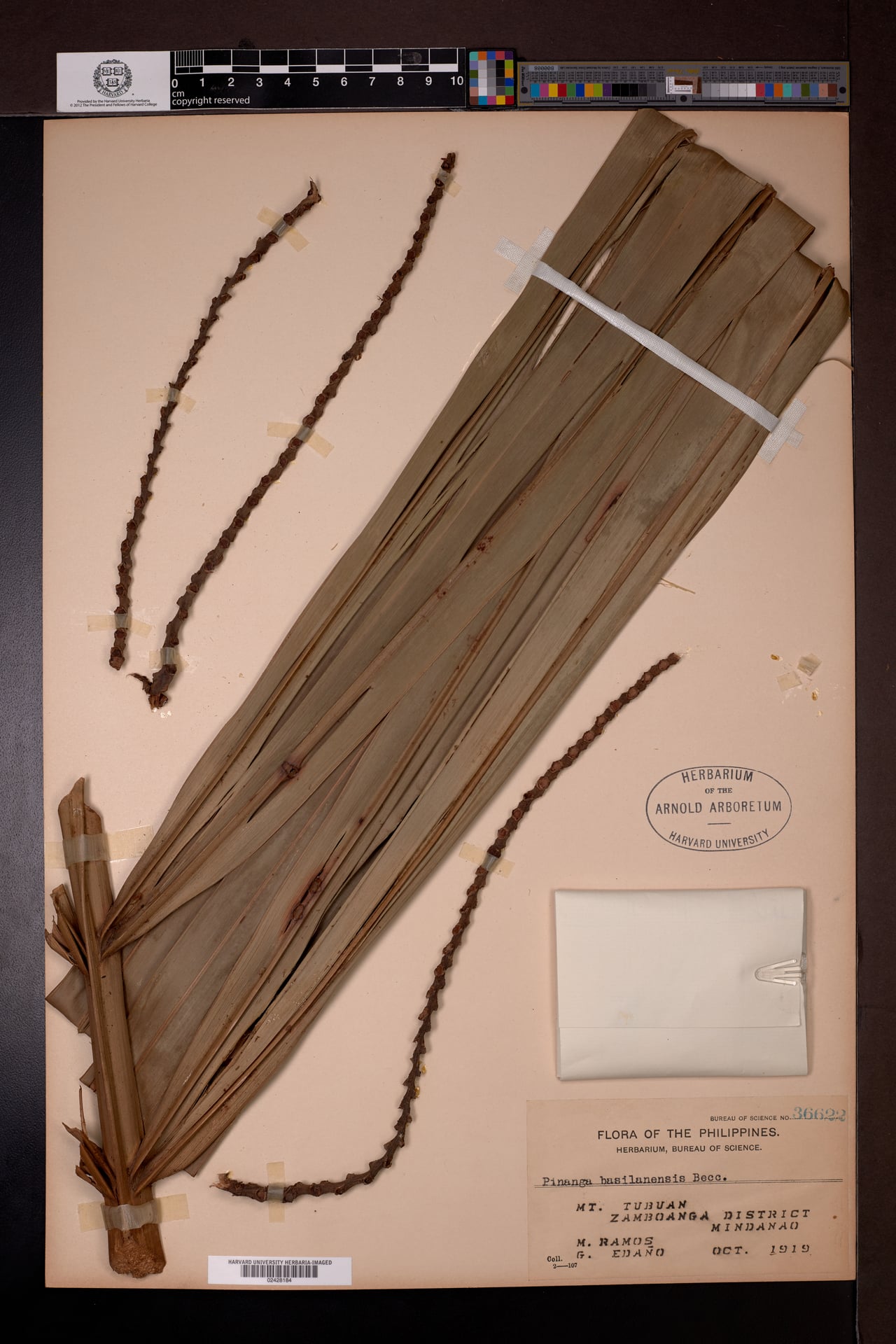
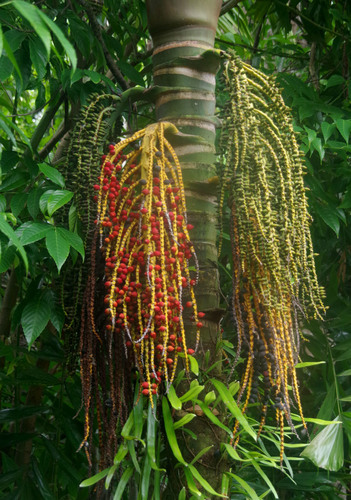
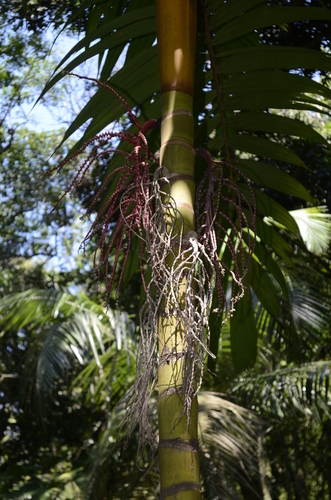
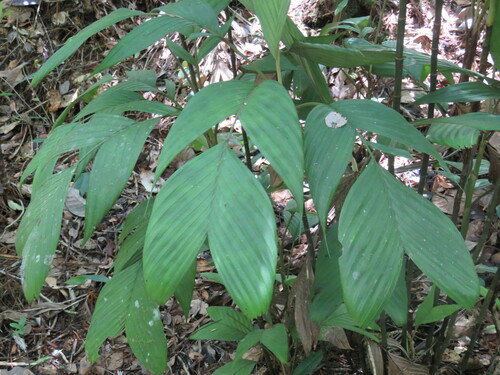
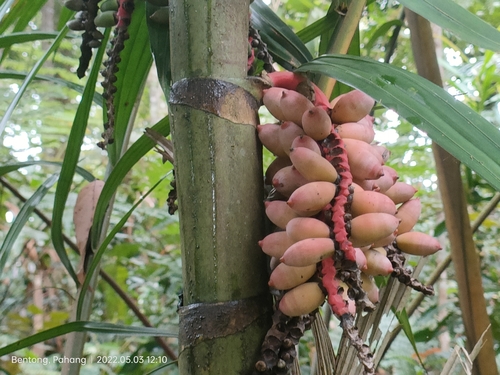
A palm. It has a single stem which is stout and erect. It can be 3.5-30 m tall and 19-35 cm across. The trunk is covered with black spines which are up to 20 cm long. There are 9-16 leaves that are 5 m long. The leaf stalk in young palms is covered with yellow winged spines. There are 120-175 leaflets on each side. They are arranged irregularly in clusters and spread in different planes. The flowering stalk is erect and amongst the leaves. The fruiting stalk is covered with black spines. The flowering branches have 2-5 female flowers at the base. The fruit are oval and 5-7 cm long by 4-5 cm wide. They are yellow or greenish yellow when ripe.
Edible Uses
The fruit pulp is eaten fresh or used to make wine, and the fruits are also toasted and eaten. The shoots are burnt to produce vegetable salt. The fruits are rich in vitamin A, and the palm heart and seeds are also edible.
Traditional Uses
The fruit pulp is eaten. It is also used for wine. The fruit are also toasted and eaten. The shoots are burnt for vegetable salt.
This uses section is brief — help expand it
Medicinal Uses
The fruits are used to treat erysipelas. The fruit pulp is said to be antihelminthic. The liquid endosperm is drunk to cleanse internal organs, especially the kidneys and liver, and to reduce fevers. The oil extracted from the seed to cure boils and toothache. Extracts from the roots have been shown to have an effect on hepatitis, malaria and yellow fever.
Known Hazards
The trunk and leaf stalks are covered with sharp black spines.
Distribution
A tropical plant. It grows in lowland rainforest. It grows on non flooded soils.
Where It Grows
Amazon, Brazil, Colombia, Ecuador, Peru, South America, Venezuela,
Other Uses
The fibres obtained from the youngest, unexpanded leaves are commonly used to weave a variety of items, especially hammocks, nets, necklaces and bags. The fibre can be used as a floss to clean the teeth. The hard endocarp of various Amazonian species is commonly used to make beads and ornaments for necklaces The plant is a natural pioneer species, being often found growing in dense populations on deforested land. It has potential for use as a pioneer species when restoring native forests.
Notes
There are about 40-50 Astrocaryum species. The fruit are rich in Vitamin A.
Synonyms
Also Known As
Beto ni, Chambira, Coco de monte, Corombolo, Cumare, Datsatsam, Kumata, Mata, Nuca ni, Pita, Tiunfa, Tucuma
References (16)
- Balick, M.J. and Beck, H.T., (Ed.), 1990, Useful palms of the World. A Synoptic Bibliography. Colombia p 333, 653,
- Creed-kanashiro, H., et al, Traditional food system of an Awajun community in Peru. Indigenous Peoples' food systems Chp. 4
- Etkin, N.L. (Ed.), 1994, Eating on the Wild Side, Univ. of Arizona. p 136
- Gilmore, M. P., et al, 2013, The socio-cultural importance of Mauritia flexuosa palm swamps (aguajales) and implications for multi-use management in two Maijuna communities of the Peruvian Amazon. Journal of Ethnobiology and Ethnomedicine 2013, 9:29
- Grandtner, M. M. & Chevrette, J., 2013, Dictionary of Trees, Volume 2: South America: Nomenclature, Taxonomy and Ecology. Academic Press p 49
Show all 16 references Hide references
- Janick, J. & Paul, R. E. (Eds.), 2008, The Encyclopedia of Fruit & Nuts. CABI p 89
- Katz, E., et al, 2012, No greens in the forest? Note on the limited consumption of greens in the Amazon. Acta Soc Bot Pol 81(4):283–293
- Kermath, B. M., et al, 2014, Food Plants in the Americas: A survey of the domesticated, cultivated and wild plants used for Human food in North, Central and South America and the Caribbean. On line draft. p 99
- Kuhnlein, H. V., et al, 2009, Indigenous Peoples' food systems. FAO Rome p 82
- Lopez-Diago, D. & Garcia, N., 2021, Wild edible fruits of Colombia. Biota ColomBiana 22 (2) p 30
- Marcia, M. J., et al, 2011, Palm Uses in Northwestern South America: A Quantitative Review. Bot. Rev. (2011) 77:462-570
- Repert. Spec. Nov. Regni Veg. 35:122. 1934
- Roa, J. A. G. & Boada, D. S. G., 2018, Fundación para el Fortalecimiento de la Fruticultura y Plantas Alimenticias no Convencionales en Colombia.
- Torre, de la L., et al, 2008, Enciclopedia de las Plantas Útiles del Ecuador. Herbario QCA. Pontificia Universidad Católica del Ecuador. p 194
- Vasquez, R. and Gentry, A. H., 1989, Use and Misuse of Forest-harvested Fruits in the Iquitos Area. Conservation Biology 3(4): 350f
- World Checklist of Useful Plant Species 2020. Royal Botanic Gardens, Kew