Billardiera cymosa
F. Muell.
Sweet apple-berry
iNaturalist· cc-by-nc
(c) Reiner Richter, some rights reserved (CC BY-NC), uploaded by Reiner Richter
iNaturalist· cc-by-nc
(c) emilysalkeld, some rights reserved (CC BY-NC)
iNaturalist· cc-by-nc
(c) Mark Hura, some rights reserved (CC BY-NC), uploaded by Mark Hura
Summary
Source: WikipediaBillardiera cymosa, commonly known as sweet apple-berry or love fruit, is a species of flowering plant in the family Pittosporaceae and is endemic to south-eastern continental Australia. It is usually a slender climber that has narrowly egg-shaped leaves and pale blue or pale purplish flowers arranged in groups of about five to twelve.
Description
A shrubby slender climber. It grows 1-2 m tall. The young branches and leaves have fine silky hairs. The leaves are short and slender. The flowers are 2 cm across. They are borne in clusters at the ends of branches. The colour can vary from cream to red to blue. The fruit are oblong and hang down. They are reddish berries. They are 2 cm long.
Edible Uses
Edible Parts: Fruit Edible Uses: Fruit - raw or cooked. A delightful aniseed flavour. The fruit is up to 1.5cm long.
Traditional Uses
The fruit are eaten fresh and roasted. They are also used for making sauces for pork, veal and chicken.
This uses section is brief — help expand it
Medicinal Uses
None known
Distribution
Temperate. It can grow in subtropical and semiarid regions. It grows in inland New South Wales, Victoria and South Australia. It suits drier areas. It needs well drained soils. It can grow in full sun. It can stand heavy frost.
Where It Grows
Australia*,
Cultivation
Requires a moist, well-drained, humus-rich, lime-free soil in sun or semi-shade with a cool root run. Plants are hardy to at least -7°c in Australian gardens but this cannot be translated directly to British gardens due to our cooler summers and longer colder and wetter winters. They probably require greenhouse protection in Britain, though they may succeed outdoors in a selected area in the milder areas of this country. Mulching the roots in winter will provide extra protection for the plant and even if the top is cut back by the cold it might resprout from the base.
Propagation
Seed - best sown in a warm greenhouse as soon as it is ripe. Only just cover the seed. Sow stored seed in early spring in a warm greenhouse. The germination of fresh seed is usually prolific, but stored seed can take a year to germinate. When they are large enough to handle, prick the seedlings out into individual pots and grow them on in the greenhouse for at least their first winter. Plant them out into their permanent positions in late spring or early summer, after the last expected frosts. Cuttings of half-ripe wood, 10 - 12cm with a heel, July/August in a frame. Fair percentage. Layering.
Other Uses
None known Special Uses
Notes
There are about 25 Billardiera species. They grow in Australia.
Synonyms
References (20)
- Bodkin, F., 1991, Encyclopedia Botanica. Cornstalk publishing, p 147
- Bonney, N., 1997, Economic Native Trees and Shrubs for South Australia. Greening Australia (SA) inc. Campbelltown SA 5074 p 50
- Bonney, N., 2012, Edible Wild Native Plants for Southern Australia. p 110
- Cherikoff V. & Isaacs, J., The Bush Food Handbook. How to gather, grow, process and cook Australian Wild Foods. Ti Tree Press, Australia p 198
- Cribb, A.B. & J.W., 1976, Wild Food in Australia, Fontana. p 62
Show all 20 references Hide references
- Dashorst, G.R.M., and Jessop, J.P., 1998, Plants of the Adelaide Plains & Hills. Botanic Gardens of Adelaide and State Herbarium. p 76
- Facciola, S., 1998, Cornucopia 2: a Source Book of Edible Plants. Kampong Publications, p 173
- Greig, D., 1996, Flowering Natives for Home Gardens. Angus & Robertson. p 74
- Hibbert, M., 2002, The Aussie Plant Finder 2002, Florilegium. p 43
- Jones, D.L. & Gray, B., 1977, Australian Climbing Plants. Reed. p 60, 77
- Lord, E.E., & Willis, J.H., 1999, Shrubs and Trees for Australian gardens. Lothian. p 321
- Low, T., 1991, Wild Food Plants of Australia. Australian Nature FieldGuide, Angus & Robertson. p 124
- Lyle, S., 2006, Discovering fruit and nuts. Land Links. p 94
- Mallee Wildflower Committee, Flowers of the Mallee. p 82
- Molyneux, B & Forrester, S., 1997, The Austraflora A-Z of Australian Plants. Reed. p 54
- Plants for a Future database, The Field, Penpol, Lostwithiel, Cornwall, PL22 0NG, UK. http://www.scs.leeds.ac.uk/pfaf/
- Smith, K & I., 199, Grow your own bushfoods. New Holland. Australia. p 24
- Trans. & Proc. Victorian Inst. Advancem. Sci. 1854-1855:29. 1855
- www.ceres.org/au/bushfood catalogue
- Zola, N., & Gott, B., 1992, Koorie Plants Koorie People. Koorie Heritage Trust. p 25
More from Pittosporaceae
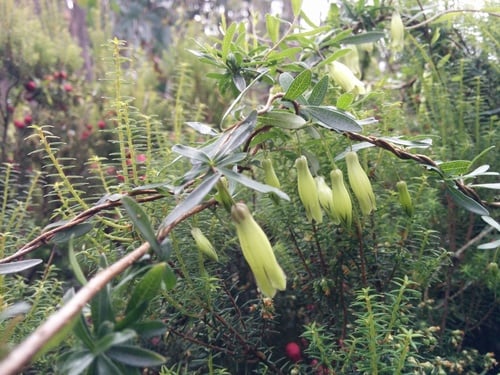
Billardiera longiflora
Purple Apple-berry, Mountain Blue Berry
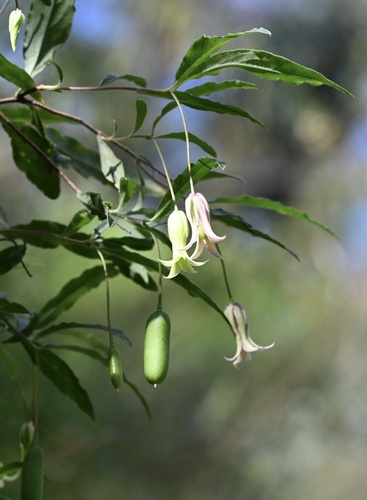
Billardiera mutabilis
Green appleberry
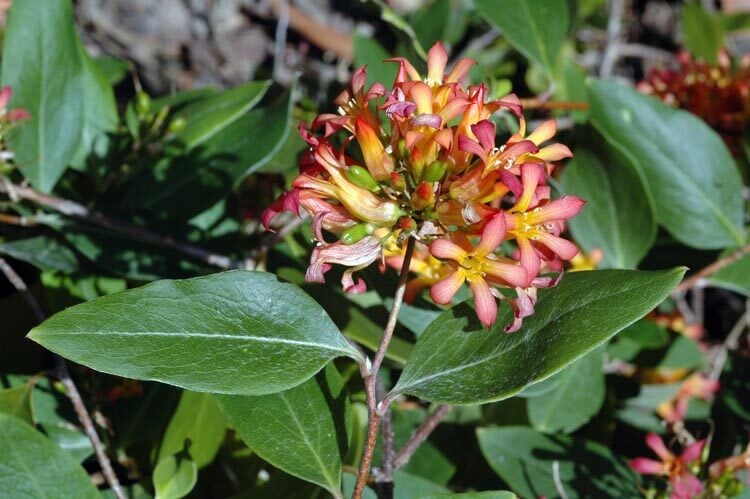
Billardiera ringens
Chapman River Climber, Chapman creeper
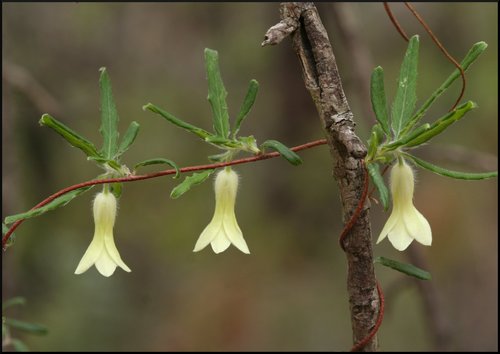
Billardiera scandens
Appleberry, Apple dumpling, Common Appleberry
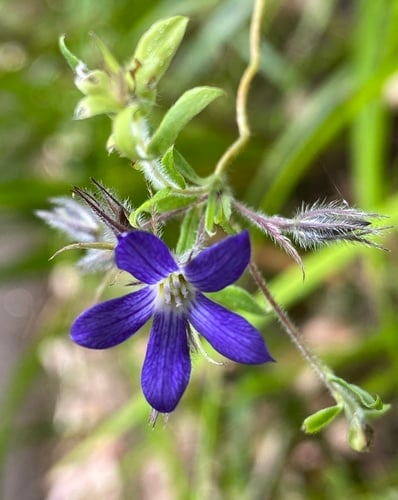
Billardiera variifolia
Western bluebell
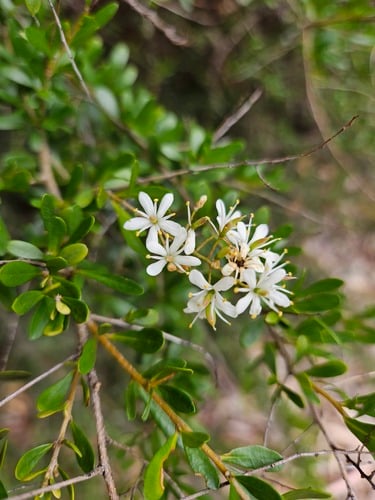
Bursaria spinosa
Australian Blackthorn, Sweet Bursaria