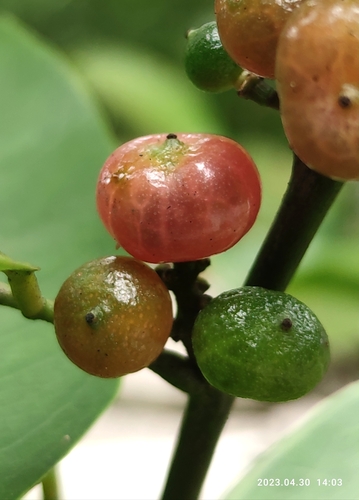
Agathosma betulina
(P. J. Bergius) Pillans
Buchu, Round leaf buchu
iNaturalist· cc-by-sa
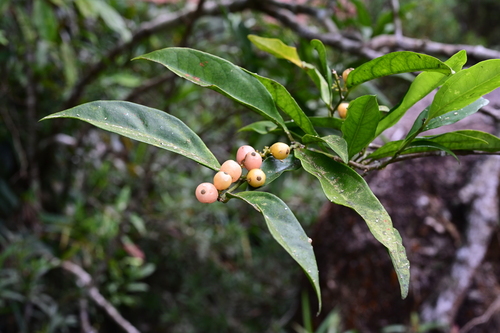
(c) magriet b, some rights reserved (CC BY-SA), uploaded by magriet b
iNaturalist· cc-by-sa
(c) Tony Rebelo, some rights reserved (CC BY-SA), uploaded by Tony Rebelo
iNaturalist· cc-by-nc
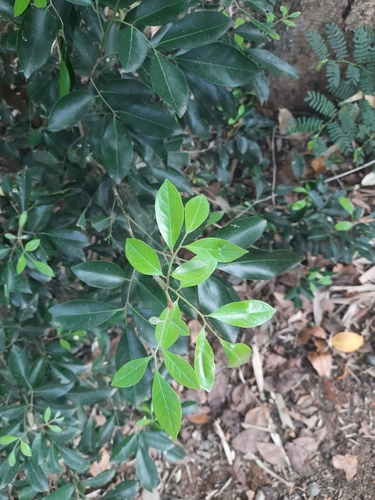
(c) Debbie Wall Smith, some rights reserved (CC BY-NC), uploaded by Debbie Wall Smith
Summary
Source: WikipediaAgathosma betulina (previously Barosma betulina) is a flowering plant in the family Rutaceae, native to the lower elevation mountains of western South Africa, where it occurs near streams in fynbos habitats.
Description
A shrub. It grows 2 m high. The leaves are small, broad and dotted with glands. The flowers are white or pale purple.
This description is brief — help expand it
Edible Uses
Wild plants of this species are still plentiful but are being harvested faster than they can reproduce. The threat of their becoming scarce has led to efforts to cultivate them. The essential oils and extracts of the leaves are used as flavoring for teas, candy, and a liquor known as buchu brandy in South Africa. The two primary chemical constituents of the oils of A. betulina are isomenthone and diosphenol. The extract is said to taste like blackcurrant.
Traditional Uses
The leaves and oil are used for flavouring. An oil extract is used to flavour candy, ice cream and baked goods. The leaves are used in the preparation of brandy. The roots are use as a flavouring and preservative.
Medicinal Uses
The plant has been used by the indigenous people of South Africa to as a folk remedy for various disorders, including urinary tract infections. Dutch settlers in early times used Agathosma betulina commonly called buchu to make a brandy tincture. The tincture is still used today.
Distribution
A subtropical plant. It grows in the high mountains of the Western cape province of South Africa. It grows in areas with an annual rainfall between 400-700 mm. It can grow in arid places.
Where It Grows
Africa, Madagascar, Malawi, Mediterranean, North Africa, South Africa*, Southern Africa, Tunisia,
Cultivation
Plants require a minimum temperature no lower than about 5°c. Requires a lime-free, moisture-retentive but well-drained soil in a sunny position. The plants are extremely aromatic, filling the surrounding area with their scent. The aroma is reminiscent of blackcurrants, though some people detect a mixture of rosemary and peppermint.
Propagation
Seed - Cuttings of semi-ripe wood.
Other Uses
The dried leaves are powdered and used as an insect repellent.
Notes
There are about 135 Agathosma species.
Synonyms
References (11)
- Facciola, S., 1998, Cornucopia 2: a Source Book of Edible Plants. Kampong Publications, p 213
- J. S. African Bot. 16:75. 1950
- Morton,
- Royal Botanic Gardens, Kew (1999). Survey of Economic Plants for Arid and Semi-Arid Lands (SEPASAL) database. Published on the Internet; http://www.rbgkew.org.uk/ceb/sepasal/internet [Accessed 10th June 2011]
- Ruiters-Welcome, A. K., 2019, Food plants of southern Africa. Ph.D. thesis. Univ. of Johannesburg p 98
Show all 11 references Hide references
- Seidemann J., 2005, World Spice Plants. Economic Usage, Botany, Taxonomy. Springer. p 12 (As Barosma betulina)
- van Wyk, B., 2005, Food Plants of the World. An illustrated guide. Timber press. p 44
- van Wyk, B-E., 2011, The potential of South African plants in the development of new food and beverage products. South African Journal of Botany 77 (2011) 857–868
- Welcome, A. K. & Van Wyk, B.-E., 2019, An inventory and analysis of the food plants of southern Africa. South African Journal of Botany 122 (2019) 136–179
- Wiersema, J. H. & Leon, B., 2013, World Economic Plants. A Standard Reference CRC Press. 2nd Ed. p 24
- World Checklist of Useful Plant Species 2020. Royal Botanic Gardens, Kew