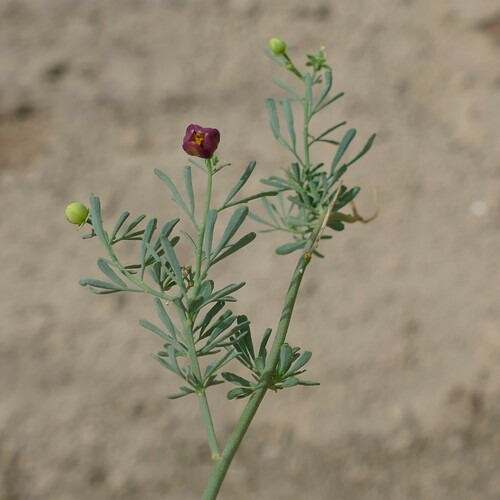
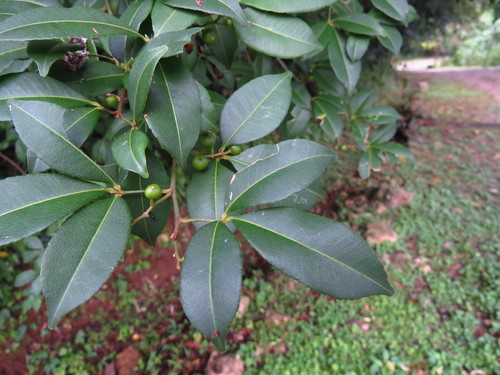
Clausena excavata
Burm.f.
Pink limeberry
iNaturalist· cc0
no rights reserved, uploaded by 葉子
iNaturalist· cc0
no rights reserved, uploaded by 葉子
iNaturalist· cc0
no rights reserved, uploaded by 葉子
Summary
Source: WikipediaClausena excavata is a species of evergreen shrub that grows 1–2 metres (3 ft 3 in – 6 ft 7 in) tall, in the family Rutaceae, native to Bangladesh, Bhutan, Cambodia, China, India, Indonesia, Laos, Malaysia, Myanmar, Nepal, the Philippines, Taiwan, Thailand, and Vietnam. The plant is commonly by various names, including pink lime-berry, cama, cemama, cemamar, cerek, cerek hitam, kemantu hitam, secerek, semeru, and suntang hitam.
Description
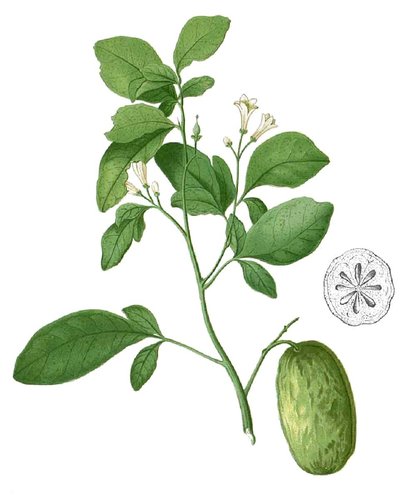
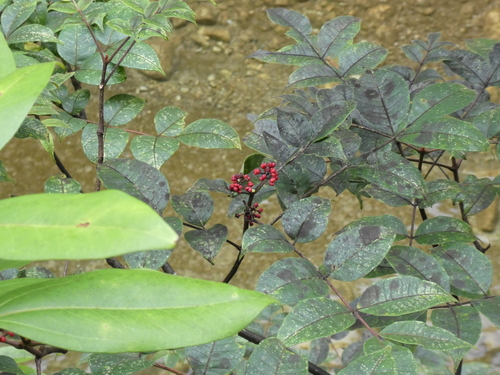
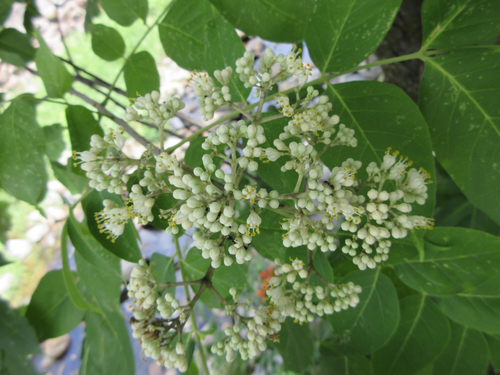
A shrub 1-2-4 m high. It can be 10 m tall. All parts of the plant are hairy. The leaves have a smell. The leaflets are placed one after another along opposite sides of the stalk. There are 15-31 leaflets. The leaflets have short stalks and are 2.5-7.5 cm long by 0.8-2.5 cm wide. They are clear along the edges. The leaves have round teeth along the edges. They are hairy underneath. The flowers are yellowish. The fruit are oblong. The fruit are in clusters. The fruit contain 3 large seeds.
Edible Uses
The ripe fruit are eaten occasionally in cooking and are popular in some regions. The leaves are stewed in curries as a spice. The rootstock is powdered to flavour local liquor.
Traditional Uses
The fruit are occasionally used in cooking. The ripe fruit are edible. The leaves are stewed in curries as a spice. The rootstock is powdered and used to flavour local liquor.
Medicinal Uses
The leaves are used in Southeast Asian cooking, emitting a curry-like smell when crushed. The plant's berries are also edible and have an anise flavour. The plant is astringent, bitter, emmenagogue and considered a tonic for digestive problems. One of the phytochemicals the plant contains is lichexanthone.
Distribution
A tropical plant. It grows in secondary undergrowth in Indochina. In Nepal it grows to about 500 m altitude. It forms dense stands along roads.
Where It Grows
Asia, Australia, Bangladesh, Bhutan, Cambodia, Central America, China, Christmas Island, Himalayas, India, Indochina, Indonesia, Laos, Malaysia, Myanmar, Nepal, Northeastern India, Pacific, Philippines, SE Asia, Taiwan, Thailand, Vietnam, West Indies,
Cultivation
Plants are grown from seed.
Other Uses
The leaves and bark contain essential oils that are used in the perfume industry. The leaves are insecticidal. The wood is white and has a fine structure. Although often too small to be of much service, in Java the tree is large enough for the wood to be used for making axe handles. The plant is often fond on disturbed ground such as along the sides of roads. This makes it sound like a potential pioneer species, though the rate of growth needs to be known first. There is also a possible concern that the plant could escape from cultivation and invade native habitats, so it should possibly only be used as a pioneer within its native range.
Other Information
It is a popular fruit in some places. It is widely cultivated.
Notes
There are about 23-30 Clausena species.
Synonyms
Also Known As
Agnijal, Agnijhad, Asanyam, Bagal tikus, Bajetah, Chamar, Chememar, Cherek hitam, Daw-hke, Fia fan, Hrila-sheng, Kantrook khmao'ch, Kemantu hitam, Ki bechetah, Opinjala, Pink wampee, Pokok cherek, Pokok kemantu, Pyin-daw-thein, Pyin-thaw-thein, Saen sok, Sam-sweng, Secherek, Seik-nan, Semeru, Shan huang pi, Sicherek, Tikusan, Whample
References (29)
- Altschul, S.V.R., 1973, Drugs and Foods from Little-known Plants. Notes in Harvard University Herbaria. Harvard Univ. Press. Massachusetts. no. 1935
- Ambasta, S.P. (Ed.), 2000, The Useful Plants of India. CSIR India. p 130
- Anderson, E. F., 1993, Plants and people of the Golden Triangle. Dioscorides Press. p 206
- Barwick, M., 2004, Tropical and Subtropical Trees. A Worldwide Encyclopedic Guide. Thames and Hudson p 119
- Burkill, I.H., 1966, A Dictionary of the Economic Products of the Malay Peninsula. Ministry of Agriculture and Cooperatives, Kuala Lumpur, Malaysia. Vol 1 (A-H) p 585
Show all 29 references Hide references
- Coronel, R.E., 1982, Fruit Collections in the Philippines. IBPGR Newsletter p 6 (As Citrus excavata)
- Dobriyal, M. J. R. & Dobriyal, R., 2014, Non Wood Forest Produce an Option for Ethnic Food and Nutritional Security in India. Int. J. of Usuf. Mngt. 15(1):17-37
- Facciola, S., 1998, Cornucopia 2: a Source Book of Edible Plants. Kampong Publications, p 219
- Fl. indica 89, t. 29. 1768
- Gardner, S., et al, 2000, A Field Guide to Forest Trees of Northern Thailand, Kobfai Publishing Project. p 104
- Hedrick, U.P., 1919, (Ed.), Sturtevant's edible plants of the world. p 202
- Hibbert, M., 2002, The Aussie Plant Finder 2002, Florilegium. p 68
- Kahlon, L. K. & Singh, R., 2019, Traditional knowledge & Dynamics of edible plants of primitive tribal group ‘Paudi Bhuyan’ with changing demography migration patterns in Northern Odisha. Indian Journal of Traditional Knowledge Vol 18(1), pp 7-15
- Kuo, W. H. J., (Ed.) Taiwan's Ethnobotanical Database (1900-2000), http://tk.agron.ntu.edu.tw/ethnobot/DB1.htm
- Manandhar, N.P., 2002, Plants and People of Nepal. Timber Press. Portland, Oregon. p 157
- Martin, F. W., et al, 1987, Perennial Edible Fruits of the Tropics. USDA Handbook 642 p 74
- Misra, R. C., et al, 2013, Genetic resources of wild tuberous food plants traditionally used in Similipal Biosphere Reserve, Odisha, India. Genetic Resources and Crop Evolution. Vol. 60 No. 2. Springer
- Murtem, G. & Chaudhrey, P., 2016, An ethnobotanical note on wild edible plants of Upper Eastern Himalaya, India. Brazilian Journal of Biological Sciences, 2016, v. 3, no. 5, p. 63-81. (As Citrus excavata)
- Phon, P., 2000, Plants used in Cambodia. © Pauline Dy Phon, Phnom Penh, Cambodia. p 161
- Ramakrishna, N. & Singh, DSR, R., 2020, Ethno-Botanical Studies of Edible Plants Used by Tribal Women in Nirmal District. IJSRSET p 310
- Reis, S. V. and Lipp, F. L., 1982, New Plant Sources for Drugs and Foods from the New York Botanical Garden herbarium. Harvard. p 144
- Seidemann J., 2005, World Spice Plants. Economic Usage, Botany, Taxonomy. Springer. p 110
- Shin, T., et al, 2018, Traditional knowledge of wild edible plants with special emphasis on medicinal uses in Southern Shan State, Myanmar. Journal of Ethnobiology and Ethnomedicine (2018) 14:48
- Singh, B., et al, 2012, Wild edible plants used by Garo tribes of Nokrek Biosphere Reserve in Meghalaya, India. Indian Journal of Traditional Knowledge. 11(1) pp 166-171
- Singh, H.B., Arora R.K.,1978, Wild edible Plants of India. Indian Council of Agricultural Research, New Delhi. p 22
- Slik, F., www.asianplant.net
- Sukenti, K., et al, 2016, Ethnobotanical study on local cuisine of the Sasak tribe in Lombok Island, Indonesia. Journal of Ethnic Foods. 3 (2016) 189-200 p 198
- Thitiprasert, W., et al, 2007, Country report on the State of Plant Genetic Resources for Food and Agriculture in Thailand (1997-2004). FAO p 95
- Tsering, J., et al, 2017, Ethnobotanical appraisal on wild edible plants used by the Monpa community of Arunchal Pradesh. Indian Journal of Traditional Knowledge. Vol 16(4), October 2017, pp 626-637