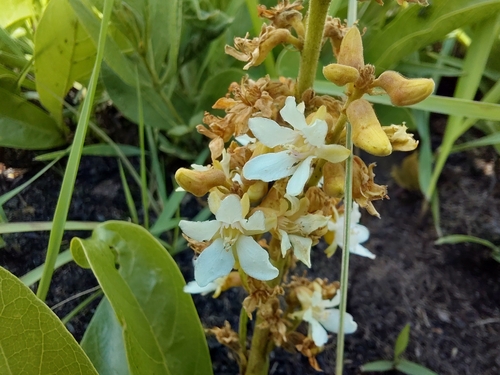
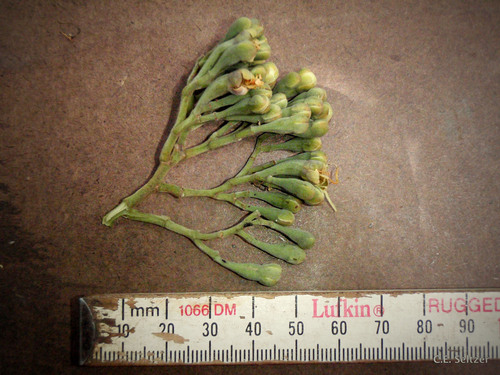
Couepia chrysocalyx
(Poeppig & Endlicher) Bentham ex Hooker f.
Golden calyx couepia
gbif· cc-by-nc
C. Dennis : Field Museum of Natural History - Botany Department
gbif· cc-by-nc
I. Huamantupa : Universidad Nacional San Antonio Abad de Cusco
gbif· cc-by-nc
C. Dennis : Field Museum of Natural History - Botany Department
Description
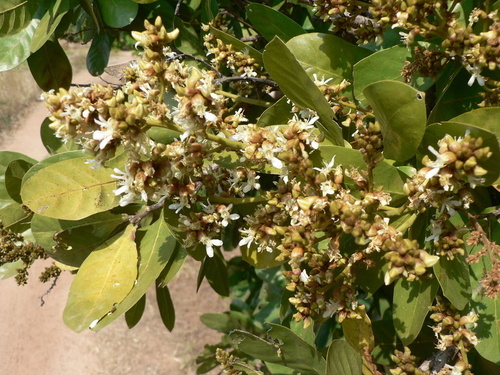
A tree. It grows 10-20 m tall. The leaves are oblong and 10-22 cm long by 4-9 cm wide. They taper to the tip and are rounded or wedge shaped at the base. There are silvery grey hairs underneath. The flowering shoots are short and densely flowered. The fruit is round and 9 cm long. It has a thick fragile case and fleshy pulp. They ripen to an orange yellow colour.
Edible Uses
The fruit is eaten.
Distribution
A tropical plant. It grows in uplands and high river banks and places that are only occasionally flooded.
Where It Grows
Amazon, Andes, Brazil*, Colombia, Ecuador, French Guiana, Peru*, South America, Venezuela,
Other Uses
A dye obtained from the large, green fruits is used as an ink. The wood is a uniform, pale brown throughout, darkening slightly on exposure. It is straight-grained; medium-textured; moderately heavy and hard; probably durable. It is tasteless, but has a slightly fragrant odour when fresh; easy to cut, takes a smooth finish.
Production
Fruit are harvested towards the end of the rainy season.
Other Information
It is cultivated for the edible fruit. Fruit are sold in local markets.
Synonyms
Also Known As
Amchichare, Cacawerewe, Caya'o, Doroje, Gingamonkawe, Guambula, Hueso, Juene, Karaipe'y, Merecure, Pagowe, Palo gavilan colorado, Parinari, Pillchi, Pillchi yura, Remo kaspi, Rumi kaspi, Sacha umapu, Supay huayo, Supai ocote, Tserentsre, Yaji
References (13)
- Grandtner, M. M. & Chevrette, J., 2013, Dictionary of Trees, Volume 2: South America: Nomenclature, Taxonomy and Ecology. Academic Press p 165
- Hedrick, U.P., 1919, (Ed.), Sturtevant's edible plants of the world. p 222
- Kermath, B. M., et al, 2014, Food Plants in the Americas: A survey of the domesticated, cultivated and wild plants used for Human food in North, Central and South America and the Caribbean. On line draft. p 268
- Kew Plants of the World onLine
- Lopez-Diago, D. & Garcia, N., 2021, Wild edible fruits of Colombia. Biota ColomBiana 22 (2) p 35
Show all 13 references Hide references
- Martin, F. W., et al, 1987, Perennial Edible Fruits of the Tropics. USDA Handbook 642 p 91
- Prance, G. T., 1972, Chrysobalanaceae in Flora Neotropica Vol. 9 Hafner. p 245
- Reis, S. V. and Lipp, F. L., 1982, New Plant Sources for Drugs and Foods from the New York Botanical Garden herbarium. Harvard. p 107
- Roa, J. A. G. & Boada, D. S. G., 2018, Fundación para el Fortalecimiento de la Fruticultura y Plantas Alimenticias no Convencionales en Colombia.
- Smith, N., et al, 2007, Amazon River Fruits. Flavors for Conservation. Missouri Botanical Gardens Press. p 94
- Torre, de la, L., et al, 2008, Enciclopedia de las Plantas Útiles del Ecuador. Herbario QCA. Pontificia Universidad Católica del Ecuador. p 280
- Vasquez, R. and Gentry, A. H., 1989, Use and Misuse of Forest-harvested Fruits in the Iquitos Area. Conservation Biology 3(4): 350f
- World Checklist of Useful Plant Species 2020. Royal Botanic Gardens, Kew