Parinari curatellifolia
Planch. ex Benth.
Mobola plum
iNaturalist· cc-by-nc-sa
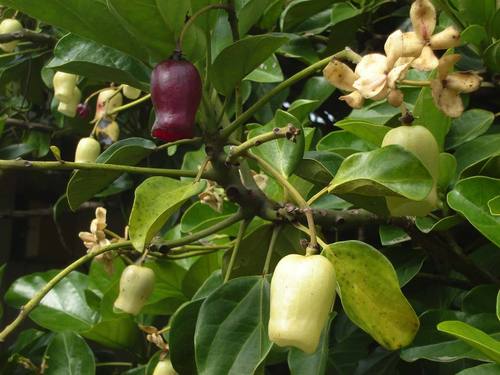
(c) Stefan Dressler, some rights reserved (CC BY-NC-SA)
iNaturalist· cc-by-nc
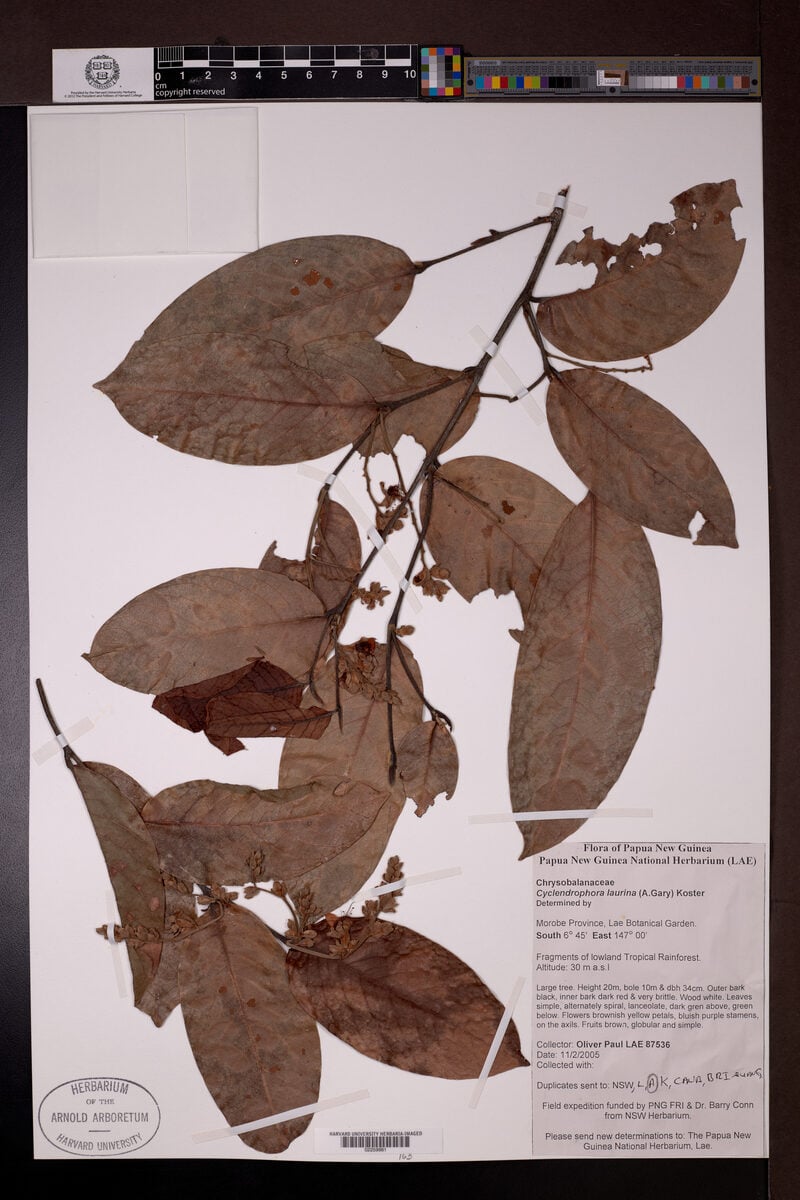
(c) Linda Loffler, some rights reserved (CC BY-NC), uploaded by Linda Loffler
iNaturalist· cc-by
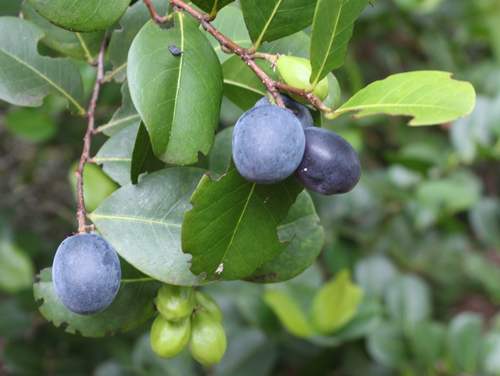
(c) Brian Gratwicke, some rights reserved (CC BY)
Summary
Source: WikipediaParinari curatellifolia (Bambara: Tutu; Yoruba: Ìdòfún) is an evergreen tropical tree of Africa, found in various types of deciduous woodland most frequently in poorly drained areas and inland at moderate altitudes. It is also known as mmupudu (by Tswana-speaking South Africans), mupundu or mobola plum after the fruit, which is considered tasty and causes the tree to be spared when woodland is cleared for cultivation. It grows in the Guinea Savanna region of West Africa, from Senegal across to Chad, then in seasonal woodland across the equator through Kenya and the eastern side of the continent, and from there in deciduous Miombo woodland inland to Zambia and Zimbabwe. Its southernmost reach is just outside the tropics in South Africa, at about 25°S.
Description
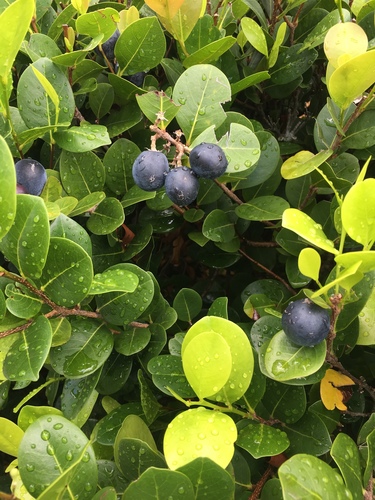
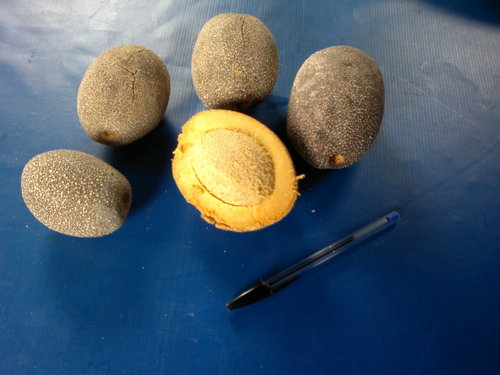
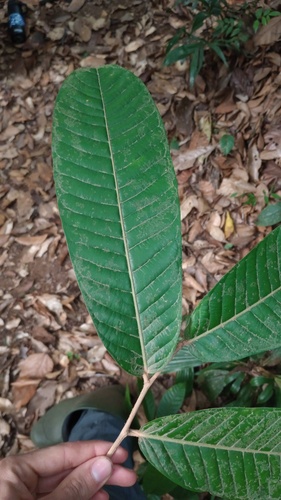
A tree that grows up to 12-20 m tall. The trunk is clean. The bark is rough and fire resistant. The young branches are hairy. The leaves are simple and oblong. They are 4-11 cm long by 2-5 cm wide. They narrow towards the base. The upper surfac e is shiny dark green and the lower surface is dull and covered with felt. The veins are conspicuous and run straight to the edge of the leaf. The flower buds occur in sprays at the ends of the branches. The flowers are pale green and have a strong sweet scent. The fruit are 2.5-4 cm long. They are olive green covered with rough grey spots. They become yellowish-red when ripe. The flesh of the fruit clings to the kernel. The fruit are edible. There are 2 subspecies.
Edible Uses
The fruit is eaten raw or cooked. It has a dry but delicious, strawberry-like flesh that is somewhat astringent and is considered one of the best wild fruits of the region. It is at its best after being stored for a few days until thoroughly ripe. The russet-yellow, ovoid fruit is 3–5cm in diameter and has a high content of protein and vitamin C. Ripe fruits can be pounded with water and the resulting liquid thickened with flour to make a gruel known as 'phala la maula'. A soft drink is prepared by peeling ripe fruits and soaking them in warm water. The fruit also makes a good jam. The seeds are an excellent substitute for almonds and are often roasted; they can also be pounded and used in soups. Seeds contain about 40% oil (70% in the kernels), which is extracted for cooking by drying, roasting, and crushing the seeds, then boiling them in water, allowing the liquid to cool, and skimming off the oil.
Traditional Uses
The fruit are eaten. The fruit are gathered after they fall. The skin and seeds are discarded but the pulp eaten. The fruit are used to make drinks - both intoxicating and non intoxicating. The seeds are used for flavouring and as raw nuts. They are also pounded for soup.
Medicinal Uses
The root is highly valued medicinally. An infusion of the roots is used to treat toothache. A hot fomentation of the bark treats pneumonia. A leaf decoction is either drunk or used in a bath as a remedy for fevers. Crushed or pulped leaves are applied as a dressing for fractures or dislocations, and for wounds, sores, and cuts.
Known Hazards
None mentioned.
Distribution
A tropical plant. It is native to tropical Africa. It is common on sandy soils and in open deciduous woodland. It is very sensitive to frost and cold. It grows in areas with an annual rainfall between 700-1,500 mm. It is often in poorly drained soils with a high water table. Plants can re-grow after fire. It grows in areas between sea level and 2,100 m above sea level. It can grow in arid places. It grows in Miombo woodland in Africa.
Where It Grows
Africa, Angola, Benin, Botswana, Burkina Faso, Burundi, Cameroon, Central Africa, Central African Republic, CAR, Chad, Congo DR, Côte d'Ivoire, East Africa, Eswatini, Gambia, Ghana, Guinea, Guinée, Guinea-Bissau, Ivory Coast, Kenya, Liberia, Madagascar, Malawi, Mali, Mozambique, Namibia, Niger, Nigeria, Rwanda, Sahel, Senegal, Seychelles, Sierra Leone, South Africa, Southern Africa, South Sudan, Sudan, Swaziland, Tanzania, Togo, Uganda, West Africa, Zambia, Zimbabwe,
Cultivation
Plants can be grown from seeds. Seeds should be collected fresh from fruit on the tree. The flesh is removed and the seeds dried in the shade. The seeds are sown shallowly. The seedlings need to be transplanted carefully to avoid damage to the taproot. They can be transplanted after 2 years.
Propagation
Seed remains viable in normal storage for at least 4 years. Sow in river sand in flat seed trays, pressing seeds level with the soil surface and covering with a thin layer of sand. Germination is very poor and prolonged, beginning after about 5 weeks. Transplant seedlings at the 3-leaf stage, taking care not to damage the taproot. Plant out when seedlings are about 30cm tall. The plant also spreads by root suckers.
Other Uses
The bark contains tannins and is used as a dye in basket making. Seeds yield around 38% oil used in making paint, varnish, and soap. Twigs are used as chew sticks to keep teeth and gums clean and healthy. The pale-brown to yellow-red wood is hard, durable, and heavy but high in silica, making it somewhat difficult to saw and plane. It is strongly fire resistant and is used for fine woodwork, building, furniture, poles, dugout canoes, and mortars. The wood is also used for fuel and makes good charcoal. The tree is an important source of forage for bees.
Production
Trees from seed can reach 3.9 m after 9 years. Fruit production often only occurs every second year. Fruit matures in 250 days.
Other Information
An attractive popular fruit. It is commonly used in West Africa. Fruit tend to be available in the drier more hungry season.
Notes
There are about 50 Parinari species. They grow in the tropics.
Nutrition
| Part | Moisture | kJ | kcal | Protein | Vit A | Vit C | Iron | Zinc |
|---|---|---|---|---|---|---|---|---|
| Nuts | 2.6 | 2737 | 655 | 28.7 | — | — | 5.5 | 3.1 |
| Fruit | 64.6 | 533 | 128 | 1.6 | — | 70.9 | 0.9 | 0.4 |
| Fruit | 75.4 | 353 | 84 | 0.7 | — | — | — | — |
Synonyms
Also Known As
Amabuye, Amanazi, Angili, Bosapple, Bua-ikuna, Cork tree, Goro soulabe, Grys apple, Hacha, Hissing tree, Kele, Mah'ulu, Mampara-djom-ae, Maula, Mbula, Mbulwa, Mbura, Mmola, Mpembu, Mphola, Msavula, Msawula, Mubola, Mubula, Mubuni, Muchacha, Muchakata, Muhacha, Muhatja, Muisha, Mujakata, Mukumbu, Mula, Munazi, Mupunda, Mupundu, Mushacata, Mutopio, Mutubi, Muvhula, Muwula, N'tupiu, Nahude, Naji, Ntja, Omoraa, Piinobga, Sand apple, Tela, Tonkorogoro, Toutou, Tubi, Tupi, Umkhuna, Umunazi
References (84)
- Akinnifesi, F. K., et al, 2006, Towards the development of Miombo fruit trees as commercial crops in Southern Africa. Forests, Trees and Livelihoods. Vol. 16 pp 1-3-121
- Alyegba, S. S. et al, 2013, Ethnobotanical Survey of Edible Wild Plants in Tiv Communities of Benue State, Nigeria. Journal of Natural Sciences Research. Vol.3, No.7
- Ambe, G., 2001, Les fruits sauvages comestibles des savanes guinéennes de Côte-d’Ivoire : état de la connaissance par une population locale, les Malinké. Biotechnol. Agron. Soc. Environ. 5(1), 43-48
- Atato, A., et al, 2010, Diversity of Edible Wild Fruit Tree Species of Togo. Global Science Books.
- Atato, A.,et al, 2011, Edible Wild Fruit Highly Consumed during Food Shortage Period in Togo: State of Knowledge and Conservation Status. Journal of Life Sciences 5 (2011) 1046-1057
Show all 84 references Hide references
- Baidu-Forson, J.J., et al ,2014,. Assessment of agrobiodiversity resources in the Borotse flood plain, Zambia. CGIAR Research Program on Aquatic Agricultural Systems. Penang, Malaysia. Working Paper: AAS-2014-12.
- Batawila, K., et al, 2007, Diversite et gestion des legumes de cueillete au Togo. African Journal of Food, Agriculture, Nutrition and Development 7( 3& 4): 65
- Barwick, M., 2004, Tropical and Subtropical Trees. A Worldwide Encyclopedic Guide. Thames and Hudson p 309
- Belem, B., et al, 2007, Use of Non Wood Forest Products by local people bordering the “Parc National Kaboré Tambi”, Burkina Faso. The Journal of Transdisciplinary Environmental Studies vol. 6, no. 1 p 9
- Belem, M., et al, 2017, Strategy of Conservation and Protection of Wild Edible Plants Diversity in Burkina Faso. ANADOLU 27 (2) 2017, 82- 90
- Bigirimana, C., et al, 2016, Utilisation of Indigenous Fruit Tree Species within the Lake Victoria Basin, Rwanda. Agricultural Science: An International Journal. (AGRIJ) Vol. 1, No. 1
- Bonou, A., et al, 2013, Valeur economique des Produits Forestiers Non Ligneux (PFNL) au Benin. Editions Universitaires Europeennes p 95
- Bruschi, P., et al, 2014, Traditional use of plants in a rural community of Mozambique and possible links with Miombo degradation and harvesting sustainability. Journal of Ethnobiology and Ethnomedicine. 2014, 10:59
- Burkill, H. M., 1985, The useful plants of west tropical Africa, Vol. 1. Kew. (not subspecies)
- Bvenura, C. & Sivakumar, D., 2017, The role of wild fruits and vegetables in delivering a balanced and healthy diet. Food Research International 99 (2017) 15–30
- Campbell, B. M., 1987, The Use of Wild Fruits in Zimbabwe. Economic Botany 41(3): 375-385
- CROSS-UPCOTT, (As Parinarium curataellifolium)
- Dalziel, J. M., 1937, The Useful plants of west tropical Africa. Crown Agents for the Colonies London.
- Davis, S.D., Heywood, V.H., & Hamilton, A.C. (eds), 1994, Centres of plant Diversity. WWF. Vol 1. p 244 (As Parinarium curataellifolium)
- Diarra, N. et al, 2016, Etude ethnobotanique des plantes alimentaires utilisées en période de soudure dans les régions Sud du Mali. Int. J. Biol. Chem. Sci. 10(1): 184-197
- Drummond, R. B., 1981, Common Trees of the Central Watershed Woodlands of Zimbabwe, National Herbarium Salisbury. p 40
- FAO. 1983, Food and fruit-bearing forest species 1: Examples from Eastern Africa. FAO Food and Forestry Paper 44/1 p 83
- FAO, 1988, Traditional Food Plants, FAO Food and Nutrition Paper 42. FAO Rome p 384
- Flowerdew, B., 2000, Complete Fruit Book. Kyle Cathie Ltd., London. p 245 (As Parinarium curataellifolium)
- Fowler, D. G., 2007, Zambian Plants: Their Vernacular Names and Uses. Kew. p 18
- Fl. trop. Afr. 2:368. 1871 (As Parinari mobola)
- Fox, F. W. & Young, M. E. N., 1982, Food from the Veld. Delta Books. p 154
- Gilbert, T., et al, 2017, Diversity and local transformation of indigenous edible fruits in sahelian domain of Cameroon. Journal of Animal & Plant Sciences Vol. 26 (2): 5289-5300
- Goode, P., 1989, Edible Plants of Uganda. FAO p 41
- Grivetti, L. E., 1980, Agricultural development: present and potential role of edible wild plants. Part 2: Sub-Saharan Africa, Report to the Department of State Agency for International Development. p 45, 47
- Hauman, L., 1952, Flore du Congo Belge et du Ruanda-Urundi: Rosaceae. vol. 3, (As Parinari mobola)
- Heubach, K., 2011, The socio-economic importance of non-timber forest products for rural livelihoods in West African savanna ecosystems: current status and future trends. PhD dissertation. Johann Wolfgang Goethe-Universitat. Frankfurt
- Heywood, V.H., Brummitt, R.K., Culham, A., and Seberg, O. 2007, Flowering Plant Families of the World. Royal Botanical Gardens, Kew. p 99
- Hines, D. A. & Eckman, K., 1993, Indigenous multipurpose trees of Tanzania: Uses and economic benefits for people. FAO Forestry Department. p 195
- INFOODS:FAO/INFOODS Databases
- Jardin, C., 1970, List of Foods Used In Africa, FAO Nutrition Information Document Series No 2.p 35, 152 (Also as Parinari mobola)
- Jardin, C., 1970, List of Foods Used In Africa, FAO Nutrition Information Document Series No 2.p 152 (As Parinari curatellifolia subsp. mobola)
- Joulan, D., et al, 2004, Volatile Flavor Constituents of Fruits from southern Africa: Mobola Plum (Parinari curatellifolia). Journal of Agricultural and Food Composition 52: 2322-2325
- Katende, A.B., Birnie, A & Tengnas B., 1995, Useful Trees and Shrubs for Uganda. Identification, Propagation and Management for Agricultural and Pastoral Communities. Technical handbook No 10. Regional Soil Conservation Unit, Nairobi, Kenya. p 474
- Kew Bull. 12:229. 1957
- Magwede, K., van Wyk, B.-E., & van Wyk, A. E., 2019, An inventory of Vhavenḓa useful plants. South African Journal of Botany 122 (2019) 57–89
- Malaisse, F., 1997, Se nourrir en floret claire africaine. Approche ecologique et nutritionnelle. CTA., p 65
- Mangambu Mokoso Jean De Dieu, et al, 2015, Etudes ethnobotanique et ethnolinguistique des ressources forestieres ligneuses utilisees par la population du coulour Ecologique du Parc National de Kahuzi-biega (R. D. Congo). European Journal of Scientific Research May 2015.
- Mannheimer, C. A. & Curtis. B.A. (eds), 2009, Le Roux and Muller's Field Guide to the Trees and Shrubs of Namibia. Windhoek: Macmillan Education Namibia. p 74
- Maroyi, A., 2011, The Gathering and Consumption of Wild Edible Plants in Nhema Communal Area, Midlands Province, Zimbabwe. Ecology of Food and Nutrition 50:6, 506-525
- Maroyi, A. & Cheikhyoussef, A., 2017, Traditional knowledge of wild edible fruit in southern Africa: A comparative use patterns in Namibia and Zimbabwe. Indian Journal of Traditional Knowledge. 16(3): 385-392
- Martin, F. W., et al, 1987, Perennial Edible Fruits of the Tropics. USDA Handbook 642 p 24
- Mashile, S. P., et al, 2019, Indigenous fruit plants species of the Mapulana of Ehlanzeni district in Mpumalanga province, South Africa. South African Journal of Botany 122 (2019) 180–183
- Maundu, P. et al, 1999, Traditional Food Plants of Kenya. National Museum of Kenya. 288p
- Mbuya, L.P., Msanga, H.P., Ruffo, C.K., Birnie, A & Tengnas, B., 1994, Useful Trees and Shrubs for Tanzania. Regional Soil Conservation Unit. Technical Handbook No 6. p 378
- Menninger, E.A., 1977, Edible Nuts of the World. Horticultural Books. Florida p 59
- Mokganya, M. G. et al, 2018, An evaluation of additional uses of some wild edible fruit plants of the Vhembe District Municipality in the Limpopo Province, South Africa. Indian Journal of Traditional Knowledge. Vol 17(2) April 2018, pp 276-281
- Moksia, F., et al, 2019, Diversity and Socio-Economic Value of Wild Edible Plants in the Mounts Mandara Region, Cameroon. International Journal of Sciences. Vol. 8:10
- Mpasiwakomu, R. A., 2017, The Diversity and Utilization of Wild Edible and Medicinal Plant Species found in Uvinza Miombo Woodlands, Tanzania. M. Sc. thesis University of Tanzania.
- Mutie, F. M., et al, 2023, Important Medicinal and Food Taxa (Orders and Families) in Kenya, Based on Three Quantitative Approaches. Plants 2023, 12, 1145
- Njana, M. A., et al, 2013, Are miombo woodlands vital to livelihoods of rural households? Evidence from Urumwa and surrounding communities, Tabora, Tanzania. Forests, Trees and Livelihoods, 22:2, 124-140
- Ouoba, P. et al, 2006, Fruit potential of the classified Niangoloko's forest in Burkina Faso. Fruits Vol. 61(1) pp 71-81
- Palgrave, K.C., 1996, Trees of Southern Africa. Struik Publishers. p 211
- Palmer, E and Pitman, N., 1972, Trees of Southern Africa. Vol. 1. A.A. Balkema, Cape Town p 681
- Peters, C. R., O'Brien, E. M., and Drummond, R.B., 1992, Edible Wild plants of Sub-saharan Africa. Kew. p 83
- Prance, G. T. & Sothers, C., 2003, Species Plantarum - Flora of the World. Chrysobalanaceae. p 205
- Prins, H. & Maghembe, J. A., 1994, Germination studies on seed of fruit trees indigenous to Malawi. Forest Ecology and Management 64:111-125
- Royal Botanic Gardens, Kew (1999). Survey of Economic Plants for Arid and Semi-Arid Lands (SEPASAL) database. Published on the Internet; http://www.rbgkew.org.uk/ceb/sepasal/internet [Accessed 10th April 2011]
- Ruffo, C. K., Birnie, A. & Tengnas, B., 2002, Edible Wild Plants of Tanzania. RELMA p 508
- Ruiters-Welcome, A. K., 2019, Food plants of southern Africa. Ph.D. thesis. Univ. of Johannesburg p 44
- Schatz, G.E., 2001, Generic Tree Flora of Madagascar. Royal Botanical Gardens, Kew and Missouri Botanical Garden. p 109
- Schmidt, E., Lotter, M., & McCleland, W., 2007, Trees and shrubs of Mpumalanga and Kruger National Park. Jacana Media p 140
- Swaziland's Flora Database http://www.sntc.org.sz/flora
- The Digital Flora of Central Africa, 2013, (Democratic Republic of Congo, Rwanda & Burundi) Botanical Garden Meise (As Parinari mobola)
- Tredgold, M.H., 1986, Food Plants of Zimbabwe. Mambo Press. p 115
- van Wyk, Be., & Gericke, N., 2007, People's plants. A Guide to Useful Plants of Southern Africa. Briza. p 52
- van Wyk, B, van Wyk, P, and van Wyk B., 2000, Photographic guide to Trees of Southern Africa. Briza. p 10, 226
- Van Wyk, Br. and van Wyk P., 2009, Field Guide to Trees of Southern Africa. Struik Nature. p 100
- van Wyk, B-E., 2011, The potential of South African plants in the development of new food and beverage products. South African Journal of Botany 77 (2011) 857–868
- Venter, F & J., 2009, Making the most of Indigenous Trees. Briza. p 226
- Vivien, J., & Faure, J.J., 1996, Fruitiers Sauvages d'Afrique. Especes du Cameroun. CTA p 116
- Walsh, M., 2009, The Use of Wild and Cultivated Plants as famine Foods on Pemba Island, Zanzibar. Études océan Indien. 42-43
- Wehmeyer, A. S, 1986, Edible Wild Plants of Southern Africa. Data on the Nutrient Contents of over 300 species
- Welcome, A. K. & Van Wyk, B.-E., 2019, An inventory and analysis of the food plants of southern Africa. South African Journal of Botany 122 (2019) 136–179
- Wickens, G.E., 1995, Edible Nuts. FAO Non-wood forest products. FAO, Rome. p 115
- Williamson, J., 2005, Useful Plants of Malawi. 3rd. Edition. Mdadzi Book Trust. p 187
- World Checklist of Useful Plant Species 2020. Royal Botanic Gardens, Kew
- www.worldagroforestrycentre.org/treedb/
- www.zimbabweflora.co.zw 2011