Calophyllum soulattri
Burm.f.
Nicobar canoe tree, Soulattri tree
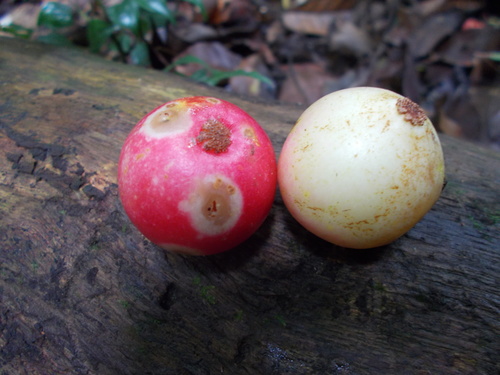
iNaturalist· cc-by-nc-sa
(c) 106611639464075912591, some rights reserved (CC BY-NC-SA), uploaded by 106611639464075912591
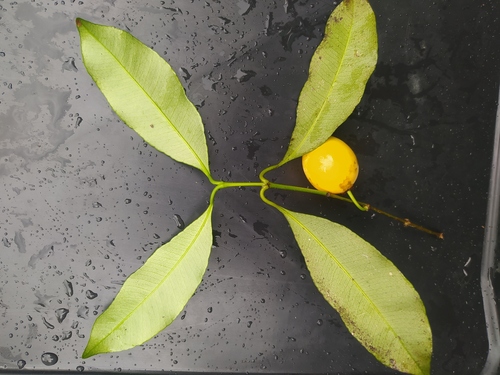
iNaturalist· cc-by-nc
(c) Natural Locasian, some rights reserved (CC BY-NC), uploaded by Natural Locasian
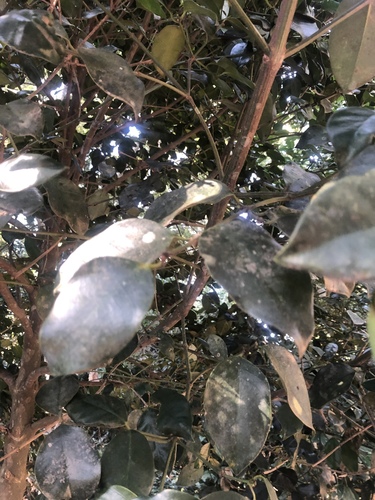
iNaturalist· cc-by-nc
(c) HP Lim, some rights reserved (CC BY-NC), uploaded by HP Lim
Summary
Source: WikipediaCalophyllum soulattri is a species of flowering plant in the Calophyllaceae family. It is found in the Northern Territory of Australia, Brunei, Cambodia, India, Indonesia, Malaysia, the Philippines, Singapore, Sri Lanka, Thailand, and Vietnam. It is considered one of the best bintangor timber species.
Description
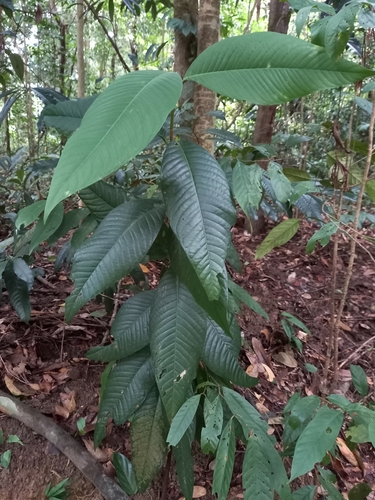
A tree up to 26 m high. The stems have white to yellow latex. The trunk is 30-70 cm across. The leaves are opposite and simple. They are 7-29 cm long by 2-10 cm wide. The flowers are 1 cm across. They are white. There are 7-20 flowers in a cluster. The fruit are dark bluish black. They are 1 cm across.
Edible Uses
Fruit - sour. The somewhat sour fruits can be eaten, but if eaten in excess they cause severe stomach-ache and diarrhoea. The more or less spherical fruit is up to 16mm in diameter.
Traditional Uses
The fruit are sour but can be eaten.
This uses section is brief — help expand it
Medicinal Uses
An infusion of the root is rubbed on to affected areas in order to alleviate rheumatic pain. Fresh bark from the shoots is used as medicine for women who have just given birth. The oil obtained from the seed is used externally in the treatment of rheumatism and skin infections. Injected into the muscles, the refined oil relieves the pain in leprosy.
Known Hazards
The latex in the plant has been used to poison dogs.
Distribution
A tropical plant. It grows in lowland rainforest. It occurs at 465 m altitude. It grows between sea level and 1220 m altitude. It does best in well drained places.
Where It Grows
Andamans, Asia, Australia, Brunei, Cambodia, Central America, East Timor, India, Indochina, Indonesia, Malaysia, Micronesia, Myanmar, Nicobar, Pacific, Palau, Panama, Papua New Guinea, PNG, Philippines, SE Asia, Singapore, Solomon Islands, Sri Lanka, Thailand, Timor-Leste, Vietnam,
Cultivation
Plants can be grown by seeds.
Other Uses
Oil can be extracted from the seeds by heating them either cut and with water or finely crushed. The oil contains resin; the purified oil contains approximately 49.7% oleic acid, 23.8% linoleic acid, 16.8% palmitic acid, and 9.7% stearic acid. It is used in soap making and is important as an illuminant. In parts of Oceania the oil is used to anoint the body, as either a substitute for, or a pleasant-smelling additive to, coconut oil. Mixed with the resin of Vateria spp, the oil is used for caulking boats. The leaves are reported to make a durable thatch. The light-red wood is cross-grained, moderately hard, durable, elastic, easily worked. The wood is not very durable. It is used for masts, spars, construction and planking.
Notes
There are about 187-200 Calophyllum species. They are evergreen trees of the tropics.
Synonyms
Also Known As
Bangkit, Bintagor, Bitangoor boonot, Cong trang, Dakartalada, Lalchuni, Malang-malang, Membaloong, Mintak, Pampiyaka, Pan-taga, Pohon bintangur sulatri, Tharapi
References (15)
- Ambasta S.P. (Ed.), 2000, The Useful Plants of India. CSIR India. p 98
- Bircher, A. G. & Bircher, W. H., 2000, Encyclopedia of Fruit Trees and Edible Flowering Plants in Egypt and the Subtropics. AUC Press. p 74
- Chai, P. P. K. (Ed), et al, 2000, A checklist of Flora, Fauna, Food and Medicinal Plants. Lanjak Entimau Wildlife Sanctuary, Sarawak. Forestry Malaysia & ITTO. p 166
- Chaudhury, R.H.N., et al, 1980, Ethnobotanical Uses of Herbaria - 2. J. Econ, Tax Bot Vol 1 p 166 (As Calophyllum spectabile)
- Conn, B.J., (Ed.) 1995, Handbooks of the Flora of Papua New Guinea. Vol 3. Melbourne University Press. p 103
Show all 15 references Hide references
- Conn, B. & Damas, K.. Guide to trees of Papua New Guinea. http:/www.pngplants.org/PNGtrees
- Cowie, I, 2006, A Survey of Flora and vegetation of the proposed Jaco-Tutuala-Lore National Park. Timor-Lests (East Timor) www.territorystories.nt/gov.au p 45
- Fl. indica 121. 1768
- Moon, H. K., et al, 2010, Tropical Tree of Indonesia. Korea Forest Research Institute. p 52
- Slik, F., www.asianplant.net
- Soerianegara, I. & Lemmens, R. H. M. L., (Eds.) 1993, Timber trees: Major commercial timbers. Plant Resources of South-East Asia. Wageningen. No. 5(1). p 130
- Sukarya, D. G., (Ed.) 2013, 3,500 Plant Species of the Botanic Gardens of Indonesia. LIPI p 173
- Tiwi Plants and Animals. 2001, Aboriginal flora and fauna knowledge from Bathurst and Melville Islands, northern Australia. Northern Territory Botanical Bulletin; No. 24 p 33
- Trimanto, & Hapsari L., 2016, Botanical survey in thirteen montane forests of Bawean Island Nature Reserve, East Java Indonesia: Conservation status, bioprospecting and potential tourism. Biodiversitas 17: 832-846.
- World Checklist of Useful Plant Species 2020. Royal Botanic Gardens, Kew