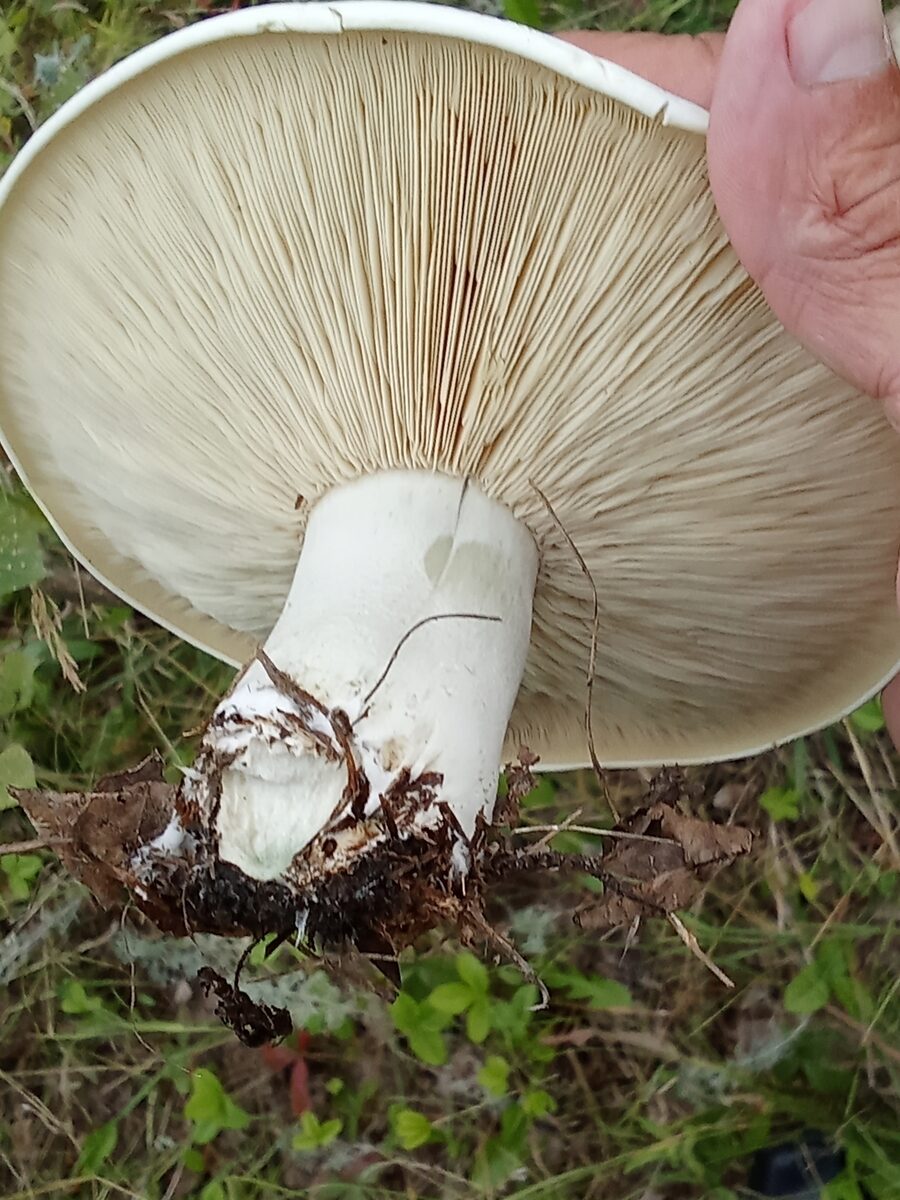
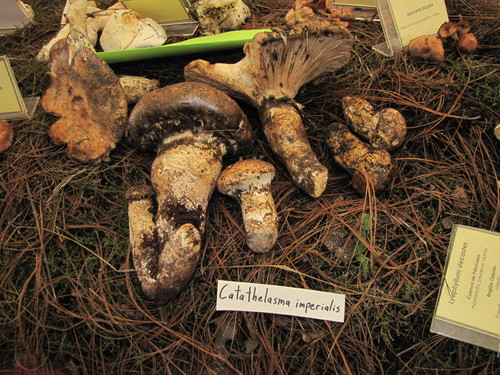
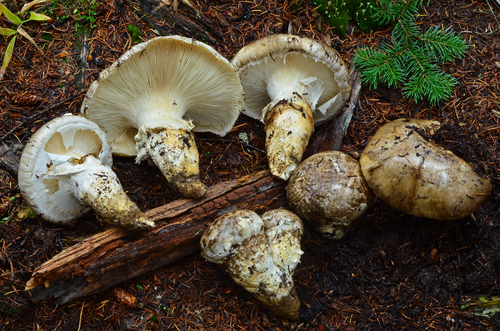
Calocybe gambosa
(Fr.: Fr.) Donk
Prugnolo, St George's mushroom
iNaturalist· cc-by
(c) Davide Puddu, some rights reserved (CC BY), uploaded by Davide Puddu
iNaturalist· cc-by-nc
(c) timendez, some rights reserved (CC BY-NC), uploaded by timendez
iNaturalist· cc-by-nc-sa
(c) Harry Harms, some rights reserved (CC BY-NC-SA)
Summary
Source: WikipediaCalocybe gambosa, commonly known as St. George's mushroom, is a species of fungus. It was previously considered a part of large genus Tricholoma. Its common name is derived from Saint George's Day (23 April), around when it appears in the United Kingdom. The mushroom grows mainly in European grasslands. It is considered a delicacy in Europe.
Description
A mushroom.
This description is brief — help expand it
Edible Uses
The mushroom is best picked in dry weather. Although it resembles some poisonous species, it can be eaten cooked, pickled, and evidently raw. The species is imported in commercial quantities from Romania, Hungary, and Turkey. It was held in high esteem in medieval Italy, reported by Costanzo Felici in 1569 as the most expensive and highly regarded mushroom in Umbria and Marches in central Italy. It was also held in high esteem in the Apennine Mountains region—Liguria, Tuscany, and Emilia-Romagna)—by Giovanni Targioni Tozzetti in 1777. It is still locally eaten in Emilia-Romagna and Tuscany. St. George's mushroom is highly prized in the Basque Country of northern Spain, where it fetches very high prices. In Álava, it is traditionally eaten on the feast of Saint Prudentius (28 April), alongside snails. The mushroom is also a cornerstone of the gastronomy of Bilbao, where it is typically eaten in an omelette. The demand in the Basque Country is so high the mushroom has to be imported from Eastern Europe.
Traditional Uses
The caps are roasted or stewed.
This uses section is brief — help expand it
Distribution
It is a temperate plant.
Where It Grows
Andorra, Armenia, Asia, Balkans, Britain, Bulgaria, Caucasus, China, Czech Republic, Europe, Finland, Hungary, India, Italy, Japan, Korea, Mediterranean, Russia, Scandinavia, Slovenia, Spain,
Other Information
It is sold in local markets.
Notes
There are about 40 Calocybe species.
Nutrition
| Part | Moisture | kJ | kcal | Protein | Vit A | Vit C | Iron | Zinc |
|---|---|---|---|---|---|---|---|---|
| Mushroom | 74.9 | — | — | 55.1 | — | — | — | — |
Synonyms
Also Known As
Garan dmak, Shaeqasunk, Xiangxing koumo
References (14)
- Boa, E. R., Wild edible fungi and their importance to people. FAO Non Wood Forest Products Booklet 17
- Cerne, M., 1992, Wild Plants from Slovenia used as Vegetables. Acta Horticulturae 318
- Cocchi, L. et al, 2006, Heavy metals in edible mushrooms in Italy. Food Chemistry 98: 277-284
- Hall, I. R., et al, 2003, Edible and Poisonous Mushrooms of the World. Timber Press. p 141, 315
- Jordan, P., 2000, The Mushroom Guide and Identifier, Hermes House, p 44
Show all 14 references Hide references
- Kalac, P. and Svoboda, L., 1999, A review of trace element concentrations in edible mushrooms. Food Chemistry 69: 273-281
- Kaufmann, B. et al, 1999, The Great Encyclopedia of Mushrooms. Konemann. p 96
- Nanagulyan, S., et al, 2020, Wild plants and fungi sold in the markets of Yerevan (Armenia). Journal of Ethnobiology and Ethnomedicine 16:26
- Pace, G., 1998, Mushrooms of the world. Firefly books. p 105 (As Lyophyllum georgii)
- Pieroni, A., 1999, Gathered wild food plants in the Upper Valley of the Serchio River (Garfagnana), Central Italy. Economic Botany 53(3) pp 327-341 (As Tricholoma georgii)
- Pieroni, A., et al, 2005, Food for two seasons: Culinary uses of non-cultivated local vegetables and mushrooms in a south Italian village. International Journal of Food Sciences and Nutrition, 56(4): 245-272 (As Tricholoma georgii)
- Stoyneva-Gartner, M.P. & Uzunov, B.A., 2015, An Ethnobiological Glance on Globalization Impact on the Traditional Use of Algae and Fungi as Food in Bulgaria. J Nutr Food Sci 2015, 5:5
- Vishwakarma, P., et al, 2016, Nutritional and antioxidant properties of wild edible macrofungi from North-Eastern Uttar Pradesh, India. Indian Journal of Traditional Knowledge. Vol. 15(1) pp. 143-148
- www.plantnames.unimelb.edu.au