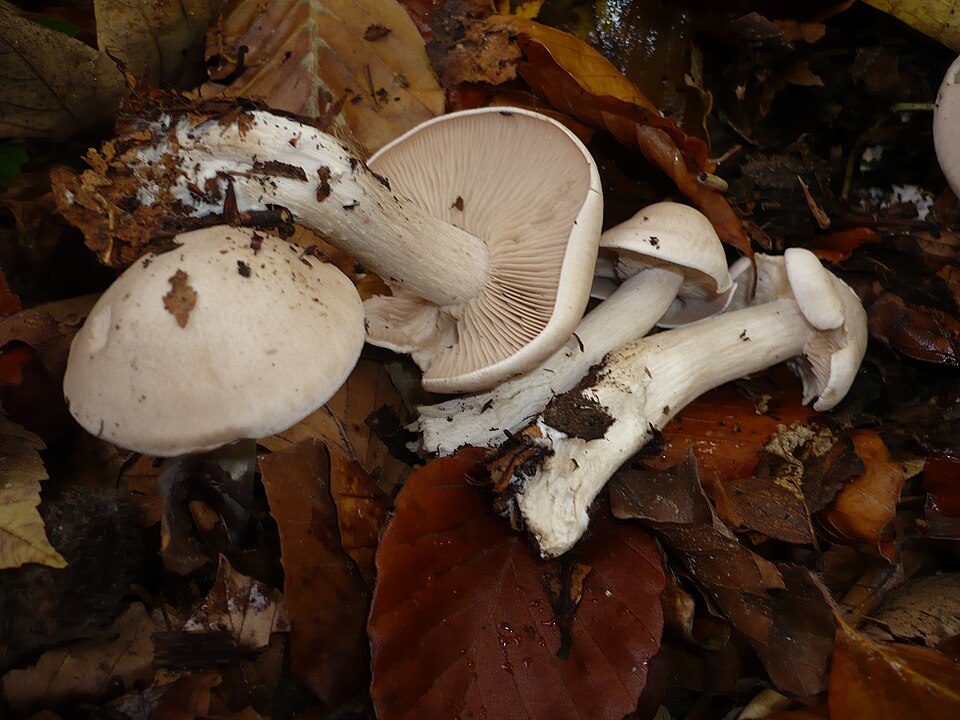
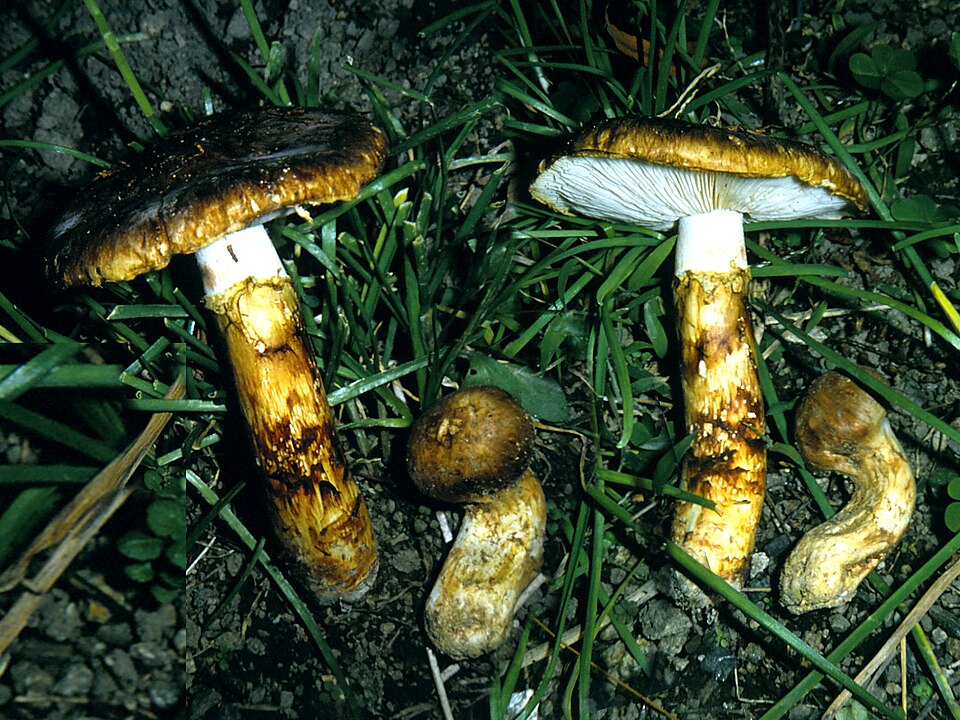
Armillaria mellea
(Vahl. :Fr.) Kummer
Boot-lace fungus, Honey mushroom
iNaturalist· cc-by-sa
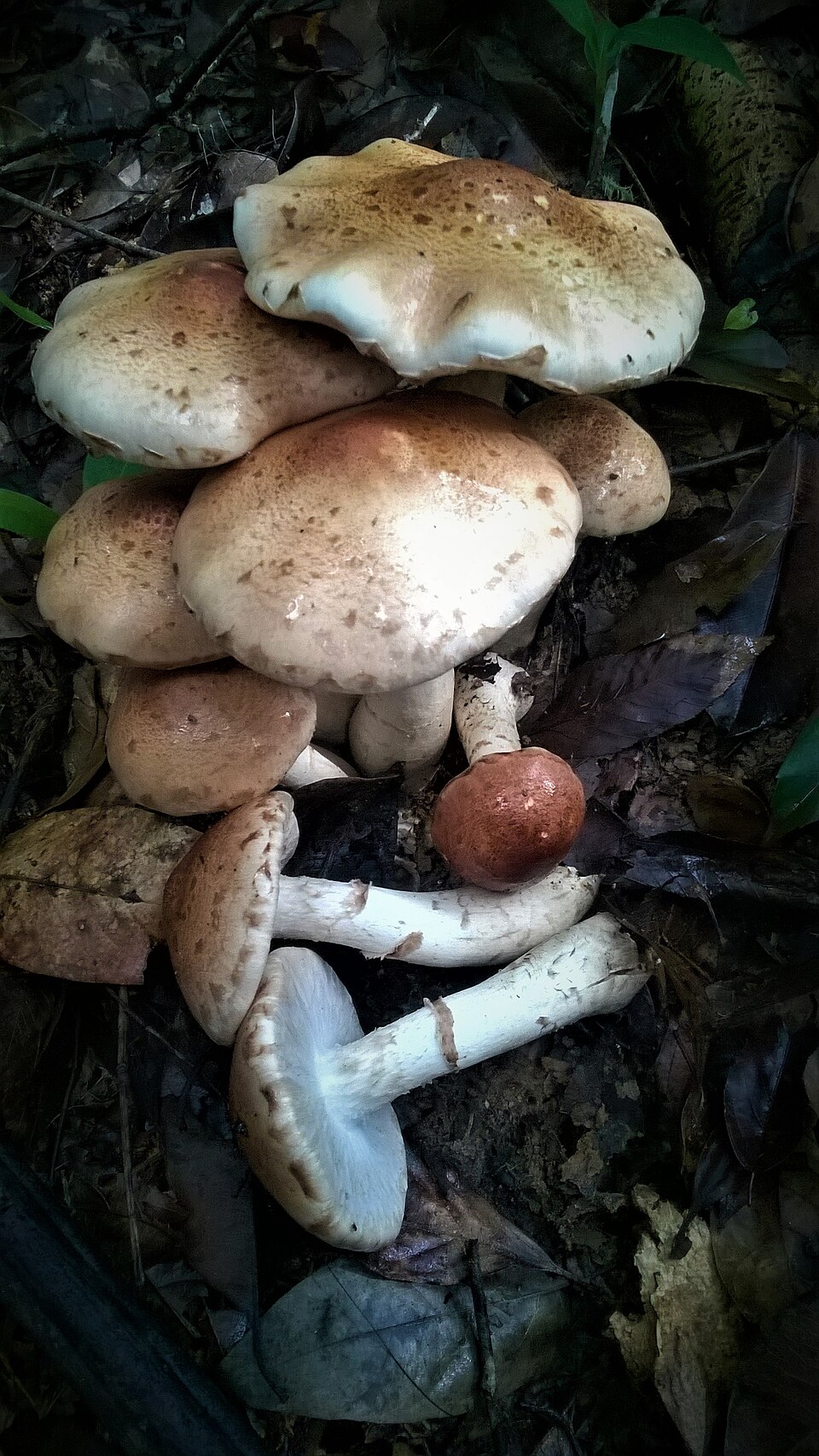
(c) Nathan Wilson, some rights reserved (CC BY-SA)
iNaturalist· cc-by
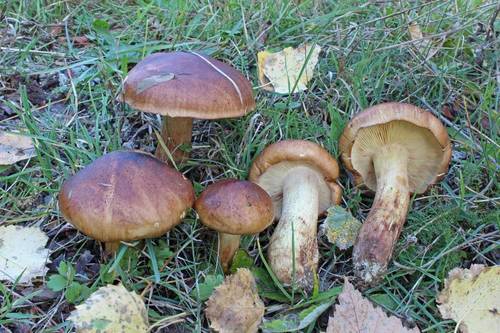
(c) Davide Puddu, some rights reserved (CC BY), uploaded by Davide Puddu
iNaturalist· cc-by-nc
(c) Jeff Skrentny, some rights reserved (CC BY-NC), uploaded by Jeff Skrentny
Summary
Source: WikipediaArmillaria mellea, commonly known as honey fungus, is an edible basidiomycete fungus in the genus Armillaria. It is a plant pathogen and part of a cryptic species complex of closely related and morphologically similar species. It causes Armillaria root rot in many plant species and produces mushrooms around the base of trees it has infected. The symptoms of infection appear in the crowns of infected trees as discoloured foliage, reduced growth, dieback of the branches and death. The mycelium is capable of producing light via bioluminescence. The mushroom is widely distributed in temperate regions of the Northern Hemisphere. It typically grows on hardwoods but may be found around and on other living and dead wood or in open areas.
Description
A mushroom. The mushroom is honey coloured. It has a thickened base and a ring when young.
This description is brief — help expand it
Edible Uses
Armillaria mellea is considered a good edible mushroom, but is not preferred by some, and the tough stalks are usually excluded. They are best collected when young and thoroughly cooked. Specimens such as those growing on buckeye or hemlock can cause gastrointestinal upset. The mushrooms have a taste that has been described as slightly sweet and nutty, with a texture ranging from chewy to crunchy, depending on the method of preparation. Parboiling mushrooms before consuming removes the bitter taste present in some specimens and may reduce the amount of gastrointestinal irritants. According to one guide, they must be cooked before eating. Drying the mushrooms preserves and intensifies their flavour, although reconstituted mushrooms tend to be tough to eat. The mushrooms can also be pickled and roasted. Different nutritional parameters of A. mellea, like protein, carbohydrate, fat, amino acid and crude have been studied. The fruit body contains large amounts of carbohydrates including polysaccharides such as glucans and glycogen, monosaccharides and disaccharides (such as trehalose), sugar, alcohols (such as manitol) and chitin. The mushroom is rich in protein and carbohydrate but is low amount of fat which could serve a proper diet for persons who sufferer from hypertension and atherosclerosis. Furthermore, due to the presence of high level of crude fiber it could help to control diabetes and obesity. The mushrooms also may have been used medicinally by indigenous peoples as a laxative.
Traditional Uses
The young caps or fruiting bodies are eaten cooked. They are also pickled, salted, dried, marinated, or added to soups. It needs to be well cooked, and the liquid secreted while cooking is discarded, as it is toxic. Some people can be intolerant to this fungus.
Distribution
It is a temperate plant. It grows in clumps on the roots of trees and dead stumps.
Where It Grows
Africa, Alaska, Armenia, Asia, Balkans, Belarus, Bulgaria, Canada, Caucasus, Central America, Chile, China, Costa Rica, Czech Republic, East Africa, Europe, Finland, Georgia, Greece, Guatemala, Himalayas, Hong Kong, Hungary, India, Italy, Japan, Kosovo, Kyrgyzstan, Mediterranean, Mexico, Mozambique, Nepal, Nigeria, North America, Poland, Russia, Scandinavia, Slovenia, South Africa, South America, Southern Africa, Spain, Sweden, Tanzania, Tasmania, Turkey, Türkiye, Uganda, Ukraine, USA, West Africa,
Other Information
It is sold in local markets.
Dangerous Lookalikes
This plant can be confused with the following toxic species. Always verify identification carefully before consuming any wild plant.
Deadly Galerina (Funeral Bell)
Galerina marginata
Alan Rockefeller
Boot-lace fungus
Armillaria mellea
(c) Nathan Wilson, some rights reserved (CC BY-SA)
Deadly Galerina (Funeral Bell): Rusty-brown spore print, smooth brown cap, thin fragile ring, grows in smaller clusters, same deadly toxins as death cap.
Boot-lace fungus: White spore print, brown-black scales on cap, prominent white ring on stem, grows in large clusters.
Synonyms
Also Known As
Chiodini, Cottonwood mushroom, Honey fungus, Honungsskivling, Mantchkvala, Nara-take, Peke, Pike, Rangagno, Xopitza, Yema, Yemita, Zhenmo
References (44)
- Akata, I., et al, 2012, Chemical Composition and Antioxidant Activities of 16 Wild Edible Mushroom Species Grown in Anatolia. International Journal of Pharmacology 8(2): 134-138
- Alexopoulos, C.J., 1962, Introductory Mycology. Wiley Toppan. p 516 (As Armillaria mellea)
- Ambasta S.P. (Ed.), 2000, The Useful Plants of India. CSIR India. p 53
- Barreau, A., et al, 2016, How Can We Teach Our Children if We Cannot Access the Forest? Generational Change in Mapuche Knowledge of Wild Edible Plants in Andean Temperate Ecosystems of Chile. Journal of Ethnobiology 36(2): 412–432
- Boa, E. R., Wild edible fungi and their importance to people. FAO Non Wood Forest Products Booklet 17
Show all 44 references Hide references
- Bussman, R. W., et al, 2016, A comparative ethnobotany of Khevsureti, Samtskhe-Javakheti, Tusheti, Svaneti, and Racha-Lechkhumi, Republic of Georgia (Sakartvelo), Caucasus. Journal of Ethnobiology and Ethnomedicine (2016) 12:4
- Bussman, R. W. et al, 2017, Ethnobotany of Samtskhe-Javakheti, Sakartvelo (Republic of Georgia), Caucasus. Indian Journal of Traditional Knowledge Vol. 16(1) pp 7-24
- Bussman, R. W., et al, 2021, Unity in diversity—food plants and fungi of Sakartvelo (Republic of Georgia), Caucasus. Journal of Ethnobiology and Ethnomedicine (2021) 17:72 p 16
- Chestnut, 1902,
- Ciesla, W.M., 1998, Non-wood forest products from conifers. Non-wood forest products 12, FAO, Rome, p 91
- Christensen, M., et al, 2008, Collection and Use of Wild Edible Fungi in Nepal. Economic Botany, 62(1), 2008, pp. 12–23
- Cocchi, L. et al, 2006, Heavy metals in edible mushrooms in Italy. Food Chemistry 98: 277-284
- Cortes, L.E.U., et al, 2018, Ethnomycology and mushroom selling in a market from Northwest Puebla, México. Scientia Fungorum vol. 47: 47-55
- Daly, A. B., 20014, Narrating changing foodways: wild edible plant knowledge and traditional food systems in Mapuche lands of the Andean Temperate Forests, Chile. Masters Thesis Vancouver. p 45
- Denchev, C. M., et al, The wild edible mushrooms in Bulgaria. Bulgarian Academy of Science.
- Devkota, S., 2008, Distribution and Status of Highland mushrooms: A study from Dolpa, Nepal. J.Nat.Hist.Mus.Vol.23,2008, 51-59
- Dongol, et al, 1995, Edible Mushrooms in Nepal
- Estrada-Martinez, E., et al, 2009, Contribucion al conocimiento etnomicologico de los Hongos Comestibles Silvestres de Mercados Regionales y Comunidades de la Sierra Nevada (Mexico). Intercienca Jan 2009 Vol. 34 No. 1
- Facciola, S., 1998, Cornucopia 2: a Source Book of Edible Plants. Kampong Publications, p 25
- Fan, L., et al, The Use of Edible Wild Plants and Fungi in Korean-Chinese Villages. Journal of Environmental Information Science 44-5 p 71-79
- Gryzenhout, M., 2010, Mushrooms of South Africa. Pocket Guide. Struik. p 30
- Guild, B., 1979, The Alaskan Mushroom Hunter's Guide. Alaska Northwest Publishing Company. p 40
- Hall, I. R., et al, 2003, Edible and Poisonous Mushrooms of the World. Timber Press. p 137, 317
- http://www.mykoweb.com/CAF/edible.html
- Imai, 1938,
- Jordan, P., 2000, The Mushroom Guide and Identifier, Hermes House, p 36
- Kalac, P. and Svoboda, L., 1999, A review of trace element concentrations in edible mushrooms. Food Chemistry 69: 273-281
- Kasper-Pakosz, R., et al, 2016, Wild and native plants and mushrooms sold in the open-air markets of south- eastern Poland. Journal of Ethnobiology and Ethnomedicine 12:45
- Kaufmann, B. et al, 1999, The Great Encyclopedia of Mushrooms. Konemann. p 76
- Kiple, K.F. & Ornelas, K.C., (eds), 2000, The Cambridge World History of Food. CUP p 318, 1819
- Lentini, F. and Venza, F., 2007, Wild food plants of popular use in Sicily. J Ethnobiol Ethnomedicine. 3: 15 (As Armillaria mellea)
- Montoya, A., et al, 2003, Traditional Knowledge about Mushrooms in a Nahua Community in the State of Tlaxcala, Mexico. Mycologia 95(5) pp. 793-806
- Ouzouni, P. K., et al, 2009, Nutritional value and metal content of wild edible mushrooms collected from West Macedonia and Epirus, Greece. Food Chemistry 115: 1575-1580 (As Armillaria)
- Pace, G., 1998, Mushrooms of the world. Firefly books. p 110
- Perez-Moreno, J. et al, 2008, Wild Mushroom Markets in Central Mexico and a Case Study at Ozumba. Economic Botany, 62(3), 2008, pp. 425–436
- Pieroni, A., 1999, Gathered wild food plants in the Upper Valley of the Serchio River (Garfagnana), Central Italy. Economic Botany 53(3) pp 327-341
- Rila Monastery Nature Park Management Plan 2004 - 2013 (Bulgaria) p 380
- Schneider, E., 2001, Vegetables from Amaranth to Zucchini: The essential reference. HarperCollins. p 314
- Stryamets, N., et al, 2015, From economic survival to recreation: contemporary uses of wild food and medicine in rural Sweden, Ukraine and NW Russia. Journal of Ethnobiology and Ethnomedicine 11:53
- Stubbs, R. D., 1966, An investigation of the Edible and Medicinal Plants used by the Flathead Indians. MA thesis University of Montana. p 41
- Svanberg, I., & Lindh, H., 2019, Mushroom hunting and consumption in twenty-first century post-industrial Sweden. Journal of Ethnobiology and Ethnomedicine (2019) 15:42
- Tibuhwa, 2013, Wild Mushroom - an underutilized healthy food resource and income generator: experience from Tanzania rural areas. Journal of Ethnobiology and Ethnomedicine 9:49
- Vetner, J., 2004, Arsenic content of some edible mushroom species. Eur. Food Res. Technol. 219: 71-74
- www.plantnames.unimelb.edu.au