Illicium anisatum
L.
Japanese star anise, Chinese anise, Anise shrub
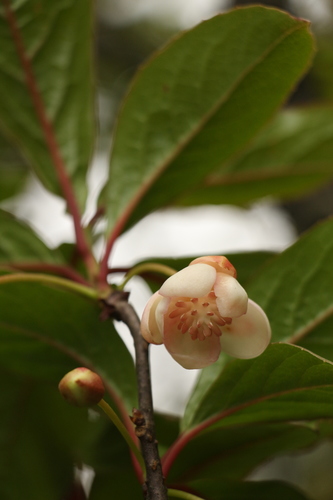
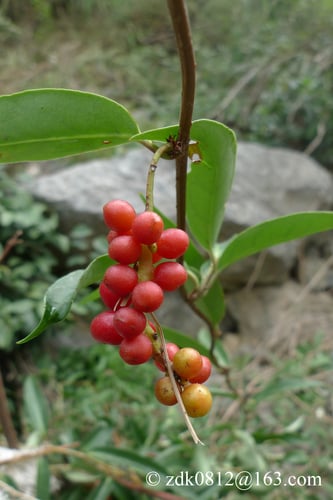
iNaturalist· cc-by-nc
(c) 羅元甫, some rights reserved (CC BY-NC), uploaded by 羅元甫
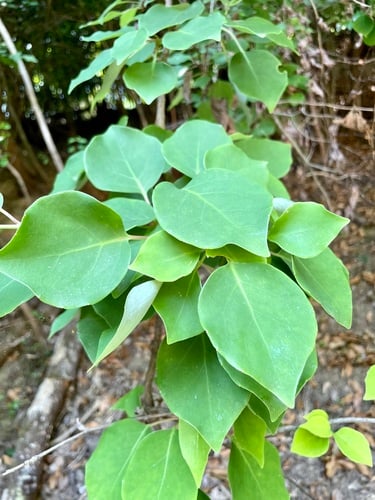
iNaturalist· cc-by-nc
(c) JODY HSIEH, some rights reserved (CC BY-NC), uploaded by JODY HSIEH
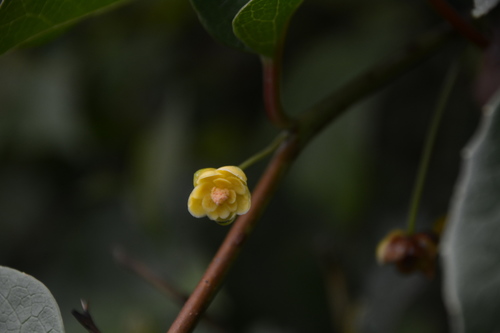
iNaturalist· cc-by-sa
(c) harum.koh, some rights reserved (CC BY-SA), uploaded by harum.koh
Summary
Source: WikipediaIllicium anisatum, with common names Japanese star anise, aniseed tree, and sacred anise tree, known in Japanese as shikimi (樒; シキミ), is an evergreen shrub or small tree closely related to the Chinese star anise (Illicium verum). Since it is highly toxic, the fruit is not edible; instead, the dried and powdered leaves are burned as incense in Japan. Its branches and evergreen leaves are considered highly sacred by Japanese Buddhists due to insects' aversion to them and their ability to remain fresh after pruning. The sacred anise tree is native to parts of east Asia including Japan, South Korea and Taiwan. It normally grows between 6–15 feet (1.8–4.6 m) with leaves that are simple, arranged alternately and oval in shape and about 1 to 3 in (2.5 to 7.6 cm)in length. Its cream or white colored flowers have numerous petals and are clustered around the leaf axils. Its fruit is a dry follicle similar to the Chinese star anise, but toxic, smaller and with a weaker odour, reputed to be more similar to the aroma of cardamom than to that of anise. Due to its poisonous nature, its seeds have been used as a fish poison as well as a natural agricultural pesticide and to repel animals from digging the grounds of Japanese graveyards. Its seeds have also been used medicinally to treat toothache and dermatitis topically, since it is unsuitable for internal use.
Description
An evergreen shrub. It is cone shaped. It grows 3-8 m high. The flowers are star shaped. They are greenish-yellow. The fruit are about 2-3 cm across. They are woody and star shaped.
Edible Uses
The fruit, which measures about 25mm in diameter, is used as a flavouring and is also chewed after meals to sweeten the breath. Some caution is advised, as it is said to be poisonous in quantity.
Traditional Uses
CAUTION: The fruit are poisonous. The alkaloids are concentrated in the seeds. These include sikimitoxin or anisatin. The oil is poisonous. Small quantities of fruit are used in flavouring. They are used to flavour coffee and tea.
Medicinal Uses
The fruit is carminative, stimulant and stomachic, used primarily to promote digestion and appetite and to relieve flatulence. It also serves as a useful additive to other medicines to improve their flavour. The leaves and seeds are antibacterial. The fruit additionally has diuretic and odontalgic properties.
Known Hazards
Japanese star anise contains anisatin, shikimin, and shikimitoxin, which cause severe inflammation of the kidneys, urinary tract, and digestive organs. Other compounds present in toxic species of Illicium are safrole and eugenol, which are not present in the edible Chinese star anise and are used to identify its toxicity. Shikimic acid, a substance also present in Japanese star anise, is so-called after the plant's Japanese name. Due to its morphological similarities, it is impossible to distinguish Chinese and Japanese star anise in dried or processed form by their appearance only, and can only be unequivocally determined by using botanical microscopy. This process must be done before the plants have been made into tea and dried out. Cases of product recalls have been reported when products containing star anise were found to be contaminated by Japanese anise. Cases of consumers admitted to hospital with neurological symptoms after ingesting excessive doses of star anise or smaller doses of products contaminated with Japanese anise have also occurred: In Europe, Chinese star anise tea is often used as a stress-relief tea. Cases of illness have been reported in France, Spain, and Switzerland after people were reported consuming Chinese star anise tea contaminated with Japanese star anise. This contamination hospitalized many people with epilepsy, hallucinations, and nausea all as a result of the toxin anisatin, found in the Japanese star anise. In 2001, there was a large outbreak of toxicity in the Netherlands due to accidental contamination of a tea blend containing more than 6 different tea plants with the Japanese star anise.
Distribution
It is a temperate plant. It needs a moist well-drained soil. It suits hardiness zones 7-11. Melbourne Botanical Gardens. Geelong Botanical Gardens. Hobart Botanical Gardens. Arboretum Tasmania.
Where It Grows
Asia, Australia, Britain, China, Europe, India, Indonesia, Japan*, Korea, Philippines, SE Asia, Taiwan, Tasmania,
Cultivation
Prefers a light, moist well-drained loam and a sheltered position. Prefers a humus-rich lime-free soil. Succeeds in sun or semi-shade. A slow-growing plant. This species is not very cold-hardy, it tolerates temperatures down to about -10°c but normally requires the protection of a wall in most of Britain. It succeeds outdoors in the mildest areas of the country. Star anise is a very ornamental and aromatic plant that is much planted near Buddhist shrines and temples in Japan. The plants have the scent of anise. All parts of the plant are pleasingly aromatic. The leaves release a powerful aromatic odour when touched and the flowers have a spicy odour. Plants seldom grow larger than about 2 metres in Britain, but are often 10 metres tall in their native habitat.
Propagation
Seed does not require pre-treatment and can be sown in early spring in a greenhouse. Prick out seedlings into individual pots when large enough to handle and grow on in the greenhouse for at least the first winter. Plant out in late spring or early summer after the last expected frosts, with some cold protection for the first year or two. Layering in early spring takes 18 months. Cuttings of half-ripe wood taken in August in a frame should be potted up once rooting begins and grown on in the greenhouse through their first winter, then planted out after the last expected frosts.
Other Uses
None known.
Production
It is quite slow growing.
Notes
There are 40 Illicium species. There are 3 species in tropical America. Also put in the family Illiciaceae. There is only one genus in the Illiciaceae.
Synonyms
Also Known As
Bunga lawang jepang, Shikimi, Sikimi noki
References (19)
- Ambasta S.P. (Ed.), 2000, The Useful Plants of India. CSIR India. p 284
- Bianchini, F., Corbetta, F., and Pistoia, M., 1975, Fruits of the Earth. Cassell. p 102
- Burkill, I.H., 1966, A Dictionary of the Economic Products of the Malay Peninsula. Ministry of Agriculture and Cooperatives, Kuala Lumpur, Malaysia. Vol 2 (I-Z) p 1242
- Cundall, P., (ed.), 2004, Gardening Australia: flora: the gardener's bible. ABC Books. p 732
- Etherington, K., & Imwold, D., (Eds), 2001, Botanica's Trees & Shrubs. The illustrated A-Z of over 8500 trees and shrubs. Random House, Australia. p 399
Show all 19 references Hide references
- Hedrick, U.P., 1919, (Ed.), Sturtevant's edible plants of the world. p 354
- Heywood, V.H., Brummitt, R.K., Culham, A., and Seberg, O. 2007, Flowering Plant Families of the World. Royal Botanical Gardens, Kew. p 174
- Hibbert, M., 2002, The Aussie Plant Finder 2002, Florilegium. p 146
- Lee, Y. M., 2014 Important Plants of East Asia II: Endemic Plant Stories. East Asia Biodiversity Conservation Network p 47
- Phillips, R. & Rix, M., 2002, The Botanical Garden Vol. 1. Trees and Shrubs. MacMillan. p 63
- PROSEA handbook Volume 13 Spices. p 277
- Ryan, S., 2008, Dicksonia. Rare Plants Manual. Hyland House. p 33
- Seidemann J., 2005, World Spice Plants. Economic Usage, Botany, Taxonomy. Springer. p 183
- Small, E., 2009, Top 100 Food Plants. The world's most important culinary crops. NRC Research Press. p 78
- Smith, N., Mori, S.A., et al, 2004, Flowering Plants of the Neotropics. Princeton. p 192
- Sukarya, D. G., (Ed.) 2013, 3,500 Plant Species of the Botanic Gardens of Indonesia. LIPI p 647
- Syst. nat. ed. 10, 2:1050. 1759
- World Checklist of Useful Plant Species 2020. Royal Botanic Gardens, Kew
- Zeven, A. C. & de West, J. M. J., 1982, Dictionary of cultivated plants and their regions of diversity. Wageningen. p 39