Schisandra chinensis
(Turcz.) Baillon
Magnolia vine, Five flavourfruit
iNaturalist· cc-by-nc
(c) Tatters ❀, some rights reserved (CC BY-NC)
iNaturalist· cc-by-nc
(c) V.S. Volkotrub, some rights reserved (CC BY-NC), uploaded by V.S. Volkotrub
iNaturalist· cc-by-nc
(c) Tatters ❀, some rights reserved (CC BY-NC)
Summary
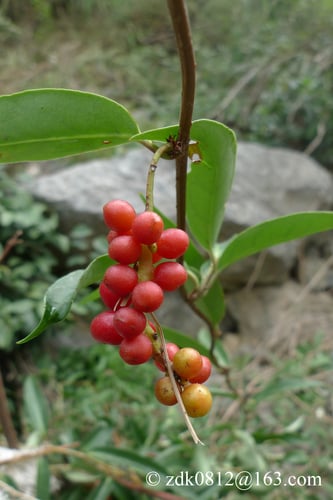
Source: WikipediaSchisandra chinensis, whose fruit is called schisandra, magnolia berry or five-flavor fruit, is a vine plant native to forests of Northern China, the Russian Far East, Korea, and Japan. It is hardy in USDA Zones 4-8. The fruits are red berries in dense clusters around 10 centimetres (3.9 in) long.
Description
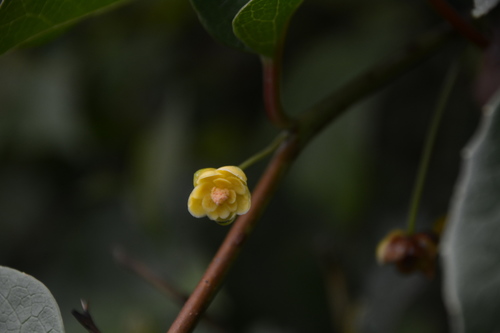
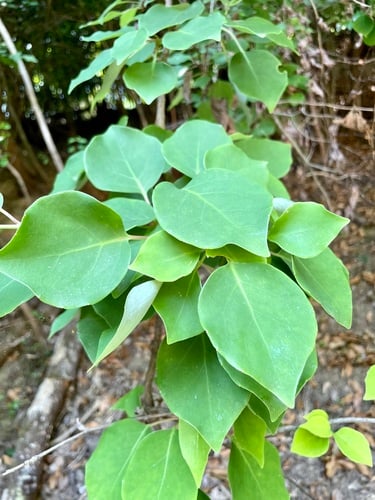
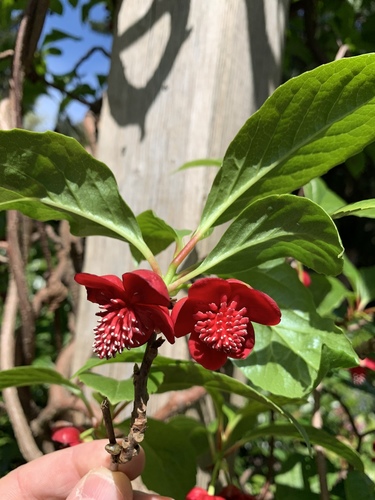
A deciduous creeper. It grows 6-9 m long. It spreads 6 m wide. The young stems are red. The leaves are rounded. They are large and light green. The flowers are small and white. They droop in clusters. Plants are separately male and female. The fruits are fleshy and red. They occur in long strings. These are 15 cm long.
Edible Uses
The fruit can be eaten raw or cooked. It is most commonly dried for use on journeys, where it is considered very sustaining. Rich in sugars, it has a sweet-sour flavour. In Russia, a paste made from the fruit is blended with Actinidia arguta to offset that species' insufficient acidity. Each fruit is around 6mm in diameter and is borne in grape-like bunches about 10cm long. Young leaves can be cooked and eaten as a vegetable.
Traditional Uses
The young leaves are boiled and eaten. The fruit is eaten raw or dried. They are also used for tea. The fresh fruit are used to make a soft drink. A paste from the fruit is mixed with hardy kiwifruit (Actinidea arguta) to balance the acidity.
Medicinal Uses
Wu Wei Zi is a well-established herb in Chinese medicine and is counted among the 50 fundamental herbs of that tradition. It is regarded as an excellent tonic and restorative, useful during stressful periods and said to increase vitality. It is considered a substitute for ginseng and a tonic for both male and female reproductive organs. The fruit is antitussive, aphrodisiac, hepatic, astringent, cardiotonic, cholagogue, expectorant, hypotensive, lenitive, nervine, pectoral, sedative, stimulant and tonic. Low doses are said to stimulate the central nervous system while large doses depress it. The fruit also helps regulate the cardiovascular system. Internally it is used to treat dry coughs, asthma, night sweats, urinary disorders, involuntary ejaculation, chronic diarrhoea, palpitations, insomnia, poor memory, hyperacidity, hepatitis and diabetes. Externally it is applied to irritating and allergic skin conditions. The fruit is harvested after the first frosts and sun-dried for later use. It contains lignans that have a pronounced protective effect on the liver; one clinical trial recorded a 76% success rate in treating hepatitis patients with no observed side effects. The seed is used in the treatment of cancer. The plant is also antirheumatic, and a mucilaginous decoction made from the branches is used to treat coughs, dysentery and gonorrhoea.
Distribution
A temperate plant. It is best in rich moist soil. In northern China it grows in valleys along rivers between 1,200-1,700 m above sea level. It suits hardiness zones 4-10.
Where It Grows
Asia, Australia, Britain, China*, Europe, Indochina, Japan, Korea, Malaysia, Russia, SE Asia, Slovenia, USA, Vietnam,
Cultivation
Plants can be grown from suckers. Plants should be pruned after fruiting.
Propagation
Seed is best sown in autumn in a cold frame. Stored seed should be pre-soaked for 12 hours in warm water before sowing in a greenhouse in spring. Germination can be slow and erratic. Prick out seedlings into individual pots when large enough to handle and grow on in light shade in the greenhouse for their first two years before planting out in early summer. Cuttings of half-ripe wood, 5–8cm with a heel, taken in August and rooted in a frame give a good success rate; overwinter in the greenhouse and plant out in late spring. Long shoots can also be layered in autumn.
Other Uses
A viscid mucoid material obtained from the fruit and branches is used as a paper size and as a hair dressing. The dried wood is notably fragrant.
Production
It takes a few years before plants flower and fruit. In northern China plants flower in May to July and fruit in July to September.
Notes
There are about 25 Schisandra species. It has medicinal properties.
Also Known As
Chosen-gomishi, Kitajska shizandra, Nguvi, Omija, Phanhung Trungquoc, Wu Wei Zi
References (20)
- Bremness, L., 1994, Herbs. Collins Eyewitness Handbooks. Harper Collins. p 284
- Brickell, C. (Ed.), 1999, The Royal Horticultural Society A-Z Encyclopedia of Garden Plants. Convent Garden Books. p 942
- Cundall, P., (ed.), 2004, Gardening Australia: flora: the gardener's bible. ABC Books. p 1322
- Facciola, S., 1998, Cornucopia 2: a Source Book of Edible Plants. Kampong Publications, p 229
- Fan, L., et al, The Use of Edible Wild Plants and Fungi in Korean-Chinese Villages. Journal of Environmental Information Science 44-5 p 71-79
Show all 20 references Hide references
- Heywood, V.H., Brummitt, R.K., Culham, A., and Seberg, O., 2007, Flowering Plant Families of the World. Royal Botanical Gardens, Kew. p 300 (Genus)
- Hibbert, M., 2002, The Aussie Plant Finder 2002, Florilegium. p 288
- Hist. pl. 1:148. 1868 "Schizandra"
- http://www.botanic-gardens-ljubljana.com/en/plants
- Hu, Shiu-ying, 2005, Food Plants of China. The Chinese University Press. p 396
- Jackes, D. A., 2007, Edible Forest Gardens
- Joyce, D., 1998, The Garden Plant Selector. Ryland, Peters and Small. p 186
- Pemberton, R. W. & Lee, N. S., 1996, Wild Food Plants in South Korea: Market Presence, New Crops, and Exports to the United States. Economic Botany, Vol. 50, No. 1, pp. 57-70
- Plants for a Future database, The Field, Penpol, Lostwithiel, Cornwall, PL22 0NG, UK. http://www.scs.leeds.ac.uk/pfaf/
- Ryan, S., 2008, Dicksonia. Rare Plants Manual. Hyland House. p 78
- Shikov, A. N. et al, 2017, Traditional and Current Food Use of Wild Plants Listed in the Russian Pharmacopoeia. Frontiers in Pharmacology. Vol. 8 Article 841
- Song, M., et al, 2013, Traditional knowledge of wild edible plants in Jeju Island, Korea. Indian Journal of Traditional Knowledge. 12(2) pp 177-194
- Williams, D., 2017, Ainu Ethnobiology. Contributions in Ethnobiology. Society of Ethnobiology. p 140
- Wujisguleng, W., & Khasbagen. K., 2010, An integrated assessment of wild vegetable resources in Inner Mongolian Autonomous Region, China. Journal of Ethnobiology and Ethnomedicine 6:34
- www.efloras.org Flora of China. Volume 7