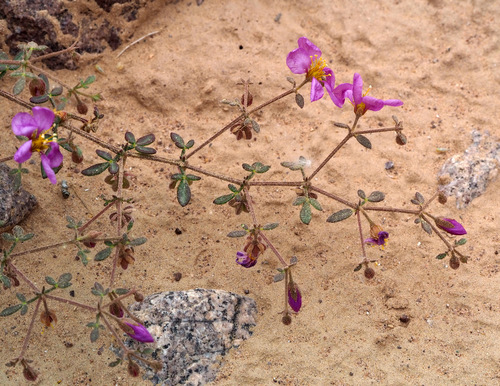
Balanites pedicellaris
Mildbr. & Schltr.
Torchwood minor, Small torchwood
iNaturalist· cc-by-nc
(c) Charles Hopkins, some rights reserved (CC BY-NC), uploaded by Charles Hopkins
iNaturalist· cc-by-nc
(c) Francois du Randt, some rights reserved (CC BY-NC), uploaded by Francois du Randt
Summary
Source: WikipediaBalanites pedicellaris, the small green-thorn or small torchwood is a small tree or shrub from Sub-Saharan Africa. It is a member of the caltrop family Zygophyllaceae.
Description
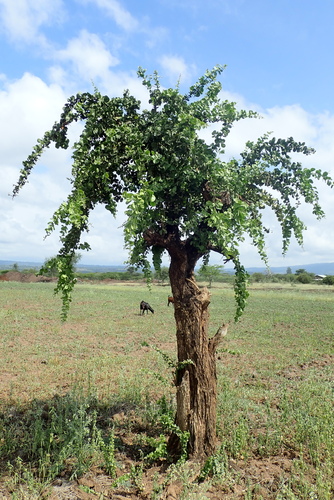
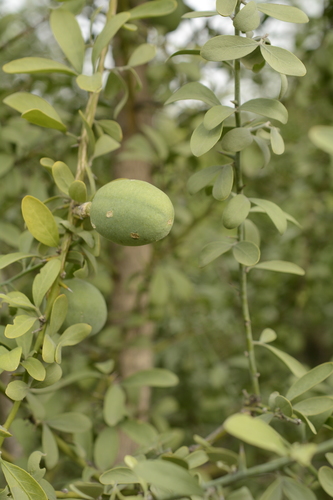
A very dense shrub. It can grow to 9 m high. It has thin drooping branches. These have long un-forked spines. The bark is light grey and often spiny. The leaves are made up of 2 leaflets without stalks. They leaves are grey-green. The leaflets are oval and 4 cm long with rounded tips. They narrow towards the base. The leaves dry with obvious wrinkles. The small branches end with spines and often leaves grow on these. The buds are small and triangular. They occur in bunches in the axils of leaves. The flowers are greenish-yellow and long fairly stout stalks. The fruit are 2.5 cm long. They are brilliant orange-red when ripe. They are edible.
Edible Uses
The fruit is eaten after very long boiling (8–9 hours with multiple water changes), and the inner part of the seeds is cooked and eaten.
Traditional Uses
The fruit are reported to be eaten after very long boiling. They are boiled for 8-9 hours with the water being changed about 10 times. The inner part of the seeds are cooked and eaten. Caution: Eating fresh fruit causes dizziness and vomiting.
Known Hazards
The fruit is eaten but is not sought after. The fresh fruits are toxic and have a bitter taste, consumption causes thirst, dizziness and vomiting. An infusion made from the roots is used to treat fever and diarrhoea, the boiled root infusion is frequently added to milk given to children. The root infusion is used as an emetic by the Turkana people. The seeds are cooked and are an important source of food in northern Kenya, particularly in Turkana. The leaves are used as browse for domestic animals while the wood is used for carvings and to make torches.
Distribution
A tropical plant. It grows in tropical and warm places. It can grow in dry salty soils. It grows from sea level to 1,700 m altitude. It can grow in arid places.
Where It Grows
Africa, Botswana, East Africa, Eswatini, Ethiopia, Kenya, Malawi, Mozambique, Somalia, South Africa, Southern Africa, South Sudan, Swaziland, Tanzania, Uganda, Zimbabwe,
Cultivation
Plants are grown from seeds. It is best to plant the seeds directly in the field.
Other Information
The fruit are not widely used.
Synonyms
Also Known As
Baddan, Chindzole, Elamach, Kalum, Kiwowa, Kullan Liphambo, Loma, Lomion, Mubadana, Sarai, Umnunu
References (15)
- Fox, F. W. & Young, M. E. N., 1982, Food from the Veld. Delta Books. p 130
- Long, C., 2005, Swaziland's Flora - siSwati names and Uses http://www.sntc.org.sz/flora/
- Maundu, P. et al, 1999, Traditional Food Plants of Kenya. National Museum of Kenya. p 71
- Morgan, W. T. W., 1981, Ethnobotany of the Turkana: Use of plants by a Pastoral People and Their Livestock in Kenya. Economic Botany 35(1):96-130
- Mutie, F. G., 2020, Conservation of Wild Food Plants and Their Potential for Combatting Food Insecurity in Kenya as Exemplified by the Drylands of Kitui County. Plants 2020, 9, 1017
Show all 15 references Hide references
- Mutie, F. M., et al, 2023, Important Medicinal and Food Taxa (Orders and Families) in Kenya, Based on Three Quantitative Approaches. Plants 2023, 12, 1145
- Ngugi, G., 2000, Case Study from Kenya on Indigenous Wild Vegetables. Paper 4 Workshop in Kenya 1999. p 32
- Palgrave, K.C., 1996, Trees of Southern Africa. Struik Publishers. p 339
- Palmer, E and Pitman, N., 1972, Trees of Southern Africa. Vol. 2. A.A. Balkema, Cape Town p 993
- Peters, C. R., O'Brien, E. M., and Drummond, R.B., 1992, Edible Wild plants of Sub-saharan Africa. Kew. p 68
- Royal Botanic Gardens, Kew (1999). Survey of Economic Plants for Arid and Semi-Arid Lands (SEPASAL) database. Published on the Internet; http://www.rbgkew.org.uk/ceb/sepasal/internet [Accessed 4th April 2011]
- Sands, M. J. S., 2001, The Desert Date and Its Relatives: A Revision of the Genus Balanites. Kew Bulletin, Vol. 56, No. 1 (2001), pp. 1-128
- Schmidt, E., Lotter, M., & McCleland, W., 2007, Trees and shrubs of Mpumalanga and Kruger National Park. Jacana Media p 230
- Tredgold, M.H., 1986, Food Plants of Zimbabwe. Mambo Press. p 85
- World Checklist of Useful Plant Species 2020. Royal Botanic Gardens, Kew