Tribulus terrestris
L.
Land Caltrops
iNaturalist· cc-by
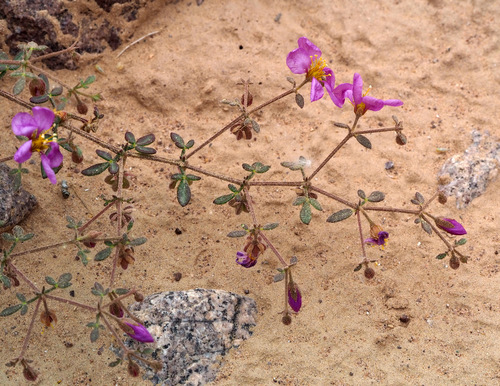
(c) Antonio W. Salas, some rights reserved (CC BY), uploaded by Antonio W. Salas
iNaturalist· cc-by-nc
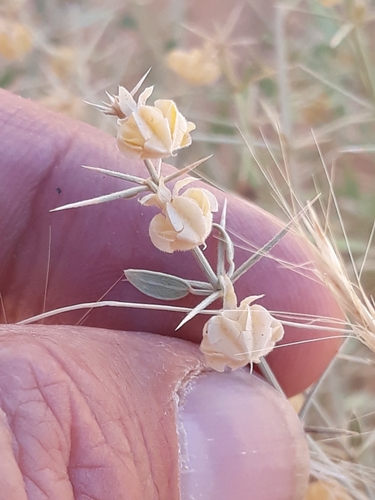
(c) Kyle Eaton, some rights reserved (CC BY-NC), uploaded by Kyle Eaton
iNaturalist· cc-by-nc
(c) kiddyhill, some rights reserved (CC BY-NC)
Summary
Source: WikipediaTribulus terrestris is an annual plant in the caltrop family (Zygophyllaceae) widely distributed around the world. It is adapted to thrive in dry climate locations in which few other plants can survive. It is native to warm temperate and tropical regions in southern Eurasia and Africa. It has been unintentionally introduced to North America and Australia. An aggressive and hardy invasive species, T. terrestris is widely known as a noxious weed because of its small woody fruit – the bur – having long sharp and strong spines which easily penetrate surfaces, such as bare feet or thin shoes of crop workers and other pedestrians, the rubber of bicycle tires, and the mouths and skin of grazing animals.
Description
A slender herb. It is an annual plant. It grows 30-60 cm tall. It creeps along the ground. The stems are hairy. The leaves are compound. They are divided along the stalk into several leaflets. There is no end leaflet. The flowers are yellow and often folded. They are small and have 5 petals. The fruit are round with sharp thorns. It becomes woody and breaks into 5 wedge shaped sections when ripe. There can be 2-5 seeds in each section. The spines are very sharp and strong.
Edible Uses
The leaves and young shoots can be cooked and eaten. Per 100g fresh weight, the leaves contain: 79.09% water, 7.22g protein, 1600mg calcium, 80mg phosphorus, 9.22mg iron, 4.6g ash, and 41mg vitamin C; calories, fat, carbohydrate, fibre, and most other vitamins and minerals are recorded as zero. The fruit is also edible when cooked — unexpanded seed capsules are ground into a powder and made into bread. It is considered a famine food, used only when other options are unavailable.
Traditional Uses
The seeds are eaten after grinding into a flour and cooked. They can be used for bread or mixed with other flours. It is used in kreb a grain mixture eaten in Chad. The fruit are brewed into a herbal tea. Oil from the fruit is used in cooking. The young leaves are cooked and eaten as greens. In Uganda they are cooked and eaten with Cleome gynandra or with sour milk. CAUTION: This plant has caused poisoning in animals due to nitrates. This nitrate would get worse in nitrogen rich soils. The cyanide or bitter principle gets removed by cooking.
Medicinal Uses
The seed is abortifacient, alterative, anthelmintic, aphrodisiac, astringent, carminative, demulcent, diuretic, emmenagogue, galactogogue, pectoral, and tonic. It stimulates blood circulation. A decoction is used to treat male impotency, nocturnal emissions, gonorrhoea, and urinary incontinence, and has also proved effective for painful urination, gout, and kidney diseases. The plant has shown anticancer activity. The flowers are used in the treatment of leprosy. The stems are used for scabious skin diseases and psoriasis. Dried and concocted fruits are used for congestion, gas, headache, and disorders of the liver, eyes, and mouth.
Known Hazards
Toxic compounds in the plant are known to cause liver damage when ingested at harmful dosages. When ingested, phylloerythrin accumulates in the blood as a byproduct of chlorophyll degradation; however, adverse reactions have not been confirmed in humans. In sheep, consumption of T. terrestris causes tribulosis, also known as 'geeldikkop', which is a type of photodermatitis. Two alkaloids that seem to cause limb paresis (staggers) in sheep that eat T. terrestris are the beta-carboline alkaloids harman (harmane) and norharman (norharmane). The alkaloid content of dried foliage is about 44 mg/kg.
Distribution
A tropical plant. The twigs spread over the ground in wet places. It grows in tropical and temperate regions. It grows on sandy soils. It is highly salt tolerant. In Ethiopia it grows between 750-1,600 m altitude. It grows between sea level and 2,300 m above sea level. It can grow in arid places. In the Indian Himalayas it grows between 3,000-3,800 m above sea level. In Argentina In Sichuan and Yunnan.
Where It Grows
Afghanistan, Africa, Albania, Algeria, Angola, Argentina, Armenia, Asia, Australia, Austria, Bahrain, Balkans, Belarus, Benin, Bolivia, Botswana, Britain, Bulgaria, Burkina Faso, Burundi, Cambodia, Cameroon, Canary Islands, Caucasus, Central Africa, Central Asia, Chad, Chile, China, Colombia, Congo, Côte d'Ivoire, Cyprus, Czech Republic, East Africa, Egypt, Eswatini, Ethiopia, Europe, France, Gambia, Ghana, Greece, Guinea-Bissau, Hawaii, Himalayas, Hungary, India, Indochina, Iran, Iraq, Israel, Italy, Ivory Coast, Japan, Jordan, Kazakhstan, Kenya, Korea, Kuwait, Lebanon, Lesotho, Libya, Macedonia, Madagascar, Malawi, Mali, Mauritania, Mauritius, Mediterranean, Mexico, Middle East, Moldova, Mongolia, Morocco, Mozambique, Myanmar, Namibia, Niger, Nigeria, North Africa, North America, Oman, Pacific, Pakistan, Palestine, Peru, Portugal, Qatar, Reunion, Romania, Russia, Rwanda, Saudi Arabia, SE Asia, Senegal, Seychelles, Sierra Leone, Slovakia, Slovenia, Socotra, Somalia, South Africa, Southern Africa, South America, South Sudan, Spain, Sri Lanka, St Helena, Sudan, Swaziland, Switzerland, Syria, Taiwan, Tajikistan, Tanzania, Thailand, Togo, Tunisia, Turkey, Türkiye, Turkmenistan, Uganda, Ukraine, United Arab Emirates, UAE, Uruguay, USA, Uzbekistan, West Africa, Yemen, Yugoslavia, Zambia, Zimbabwe,
Cultivation
We have very little information on this species and are not sure how successful it will be in Britain. There are conflicting reports on its hardiness - according to one report it is native to N. France which should make it hardy in Britain whilst another report says that it is only hardy in zone 10 which means that it is not frost tolerant. We would suggest treating it as a frost tender annual and then experimenting with its hardiness. It is likely to require a well-drained dry to moist soil and is also likely to be tolerant of maritime exposure. The plant is very fast growing from seed. A good bee plant.
Propagation
Sow seed in spring in a greenhouse. Once seedlings are large enough to handle, prick them out into individual pots and plant out after the last expected frost.
Other Uses
None known
Production
Leaves are collected during the rainy season. The dried leaves can be stored.
Other Information
It is a famine food. It is highly palatable.
Notes
Chemical composition (per 100g) (leaves): Protein = 5.4. Fat = 0.6g. Kcal = 70. They are low in iron. It is high in proVitamin A.
Nutrition
| Part | Moisture | kJ | kcal | Protein | Vit A | Vit C | Iron | Zinc |
|---|---|---|---|---|---|---|---|---|
| Leaves raw | 72 | 293 | 70 | 5.4 | 74 | — | — | — |
Synonyms
Also Known As
Abrojito, Abrojo, Akakima, Akanti, Asukuru, Bakhra, Bakhro, Betagokhru, Bhakhra, Bhaukeri, Bindi-eye, Burra gokharu, Burra-gokhur, Caltrop, Chinnipalleru, Chirupalleru, Croix de malte, Derressat on nas, Devil’s Thorn, Diresa, Don shingi gokharu, Drese, Dubbeltjie, Esukuru, Esuguguru, Gakhura, Goat's head, Gocondho, Gokhari, Gokharu, Gokhatri, Gokhru-bara, Gokhru, Gokhrudesi, Gokshra, Gokshura, Ground bur-nut, Gucundho, Hisek, Ikshugandha, Ivua, Kahar, Kanjate, Kanti, Kaxar, Kokulla, Krachab dei, Kuruec, Kurumshit, Kutob, Lahango-khru, Lotak, Maltese cross, Malei, Mithagokhru, Mithu, Naar-lar, Nahanagokhrua, Nerenjee keeray, Nerinjeekai, Nerringi keerai, Nerunji, Nirunji, Pakhra, Pallerukatalu, Pespsa, Puncture vine, Punctureweed, Qumputia, Rasha, Revienta camino, Roseta francesca, Sanna neggilu, Sarala, Sarata, Serata, Sharatte, Suessue, Tara, Thleso, Tribolo, Tsaydo, Tsetwana, Tsule, Xitzetuane, Zobačica
References (82)
- Akram M. and Asif H. M., 2011, Tribulus terrestris Linn: A review. Journal of medicinal plants research, 5(16), pp. 360-364.
- Al-Sodany, Y. M., et al, 2013, Medicinal Plants in Saudi Arabia: I. Sarrwat Mountains at Taif, KSA. Academic Journal of Plant Sciences 6 (4): 134-145
- Ambasta, S.P. (Ed.), 2000, The Useful Plants of India. CSIR India. p 647
- BERRY-KOCH,
- BHANDARI,
Show all 82 references Hide references
- Blamey, M and Grey-Wilson, C., 2005, Wild flowers of the Mediterranean. A & C Black London. p 115
- Burkill, H. M., 1985, The useful plants of west tropical Africa, Vol. 5. Kew.
- Busson, 1965,
- CRÉAC'H,
- Dansi, A., et al, 2008, Traditional leafy vegetables and their use in the Benin Republic. Genet Resour Crop Evol (2008) 55:1239–1256
- Dobriyal, M. J. R. & Dobriyal, R., 2014, Non Wood Forest Produce an Option for Ethnic Food and Nutritional Security in India. Int. J. of Usuf. Mngt. 15(1):17-37
- Exell, A.W. et al, (Ed), 1963, Flora Zambesiaca Vol 2 Part 1 Crown Agents, London. p 126
- Facciola, S., 1998, Cornucopia 2: a Source Book of Edible Plants. Kampong Publications, p 249
- FAO, 1988, Traditional Food Plants, FAO Food and Nutrition Paper 42. FAO Rome p 490
- Food Composition Tables for use in Africa FAO http://www.fao.org/infoods/directory No. 761
- Fowler, D. G., 2007, Zambian Plants: Their Vernacular Names and Uses. Kew. p 64
- GAMMIE,
- Goode, P., 1989, Edible Plants of Uganda. FAO p 36
- Grivetti, L. E., 1980, Agricultural development: present and potential role of edible wild plants. Part 2: Sub-Saharan Africa, Report to the Department of State Agency for International Development. p 26, 41, 49
- Harris, F. M. A. and Salisu Mohammed, 2003, Relying on nature: Wild Foods in Northern Nigeria. AMBIO Vol. 32 No. 1, p 27
- Hedrick, U.P., 1919, (Ed.), Sturtevant's edible plants of the world. p 652
- High, C. & Shackleton, C. M., 2000, The comparative value of wild and domestic plants in home gardens of a South African rural village. Agroforestry Systems 48: 141–156, 2000
- http://www.botanic-gardens-ljubljana.com/en/plants
- https://www.fireflyforest.com/flowers/category/edible-plants/ Edible Plants – Southeastern Arizona Wildflowers and Plants
- Hunter, J.T., 2017, Is there a relationship between contemporary high Aboriginal plant resource locations and mapped vegetation communities? Cunninghamia 17:27-34. The Royal Botanic Garden Sydney. ISSN 2200 - 405X
- Hussey, B.M.J., Keighery, G.J., Cousens, R.D., Dodd, J., Lloyd, S.G., 1997, Western Weeds. A guide to the weeds of Western Australia. Plant Protection Society of Western Australia. p 230
- Hu, Shiu-ying, 2005, Food Plants of China. The Chinese University Press. p 491
- HURST,
- IRVINE,
- Jadhav, R., et al, 2015, Forest Foods of Northern Western Ghats: Mode of Consumption, Nutrition and Availability. Asian Agri-History Vol. 19, No. 4: 293-317
- Jackes, B.R., 2001, Plants of the Tropics. Rainforest to Heath. An Identification Guide. James Cook University. p 87
- Jardin, C., 1970, List of Foods Used In Africa, FAO Nutrition Information Document Series No 2.p 48, 107
- Johns, T., Mhoro, E. B. and Sanaya, P., 1996, Food Plants and Masticants of the Batemi of Ngorongoro District, Tanzania. Economic Botany, Vol. 50, No. 1, pp. 115-121
- Karim, F. M. & Dakheel, A, J., 2006, Salt-tolerant plants of the United Arab Emirates. 2006. International Center for Biosaline Agriculture, Dubai, UAE. p 159
- Karthi, Sathya, & Salome, 2014, Uncultivated Edible Greens from Small Millet Farms Tamil Nadu India. IDRC
- Kiple, K.F. & Ornelas, K.C., (eds), 2000, The Cambridge World History of Food. CUP p 1840
- Lamp, C & Collet F., 1989, Field Guide to Weeds in Australia. Inkata Press. p 303
- Lazarides, M. & Hince, B., 1993, Handbook of Economic Plants of Australia, CSIRO. p 238
- Lulekal, E., et al, 2011, Wild edible plants in Ethiopia: a review on their potential to combat food insecurity. Afrika Focus - Vol. 24, No 2. pp 71-121
- MacMahon, J.A., 1990, Deserts. Audubon Society Nature Guides. Knopf. p 405 Plate 143
- Magwede, K., van Wyk, B.-E., & van Wyk, A. E., 2019, An inventory of Vhavenḓa useful plants. South African Journal of Botany 122 (2019) 57–89
- Majeed, M., et al, 2021, Gathered Wild Food Plants among Diverse Religious Groups in Jhelum District, Punjab, Pakistan. Foods 2021, 10, 594.
- Malezas Comestibles del Cono Sur, INTA, 2009, Buernos Aires
- Martin, F.W. & Ruberte, R.M., 1979, Edible Leaves of the Tropics. Antillian College Press, Mayaguez, Puerto Rico. p 78, 225
- McMakin, P.D., 2000, Flowering Plants of Thailand. A Field Guide. White Lotus. p 103
- Menninger, E.A., 1977, Edible Nuts of the World. Horticultural Books. Florida p
- Mertz, O., Lykke, A. M., and Reenberg, A., 2001, Importance and Seasonality of Vegetable Consumption and Marketing in Burkina Faso. Economic Botany, 55(2):276-289
- Mutie, F. M., et al, 2023, Important Medicinal and Food Taxa (Orders and Families) in Kenya, Based on Three Quantitative Approaches. Plants 2023, 12, 1145
- National Research Council, 1996, Lost crops of Africa. Volume 1 grains, p 258
- Ojelel, S., et al, 2019, Wild edible plants used by communities in and around selected forest reserves of Teso-Karamoja region, Uganda. Journal of Ethnobiology and Ethnomedicine (2019) 15:3
- Paczkowska, G . & Chapman, A.R., 2000, The Western Australian Flora. A Descriptive Calatogue. Western Australian Herbarium. p 568
- Peters, C. R., O'Brien, E. M., and Drummond, R.B., 1992, Edible Wild plants of Sub-saharan Africa. Kew. p 203
- Petheram, R.J. and Kok, B., 2003, Plants of the Kimberley Region of Western Australia. UWA Press p 229
- Phon, P., 2000, Plants used in Cambodia. © Pauline Dy Phon, Phnom Penh, Cambodia. p 607
- Pickering, H., & Roe, E., 2009, Wild Flowers of the Victoria Falls Area. Helen Pickering, London. p 115
- Plants for a Future database, The Field, Penpol, Lostwithiel, Cornwall, PL22 0NG, UK. http://www.scs.leeds.ac.uk/pfaf/
- Prachi, K., et al, 2012, Underutilized wild fruits of North Maharashtra. Journal of Research in Plant Sciences. (2012) 1:071-076
- READ,
- Roodt, V., 1998, Common Wild Flowers of the Okavango Delta. Medicinal Uses and Nutritional value. The Shell Field Guide Series: Part 2. Shell Botswana. p 159
- Royal Botanic Gardens, Kew (1999). Survey of Economic Plants for Arid and Semi-Arid Lands (SEPASAL) database. Published on the Internet; http://www.rbgkew.org.uk/ceb/sepasal/internet [Accessed 13th June 2011]
- Rubaihayo, E. B., Conservation and use of traditional vegetables in Uganda. Bioversity International.
- Ruffo, C. K., Birnie, A. & Tengnas, B., 2002, Edible Wild Plants of Tanzania. RELMA p 670
- Ruiters-Welcome, A. K., 2019, Food plants of southern Africa. Ph.D. thesis. Univ. of Johannesburg p 109
- Shackleton, S. E., et al, 1998, Use and Trading of Wild Edible Herbs in the Central Lowveld Savanna Region, South Africa. Economic Botany, Vol. 52, No. 3, pp. 251-259
- Shah, G.L. et al, 1981, An account of the Ethnobotany of Saurashtra in Gujarat State (India). J. Econ. Tax. Bot. Vol 2 pp 173-182
- Sharma, L. et al, 2018, Diversity, distribution pattern, endemism and indigenous uses of wild edible plants in Cold Desert Biosphere Reserve of Indian Trans Himalaya. Indian Journal of Traditional Knowledge. Vol 17(1) January 2018 pp 122-131
- SHORTT,
- Silberbauer, 1972, 1981,
- Singh, H.B., Arora R.K.,1978, Wild edible Plants of India. Indian Council of Agricultural Research, New Delhi. p 85
- Singh, V. and Singh, P., 1981, Edible Wild Plants of Eastern Rajasthan. J. Econ. Tax. Bot. Vol 2 pp 197-207
- Sp. pl. 1:387. 1753
- Staples, G.W. and Herbst, D.R., 2005, A tropical Garden Flora. Bishop Museum Press, Honolulu, Hawaii. p 575
- Swaziland's Flora Database http://www.sntc.org.sz/flora
- UPHOF,
- Vanderjagt, F. J., et al, 2000, The trypsin inhibitor content of 61 wild edible plant foods of Niger. Plant Foods for Human Nutrition 55: 335–346, 2000.
- VAN ETTEN et al (1967),
- WEBB.
- Welcome, A. K. & Van Wyk, B.-E., 2019, An inventory and analysis of the food plants of southern Africa. South African Journal of Botany 122 (2019) 136–179
- Wheeler, J.R.(ed.), 1992, Flora of the Kimberley Region. CALM, Western Australian Herbarium, p 679
- Wild edible plants of Himachal Pradesh
- World Checklist of Useful Plant Species 2020. Royal Botanic Gardens, Kew
- Young, H., et al, 2005, Darfur - Livelihoods under Siege. Feinstein International Famine Center. p 175