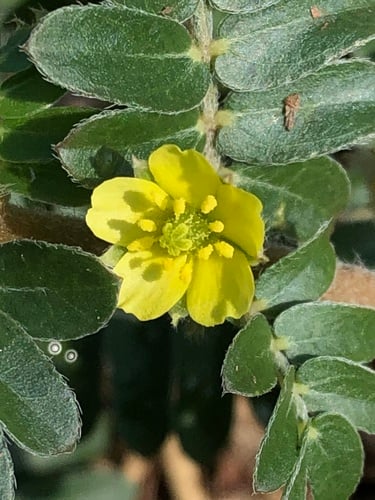
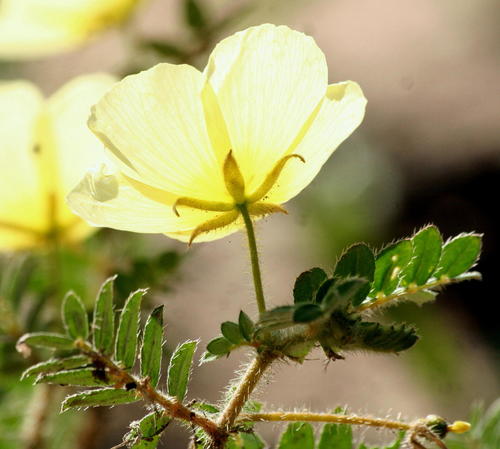
Tribulus pentandrus
Forssk.
iNaturalist· cc-by-nc
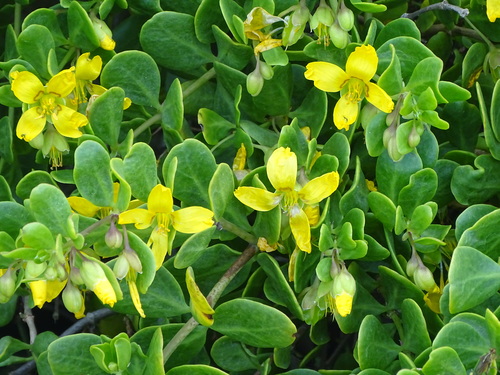
(c) Ron Frumkin, some rights reserved (CC BY-NC), uploaded by Ron Frumkin
iNaturalist· cc-by-nc
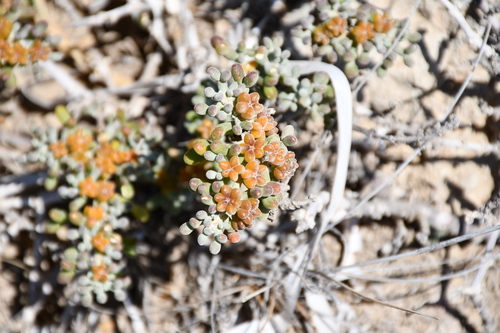
(c) Ron Frumkin, some rights reserved (CC BY-NC), uploaded by Ron Frumkin
iNaturalist· cc-by-nc
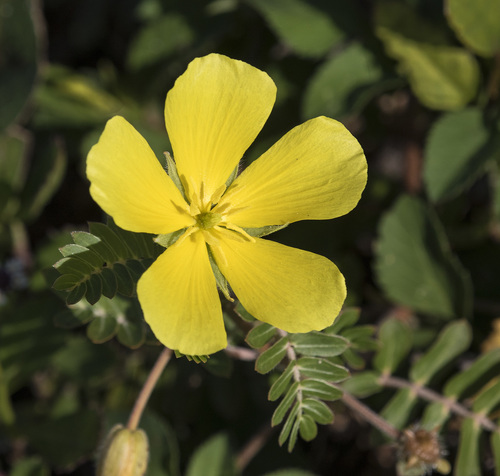
(c) John Pereira, some rights reserved (CC BY-NC), uploaded by John Pereira
Description
A herb. It keeps growing from year to year. The stems branch from the base. It lies along the ground and is spreading. It grows 40 cm tall. It is covered with short white hairs. The leaves are in pairs with 8-14 leaflets. The flowers occur singly and are yellow. The fruit are along the underside of the stems and are 1 cm across. They consist of 5 segments with toothed narrow wings.
Edible Uses
Young plants are used as a pot-herb, and the seeds are eaten as food, particularly in times of scarcity.
Traditional Uses
Young plants are used as a pot-herb. The seeds are eaten as food in times of scarcity.
This uses section is brief — help expand it
Distribution
It is a Mediterranean climate plant. It grows in arid places on sand.
Where It Grows
Africa, Asia, East Africa, India, Middle East, Uganda, United Arab Emirates, UAE,
Notes
There are 25 Tribulus species.
Synonyms
Also Known As
Bakdu, Bakra, Esuguru, Gokhru-kalan, Lalak, Nindo-trikhand, Shirsir, Trikundari
References (6)
- Ambasta, S.P. (Ed.), 2000, The Useful Plants of India. CSIR India. p 647 (As Tribulus alatus)
- Dubai Desert Conservation Reserve. www.ddcr.org.
- Goode, P., 1989, Edible Plants of Uganda. FAO p 30 (As Tribulus longipetalus)
- Rubaihayo, E. B., Conservation and use of traditional vegetables in Uganda. Bioversity International. (As Tribulus longipetalus)
- Singh, H.B., Arora R.K.,1978, Wild edible Plants of India. Indian Council of Agricultural Research, New Delhi. p 85 (As Tribulus alatus)
Show all 6 references Hide references
- WATT, (As Tribulus alatus)