Sannantha virgata
(Forst. & Forst. f.) Peter G. Wilson
Twiggy Heath Myrtle, Twiggy Baeckea, Tall Baeckea
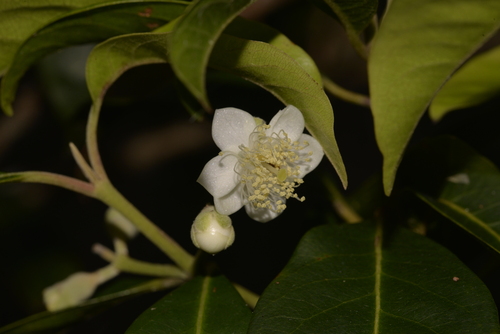
iNaturalist· cc-by-nc-sa
(c) Nuno Veríssimo P., some rights reserved (CC BY-NC-SA), uploaded by Nuno Veríssimo P.
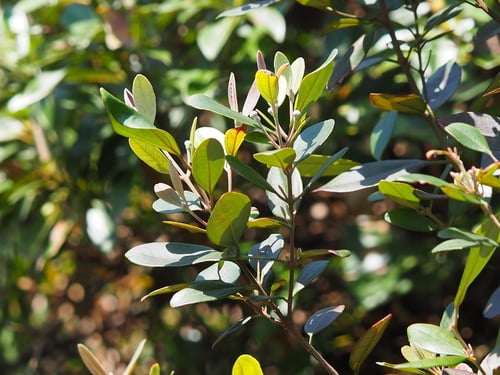
iNaturalist· cc-by-nc
(c) grantzeng, some rights reserved (CC BY-NC)
Summary
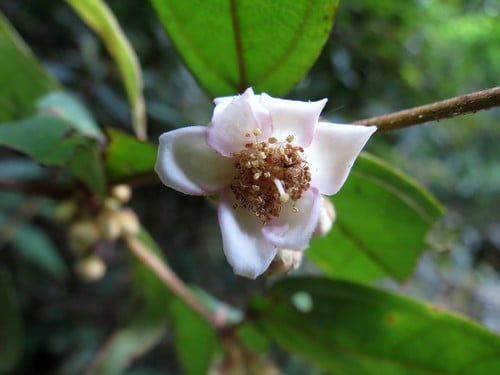
Source: WikipediaSannantha virgata is a flowering shrub species in the myrtle family, Myrtaceae. It is endemic to New Caledonia. The plant grows to between 0.5 and 3 metres high. White flowers appear in spring or summer with 5 rounded petals surrounding 7 to 10 stamens. The fruits are 1–2 mm wide and 2–3 mm in length.
Description
An erect shrub. It grows 1-3 m high and spreads 1-2 m across. The stems are slender and spreading. They sometimes hang downwards at the ends. The leaves are sword shaped and 1-2.5 cm long and 2-6 mm wide. The midrib is easy to see. The flowers are small and white. They are 8 mm across and with 5 rounded petals. They are grouped into clusters of 3-7 flowers together. The fruit is a tiny capsule 3 mm across.
Edible Uses
The leaves are used to make tea.
Traditional Uses
The leaves are used for tea.
This uses section is brief — help expand it
Distribution
It occurs in coastal districts. It grows in heath and open forests often along stream banks. It suits temperate and subtropical climates. It can tolerate heavy frosts. It needs moist well drained soils. It suits hardiness zones 9-10. Wittunga Botanical Gardens.
Where It Grows
Australia*,
Cultivation
It can be grown from seed or by tip cuttings.
Notes
There are 70 Baeckea species. Most are in Australia.
Synonyms
References (16)
- Bodkin, F., 1991, Encyclopedia Botanica. Cornstalk publishing, p 125 (As Baeckea virgata)
- Bonney, N., 1997, Economic Native Trees and Shrubs for South Australia. Greening Australia (SA) inc. Campbelltown SA 5074 p 36 (As Baeckea virgata)
- Bot. Repos. 10: t. 598. 1810 (As Baeckea virgata)
- Brickell, C. (Ed.), 1999, The Royal Horticultural Society A-Z Encyclopedia of Garden Plants. Convent Garden Books. p 158 (As Baeckea virgata)
- Cribb, A.B. & J.W., 1976, Wild Food in Australia, Fontana. p 173 (As Baeckea virgata)
Show all 16 references Hide references
- Cronin, L., 1989, The Concise Australian Flora. Reed. p 89 (As Baeckea virgata)
- Elliot, W.R., & Jones, D.L., 1982, Encyclopedia of Australian Plants suitable for cultivation. Vol 2. Lothian. p 278 (As Baeckea virgata)
- Etherington, K., & Imwold, D., (Eds), 2001, Botanica's Trees & Shrubs. The illustrated A-Z of over 8500 trees and shrubs. Random House, Australia. p 113 (As Baeckea virgata)
- Facciola, S., 1998, Cornucopia 2: a Source Book of Edible Plants. Kampong Publications, p 140
- Greig, D., 1996, Flowering Natives for Home Gardens. Angus & Robertson. p 62
- Grieg, D., 2002, A photographic guide to Wildflowers of South-eastern Australia. New Holland. p 76
- Hibbert, M., 2002, The Aussie Plant Finder 2002, Florilegium. p 37
- Lazarides, M. & Hince, B., 1993, Handbook of Economic Plants of Australia, CSIRO. p 30 (As Baeckea virgata)
- Lord, E.E., & Willis, J.H., 1999, Shrubs and Trees for Australian gardens. Lothian. p 149 (As Baeckea virgata)
- Molyneux, B & Forrester, S., 1997, The Austraflora A-Z of Australian Plants. Reed. p 48 (As Baeckea virgata)
- Steenbeeke, Greg as part of the Plants Directory project. List of plant species from northern NSW that may be used as food plants p 10 (As Baeckea virgata)