Rhodomyrtus tomentosa
(Aiton) Hassk.
Downy myrtle, Ceylon Hill Cherry
iNaturalist· cc0
no rights reserved
iNaturalist· cc0
no rights reserved
iNaturalist· cc0
no rights reserved
Summary
Source: WikipediaRhodomyrtus tomentosa also known as rose myrtle, is a flowering plant in the family Myrtaceae, native to southern and southeastern Asia, from India, east to southern China, Hong Kong, Taiwan and the Philippines, and south to Malaysia and Sulawesi. It grows in coasts, natural forest, riparian zones, wetlands, moist and wet forests, bog margins, from sea level up to 2400 m elevation.
Description
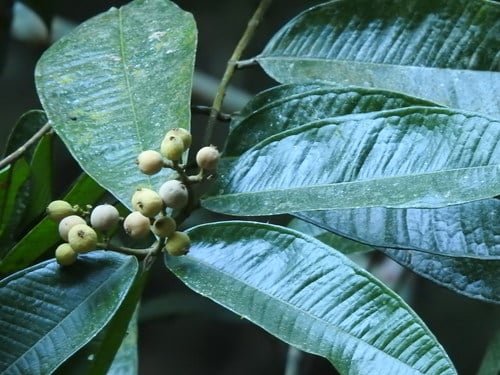
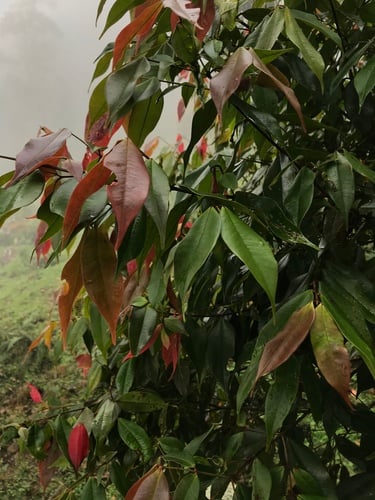
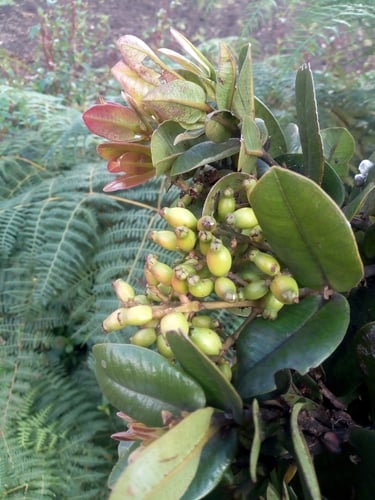
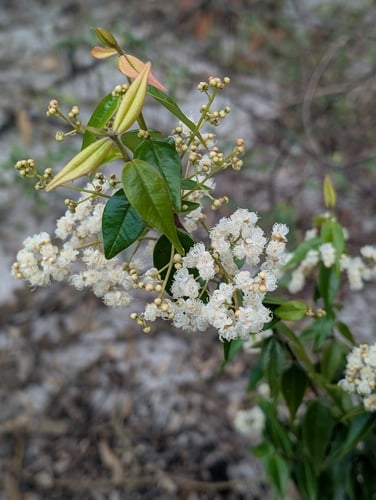
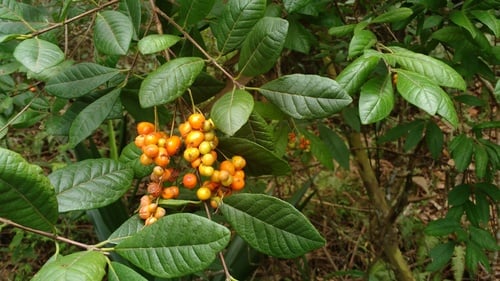
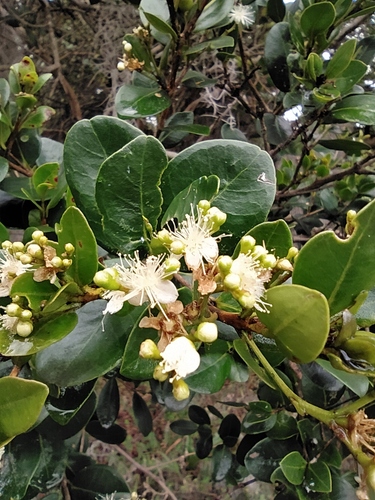
A shrub. It grows 1-2 m tall. The leaves are opposite, leathery and pointed at the base and slightly pointed at the tip. They are hairy underneath. The leaves have 3 veins. The flowers are showy. They are pink and have S shaped petals. They occur in the axils of leaves. The fruit are small yellow berries. They can be greenish-purple. They contain several seeds. The flesh is sweet.
Edible Uses
The fruit is usually eaten raw but is also used in pies, tarts, jellies, and salads, and makes an excellent jam. Fully ripe fruit is sweet and much enjoyed by children, though it is somewhat astringent before reaching full maturity. In Cambodia and Vietnam, fermented fruit is made into an alcoholic wine-like drink called 'ruou sim' (myrtle wine). In Vietnam, the fruits are also freshly canned with syrup for export. The purple, oblong fruit is up to 15mm long and 10mm wide.
Traditional Uses
The fleshy layer of the fruit is eaten raw. It is also cooked and used in pies and jam. They are also preserved.
This uses section is brief — help expand it
Medicinal Uses
The fruit has been used as a treatment for dysentery and diarrhoea. A decoction of the roots or leaves is drunk for diarrhoea and stomachache, and as a protective medicine after childbirth. A decoction or extracted juice of the buds and young leaves is beneficial for colic, diarrhoea, dysentery, abscesses, furunculosis, and haemorrhage. A concentrated leaf decoction serves as an antiseptic wash for wounds, impetigo, and abscesses. Crushed leaves are applied directly to dress wounds.
Distribution
A tropical plant. It suits cool tropical and subtropical conditions. It grows in shrubby savannas. It grows in wet forests up to 2,400 m above sea level. Found only in northern Luzon and the Babuyanes islands in the Philippines. It can tolerate wet soil conditions. It can grow in acid soils with pH 4-5. It cannot tolerate frost. In Yunnan.
Where It Grows
Asia*, Australia, Brazil, Cambodia, China, Hawaii, India, Indochina, Indonesia, Japan, Laos, Malaysia, Myanmar, North America, Pacific, Philippines, SE Asia, Singapore, South America, Sri Lanka, Taiwan, Thailand, USA, Vietnam,
Cultivation
Plants are grown from seed. It can also be grown by division of the plant. It can be grown by cuttings.
Propagation
Seed is best sown fresh, with the seed removed from the fruit pulp before sowing. Propagation is also possible from cuttings or by division of crowns.
Other Uses
Within its native range, R. tomentosa is a fast-growing early successional species that is fire-adapted and sprouts prolifically after fire. It has shown promise as a fire-retardant species for use in firebreaks in the Himalayas. Wood tar from the plant can serve as a black dye and has been used to blacken teeth and eyebrows. The plant is cultivated both as an ornamental and for its edible berries, though it is more commonly grown for its ornamental value and attractive flowers. In southern China it has been tested in restoration plantings to provide shade for slower-growing native species. The fruit also serves as a food source for animals and birds.
Production
It produces fruit in 3-4 years. Fruit mature in 60 days.
Other Information
The fruit are sold in markets. It is cultivated.
Notes
It can be invasive.
Nutrition
| Part | Moisture | kJ | kcal | Protein | Vit A | Vit C | Iron | Zinc |
|---|---|---|---|---|---|---|---|---|
| Fruit | 82.5 | 197 | 47 | 0.6 | — | 0 | 0.09 | — |
Synonyms
Also Known As
Bekakangal, Dayopod-mabolo, Downy myrtle, Downy rhodomyrtus, Downy rosemyrtle, Harendong sabrang, Hill-gooseberry, Kamuting, Karamunting, Kemuntian, Kemunting, Kemuting, Keramunsing, Keramunting, Keremunting, Koratta, Phruat, Phruat-kinluk, Pouch uol, Pourch, Puech, Puoch, Rose myrtle, Sim, Thabutu pazham, Thoh, To, Trobek-prey, Tu-pruet
References (43)
- Arora, R. K., 2014, Diversity in Underutilized Plant Species - An Asia-Pacific Perspective. Bioversity International. p 84
- Ashton, M. S., et al 1997, A Field Guide to the Common Trees and Shrubs of Sri Lanka. WHT Publications Ltd. pdf p 295
- Brown, W.H., 1920, Wild Food Plants of the Philippines. Bureau of Forestry Bulletin No. 21 Manila. p 140
- Burkill, I.H., 1966, A Dictionary of the Economic Products of the Malay Peninsula. Ministry of Agriculture and Cooperatives, Kuala Lumpur, Malaysia. Vol 2 (I-Z) p 1937
- Cengel, D. J. & Dany, C., (Eds), 2016, Integrating Forest Biodiversity Resource Management and Sustainable Community Livelihood Development in the Preah Vihear Protected Forest. International Tropical Timber Organization p 123
Show all 43 references Hide references
- Chandrashekara, U. M., 2009, Tree species yielding edible fruit in the coffee-based homegardens of Kerala, India: their diversity, uses and management. Food Sec. 1:361-370
- Davis, S.D., Heywood, V.H., & Hamilton, A.C. (eds), 1994, Centres of plant Diversity. WWF. Vol 1 or 2. p 117
- Facciola, S., 1998, Cornucopia 2: a Source Book of Edible Plants. Kampong Publications, p 160
- Flora 25(2), Beibl. 1:35. 1842
- Giesen, W., 2013, Paludiculture: sustainable alternatives on degraded peat land in Indonesia (revised draft)
- Hedrick, U.P., 1919, (Ed.), Sturtevant's edible plants of the world. p 559
- Hibbert, M., 2002, The Aussie Plant Finder 2002, Florilegium. p 251
- Hu, Shiu-ying, 2005, Food Plants of China. The Chinese University Press. p 578
- Kermath, B. M., et al, 2014, Food Plants in the Americas: A survey of the domesticated, cultivated and wild plants used for Human food in North, Central and South America and the Caribbean. On line draft. p 743
- Liu, Yi-tao, & Long, Chun-Lin, 2002, Studies on Edible Flowers Consumed by Ethnic Groups in Yunnan. Acta Botanica Yunnanica. 24(1):41-56
- Lorenzi, H., Bacher, L., Lacerda, M. & Sartori, S., 2006, Brazilian Fruits & Cultivated Exotics. Sao Paulo, Instituto Plantarum de Estuados da Flora Ltda. p 458
- Marinelli, J. (Ed), 2004, Plant. DK. p 467
- Macmillan, H.F. (Revised Barlow, H.S., et al) 1991, Tropical Planting and Gardening. Sixth edition. Malayan Nature Society. Kuala Lumpur. p 318
- Martin, F. W., et al, 1987, Perennial Edible Fruits of the Tropics. USDA Handbook 642 p 42
- Martin, M.A., 1971, Introduction L'Ethnobotanique du Cambodge. Centre National de la Recherche Scientifique. Paris.
- McMakin, P.D., 2000, Flowering Plants of Thailand. A Field Guide. White Lotus. p 56
- Monsalud, M.R., Tongacan, A.L., Lopez, F.R., & Lagrimas, M.Q., 1966, Edible Wild Plants in Philippine Forests. Philippine Journal of Science. p 505
- Nayaham, M. C., et al, 1993, Less Known Edible Fruit - Yielding plants of Nilgiris. Ancient Science of Lif. Vol. X11 Nos. 3 & 4, pp 363-376
- Phon, P., 2000, Plants used in Cambodia. © Pauline Dy Phon, Phnom Penh, Cambodia. p 537
- Popenoe,
- Priyadi, H., et al, Five hundred plant species in Gunung Halimun Salak National Park West Java. A checklist including Sundanese names, distribution and use. CIFOR, FFPRI, SLU p 51
- PROSEA No. 2
- Recher, P, 2001, Fruit Spirit Botanical Gardens Plant Index. www.nrg.com.au/~recher/ seedlist.html p 3
- Sang, D. T., & Mizoue, K. O. N., 2012, Use of Edible Forest Plants among Indigenous Ethnic Minorities in Cat Tien Biosphere Reserve, Vietnam. Asian Journal of Biodiversity Vol. 3 (1), p 23-49
- Sasi, R. & Rajendran, A., 2012, Diversity of Wild Fruits in Nilgiri Hills of the Southern Western Ghats - Ethnobotanical Aspects. IJABPT, 3(1) p 82-87
- Self, M., 199, Phoenix Seeds catalogue. p 15
- Singh, H.B., Arora R.K.,1978, Wild edible Plants of India. Indian Council of Agricultural Research, New Delhi. p 69. As Rhodomyrtus parviflora Alston.
- Slik, F., www.asianplant.net
- Staples, G.W. and Herbst, D.R., 2005, A tropical Garden Flora. Bishop Museum Press, Honolulu, Hawaii. p 431
- Sukarya, D. G., (Ed.) 2013, 3,500 Plant Species of the Botanic Gardens of Indonesia. LIPI p 705
- Turreira Garcia, N., et al, 2017, Ethnobotanical knowledgeof the Kuy and Khmer people in Prey Lang, Cambodia. Cambodian Journal of Natural History 2017 (1): 76-101
- Uphof,
- USDA, ARS, National Genetic Resources Program. Germplasm Resources Information Network - (GRIN). [Online Database] National Germplasm Resources Laboratory, Beltsville, Maryland. Available: www.ars-grin.gov/cgi-bin/npgs/html/econ.pl (10 April 2000)
- Van Sam, H. et al, 2008, Uses and Conservation of Plant Species in a National Park. A case study of Ben En, Vietnam. Economic Botany 62:574-593
- Wiersema, J. H. & Leon, B., 2013, World Economic Plants. A Standard Reference CRC Press. 2nd Ed. p 589
- World Checklist of Useful Plant Species 2020. Royal Botanic Gardens, Kew
- Zawiah, N. & Othaman, H., 2012, 99 Spesies Buah di FRIM. Institut Penyelidikan Perhutanan Malaysia. p 202
- Zeven, A. C. & de West, J. M. J., 1982, Dictionary of cultivated plants and their regions of diversity. Wageningen. p 61, 78