Backhousia citriodora
F. Muell.
Lemon Myrtle, Lemon Ironwood, Lemon Scented Myrtle
iNaturalist· cc-by-nc-sa
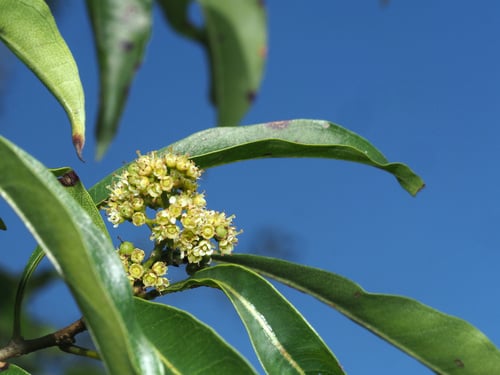
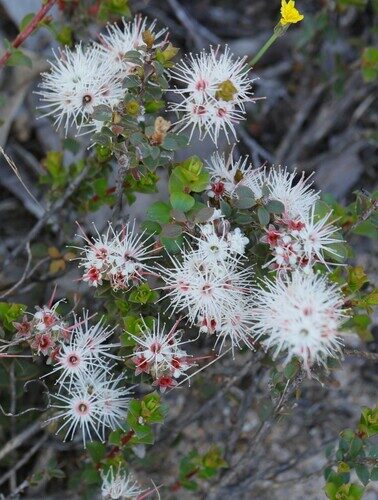
(c) Arthur Chapman, some rights reserved (CC BY-NC-SA)
iNaturalist· cc-by-nc
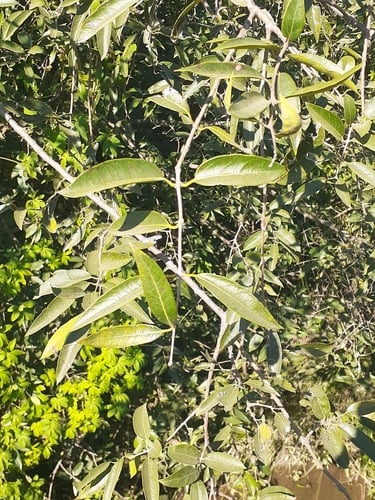
(c) Ian McMaster, some rights reserved (CC BY-NC), uploaded by Ian McMaster
iNaturalist· cc-by-nc
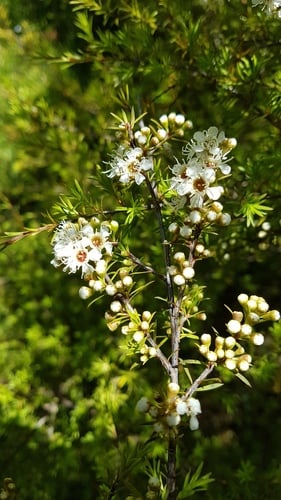
(c) Joe Lipson, some rights reserved (CC BY-NC), uploaded by Joe Lipson
Summary
Source: WikipediaBackhousia citriodora, commonly known as lemon myrtle, lemon scented myrtle or lemon scented ironwood, is a flowering plant in the family Myrtaceae. It is native to the subtropical rainforests of central and south-eastern Queensland, Australia, with a natural distribution from Mackay to Brisbane.
Description
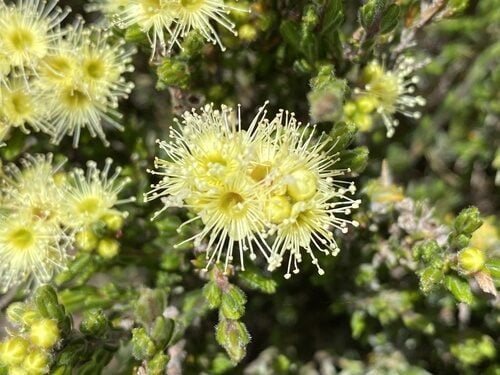
A large shrub or medium sized tree. It grows 3-15 m tall and spreads 2-6 m across. The bark is light brown and rough and scaly and flakes off. The leaves are broad sword shaped. They are hairy and reddish green when young but mature to a glossy deep green. Leaves are 5-12 cm long and 2.5-5 cm wide. The leaves have a sweet lemon smell. The flowers are in umbels 10-15 cm across. The flowers are small and white. They have 4 petals and the stamens are easy to see. The fruit has 2 cells.
Edible Uses
Lemon myrtle is one of the well known bushfood flavours and is sometimes referred to as the "Queen of the lemon herbs". The leaf is often used as dried flakes, or in the form of an encapsulated flavour essence for enhanced shelf-life. It has a range of uses, such as lemon myrtle flakes in shortbread; flavouring in pasta; whole leaf with baked fish; infused in macadamia or vegetable oils; and made into tea, including tea blends. It can also be used as a lemon flavour replacement in milk-based foods, such as cheesecake, lemon flavoured ice-cream and sorbet without the curdling problem associated with lemon fruit acidity. Backhousia citriodora has two essential oil chemotypes. The citral chemotype is more prevalent and is cultivated in Australia for flavouring and essential oil. Citral as an isolate in steam distilled lemon myrtle oil is typically 90–98%, and oil yield 1–3% from fresh leaf. The citronellal chemotype is uncommon, and can be used as an insect repellent. The dried leaf has free radical scavenging ability.
Traditional Uses
The leaves are used for flavouring and in herbal teas. They can also be dried and crushed and used as a spice. They are used in cakes, biscuits, sauces and desserts. They are also the source of an essential oil.
Medicinal Uses
The essential oil obtained from the leaves possesses anti-microbial activity.
Distribution
A tropical and subtropical plant. Plants grow naturally in Queensland in Australia. They required acid well drained soils. A pH of 4.5-6.5 is suitable. A rainfall in the range 800-1100 m is adequate. It occurs naturally in the rainforest. It suits humid locations. Sheltered warm situations are needed and regular watering during dry periods is important. It is damaged by frost. It needs a minimum temperature above 5-7°C. It suits hardiness zones 9-10. Coffs Harbour Botanical Gardens.
Where It Grows
Africa, Asia, Australia*, China, Indochina, Indonesia, North America, SE Asia, South Africa, Southern Africa, Thailand, USA,
Cultivation
Plants can be grown from cuttings. It is important to use clonal propagation as oil quality varies considerably. Semi-ripe cuttings should be used. Plants can however be grown from seed. Seed should be near the surface and need temperatures above 13-15°C. Plants should be 3 m apart and well composted and mulched sites give better production.
Propagation
Seed - it is difficult to germinate. Surface sow onto a moist medium, standing the seed tray in almost half its depth of clean water and maintain a temperature around 16 - 18c. Seedlings take about 12 months to develop fully. When seedlings are about 5mm tall, remove the tray from the water, leave for 4 - 5 days and then prick the seedlings out into individual containers. Cuttings of semi-ripe wood with a heel. Slow to make roots. Small lower branches often touch the ground and form roots. These can be severed from the parent plant, and planted elsewhere.
Other Uses
The leaves contain an essential oil that contains more than 90% citral. It is used in perfumes and soaps and as a flavouring. The oil resembles lemongrass oil, but is said to be of a better quality (e.g. lacking grassy-fatty or harsh notes) and of higher yield. This species is known to have at least two chemical forms, with their respective aromatic essential oils (which give the aroma and flavour) being richer either in citral or its close chemical relative citronellal. The citral form seems to be much commoner, and this form is the one selected and grown for its sweet lemon-type perfume and flavour. The light pink colourd wood is fine-grained, very hard and heavy. It is likely to be useful for ornamental purposes.
Production
It is fairly slow growing. Leaves can be picked throughout the year. The older, mature, dark green leaves have the best flavour.
Notes
There are 7-13 Backhousia species. They occur in Australia.
Also Known As
Pohon surawung
References (31)
- Alice, L. & O'Quinn, T., Australian Bush Superfoods. Explore Australia p 90
- Anon., 2003, Native Plants for the Fitzroy basin. Society for Growing Australian Plants Inc. (Rockhampton Branch)
- Barwick, M., 2004, Tropical and Subtropical Trees. A Worldwide Encyclopedic Guide. Thames and Hudson p 41
- Bodkin, F., 1991, Encyclopedia Botanica. Cornstalk publishing, p 124
- Bonney, N., 1997, Economic Native Trees and Shrubs for South Australia. Greening Australia (SA) inc. Campbelltown SA 5074 p 34
Show all 31 references Hide references
- Bonney, N., 2012, Edible Wild Native Plants for Southern Australia. p 24
- Brickell, C. (Ed.), 1999, The Royal Horticultural Society A-Z Encyclopedia of Garden Plants. Convent Garden Books. p 158
- Brown, D., 2002, The Royal Horticultural Society encyclopedia of Herbs and their uses. DK Books. p 139
- Cooper, W. and Cooper, W., 2004, Fruits of the Australian Tropical Rainforest. Nokomis Editions, Victoria, Australia. p 342
- Cronin, L., 1989, The Concise Australian Flora. Reed. p 166
- Cundall, P., (ed.), 2004, Gardening Australia: flora: the gardener's bible. ABC Books. p 215
- Elliot, W.R., & Jones, D.L., 1982, Encyclopedia of Australian Plants suitable for cultivation. Vol 2. Lothian. p 267
- Etherington, K., & Imwold, D., (Eds), 2001, Botanica's Trees & Shrubs. The illustrated A-Z of over 8500 trees and shrubs. Random House, Australia. p 112
- Facciola, S., 1998, Cornucopia 2: a Source Book of Edible Plants. Kampong Publications, p 140
- Fragm. 1:78. 1859
- Greig, D., 1996, Flowering Natives for Home Gardens. Angus & Robertson. p 59
- Hemphill, I, 2002, Spice Notes. Macmillan. p 224
- Jones D, L, 1986, Ornamental Rainforest Plants in Australia, Reed Books, p 67
- Lord, E.E., & Willis, J.H., 1999, Shrubs and Trees for Australian gardens. Lothian. p 12
- Melzer, R. & Plumb, J., 2011, Plants of Capricornia. Belgamba, Rockhampton. p 220
- Molyneux, B & Forrester, S., 1997, The Austraflora A-Z of Australian Plants. Reed. p 47
- Nicholson, N & H., 1996, Australian Rainforest Plants 2, Terania Rainforest Publishing. NSW. p 12
- PROSEA handbook Volume 13 Spices. p 274
- Ratcliffe D & P., 1987, Australian Native Plants for Indoors. Little Hills press. p 60
- Robins, J., 1996, Wild Lime. Cooking from the Bush food garden. Allen & Unwin p 136
- Seidemann J., 2005, World Spice Plants. Economic Usage, Botany, Taxonomy. Springer. p 61
- Smith, K & I., 199, Grow your own bushfoods. New Holland. Australia. p 5
- Sukarya, D. G., (Ed.) 2013, 3,500 Plant Species of the Botanic Gardens of Indonesia. LIPI p 147
- Townsend, K., 1994, Across the Top. Gardening with Australian Plants in the tropics. Society for Growing Australian Plants, Townsville Branch Inc. p 93
- Williams, J.B., Harden, G.J., and McDonald, W.J.F., 1984, Trees and shrubs in rainforests of New South Wales and Southern Queensland. Univ. of New England, Armidale. p 103, 110
- www.ceres.org/au/bushfood catalogue