Auricularia auricula-judae
Schroet
Jew’s ear, Tree ear, mushroom
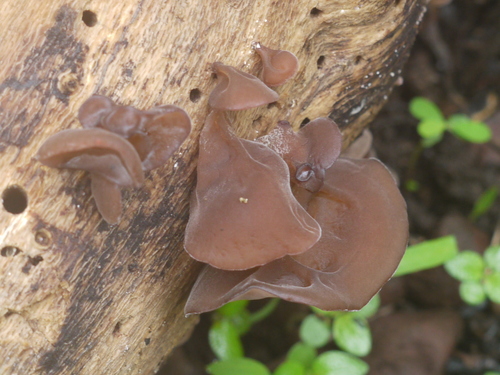
iNaturalist· cc-by-nc
(c) Jurga Motiejūnaitė, some rights reserved (CC BY-NC), uploaded by Jurga Motiejūnaitė
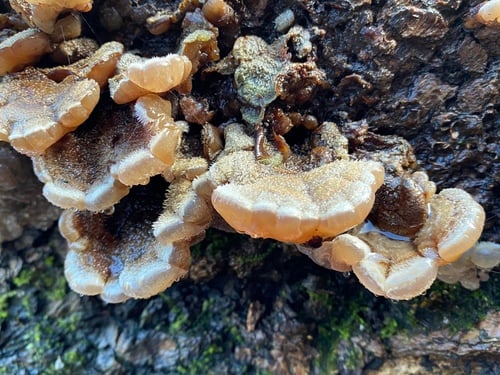
iNaturalist· cc-by-nc
(c) gremace, some rights reserved (CC BY-NC), uploaded by gremace
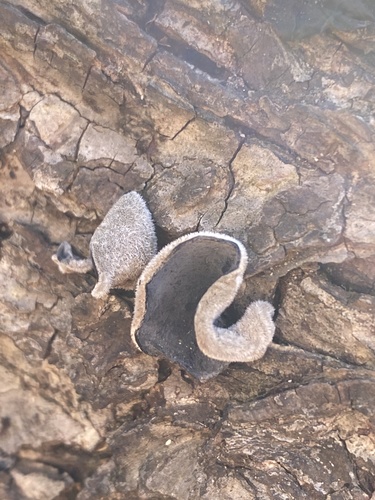
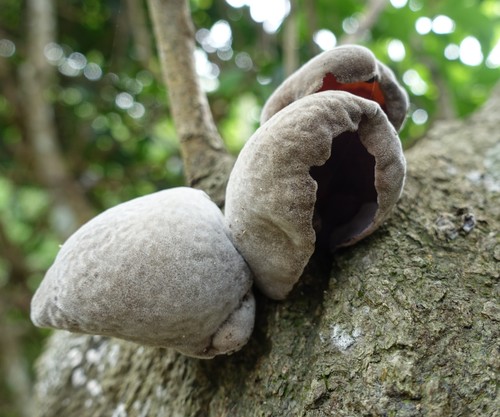
iNaturalist· cc-by-nc
(c) tilligerrynaturewatch, some rights reserved (CC BY-NC)
Summary
Source: WikipediaAuricularia auricula-judae, commonly known as wood ear, jelly ear or historically as Jew's ear, is a species of fungus in the order Auriculariales. Basidiocarps (fruit bodies) are brown, gelatinous, and have a noticeably ear-like shape. They grow on wood, especially elder. The specific epithet is derived from the belief that Judas Iscariot hanged himself from an elder tree. The fungus can be found throughout the year in Europe, where it normally grows on wood of broadleaf trees and shrubs. Auricularia auricula-judae was used in folk medicine as recently as the 19th century for complaints including sore throats, sore eyes and jaundice, and as an astringent. It is edible but not widely consumed.
Description
A mushroom. The fruiting bodies are 10 cm across. They are irregular and ear shaped.
This description is brief — help expand it
Edible Uses
Auricularia auricula-judae has a soft, jelly-like texture. Though edible, it is not held in high culinary regard. It has been likened to "eating an Indian rubber with bones in it", while in 19th-century Britain, it was said that "it has never been regarded here as an edible fungus". The species is said to be commonly consumed in Poland. A related fungus, Auricularia heimuer, is widely used in East Asian cooking and has often been misidentified as A. auricula-judae. Auricularia auricula-judae has a mild flavour, which may be considered bland. It can be dried and rehydrated, sometimes swelling to 3–4 times in size. The species is not edible when raw, needing to be cooked thoroughly. A 100 g (3.5 oz) reference serving of dried fungus provides 1,500 kilojoules (370 kilocalories) of food energy, 10.6 g of protein, 0.2 g of fat, 65 g of carbohydrate, 5.8 g ash, and 0.03% mg of carotene. Fresh mushrooms contain about 90% moisture. Dried specimens may be ground up into a powder and used to absorb excess liquid in soups and stews, as it rehydrates into tiny fragments.
Traditional Uses
The fruiting bodies are eaten. They are dried and used in stews. They are also used in soups.
This uses section is brief — help expand it
Medicinal Uses
Auricularia auricula-judae has been used as a medicinal fungus by many herbalists. It was used as a poultice to treat inflammations of the eye, as well as a palliative for throat problems. The 16th-century herbalist John Gerard, writing in 1597, recommended A. auricula-judae for a very specific use; other fungi were used more generally. He recommends the preparation of a liquid extract by boiling the fruit bodies in milk, or else leaving them steeped in beer, which would then be sipped slowly in order to cure a sore throat. The resultant broth was probably not dissimilar to the Chinese soups that use Auricularia cornea. Carolus Clusius, writing in 1601, also said that the species could be gargled to cure a sore throat, and John Parkinson, writing in 1640, reported that boiling in milk or steeping in vinegar was "the onely use they are put unto that I know". Writing in 1694, the herbalist John Pechey described A. auricula-judae by saying "It grows to the Trunk of the Elder-Tree. Being dried it will keep a good year. Boyl'd in Milk, or infus'd in Vinegarm 'tis good to gargle the Mouth or Throat in Quinsies, and other inflammations of the Mouth and Throat. And being infus'd in some proper Water, it is good in Diseases of the Eyes." The species also saw use as an astringent due to its ability to absorb water. There are recorded medicinal usages from Scotland, where it was again used as a gargle for sore throats, and from Ireland, where, in an attempt to cure jaundice, it was boiled in milk. The medicinal use of A. auricula-judae continued until at least 1860, when it was still sold at Covent Garden; at the time, it was not considered edible in the United Kingdom.
Distribution
It grows on rotting wood. In Northeastern India it grows between 3,600-4,100 m above sea level.
Where It Grows
Africa, Asia, Australia, Britain, Bulgaria, Cameroon, Caucasus, Central Africa, Chile, China, Congo DR, East Africa, Europe, Georgia, Himalayas, Hong Kong, India, Indonesia, Japan, Kosovo, Liberia, Madagascar, Malawi, Malaysia, Mexico, Mozambique, Nepal, New Zealand, Nigeria, North America, Northeastern India, Pacific, Philippines, Poland, Russia, Rwanda, SE Asia, South America, West Africa,
Nutrition
| Part | Moisture | kJ | kcal | Protein | Vit A | Vit C | Iron | Zinc |
|---|---|---|---|---|---|---|---|---|
| Mushroom dried | 13.1 | 715 | 171 | 4.6 | — | 0 | 0.8 | 0.2 |
| Mushroom boiled | 82.1 | 146 | 35 | 0.8 | — | 0 | 0.1 | — |
Synonyms
Also Known As
Chendawan telinga tikus, Ero ntioke, Kane, Kedzekel, Koko, Kulat telinga tikus, Morddu, Nyorung, Pepeao, Sofinamboa, Tondungol
References (27)
- Boa, E. R., 2004, Wild edible fungi and their importance to people. FAO Non Wood Forest Products Booklet 17
- Brouk, B., 1975, Plants Consumed by Man. Academic Press, London. p 59
- Burkill, I.H., 1966, A Dictionary of the Economic Products of the Malay Peninsula. Ministry of Agriculture and Cooperatives, Kuala Lumpur, Malaysia. Vol 1 (A-H) p 270
- Bussman, R. W., et al, 2021, Unity in diversity—food plants and fungi of Sakartvelo (Republic of Georgia), Caucasus. Journal of Ethnobiology and Ethnomedicine (2021) 17:72 p 16
- Christensen, M., et al, 2008, Collection and Use of Wild Edible Fungi in Nepal. Economic Botany, 62(1), 2008, pp. 12–23
Show all 27 references Hide references
- Colenso, 1881, (As Hirneola auricula-judae)
- Degreef, J., et al, 2016, Wild edible mushrooms, a valuable resource for food security and rural development in Burundi and Rwanda. Biotechnol. Agron. Soc. Environ. 2016 20(4), 441-452
- Devkota, S., 2008, Distribution and Status of Highland mushrooms: A study from Dolpa, Nepal. J.Nat.Hist.Mus.Vol.23,2008, 51-59
- efta-online.org, Edible Fungi of Tropical Africa, Jardin botanique Meise
- Facciola, S., 1998, Cornucopia 2: a Source Book of Edible Plants. Kampong Publications, p 250 (As Auricularia auricula)
- Fuhrer, B., 2005, A field guide to Australian Fungi. Bloomings Books. p 289
- Hwang, L. C., et al, 2020, Traditional Botanical Uses of Non-Timber Forest Products (NTFP) in Seven Counties in Liberia. ACS Symposium Series; American Chemical Society: Washington, DC, 2020.
- Jordan, P., 2000, The Mushroom Guide and Identifier, Hermes House, p 40
- Kang, J. et al, 2016, Wild food plants and fungi used in the mycophilous Tibetan community of Zhagana (Tewo Country, Gansu, China) Journal of Ethnobiology and Ethnomedicine. 12:21
- Kiple, K.F. & Ornelas, K.C., (eds), 2000, The Cambridge World History of Food. CUP p 320, 322
- Koni, J. M. & Bostein, K., 2008, Noms et usages des plantes utiles chez les Nsong, DR Congo. University of Gothenburg. Department of Oriental and African Languages.
- Kulip, J., 2003, An ethnobotanical survey of medicinal and other useful plants of Muruts in Sabah, Malaysia. Telopea 10(1) p 92
- Mabey, R., 1973, Food for Free. A Guide to the edible wild plants of Britain, Collins. p 54
- Montoya, A., et al, 2014, Availability of Wild Edible Fungi in La Malinche National park, Mexico. Journal of Mycology. Article ID 241896, 15 pages
- Ochse, J.J. et al, 1931, Vegetables of the Dutch East Indies. Asher reprint. p 72
- Okigbo, R. N. & Nwatu, C.M., 2015, Ethnostudy and Usage of Edible and Medicinal Mushrooms in Some Parts of Anambra State, Nigeria. Natural Resources, 2015, 6, 79-89
- Pace, G., 1998, Mushrooms of the world. Firefly books. p 231
- Reinking, 1921,
- Semwal, K. C., et al, 2014, Edible mushrooms of the Northwestern Himalaya, India: a study of indigenous knowledge, distribution and diversity. Mycosphere 5(3): 440–461
- Stoyneva-Gartner, M.P. & Uzunov, B.A., 2015, An Ethnobiological Glance on Globalization Impact on the Traditional Use of Algae and Fungi as Food in Bulgaria. J Nutr Food Sci 2015, 5:5
- Taram, M., et al, 2018, Wild Food Plant Resources of Komkar Adi Tribe of Upper Siang District in Arunachal Pradesh, India. Bulletin of Arunachal Forest Research, Vol. 33(2), 27-35
- Thatoi, H. & Singdevsachan, S. K., 2014, Diversity, nutritional composition and medicinal potential of Indian mushrooms: A review. African Journal of Biotechnology 13(4): 523-545