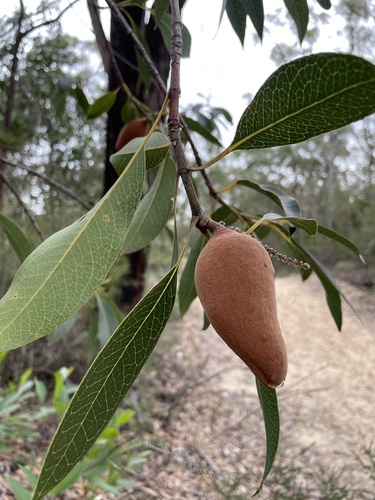
Athertonia diversifolia
(C. White) L. Johnson & B. Briggs
Atherton oak, White Oak, Creamy silky oak, Atherton nut
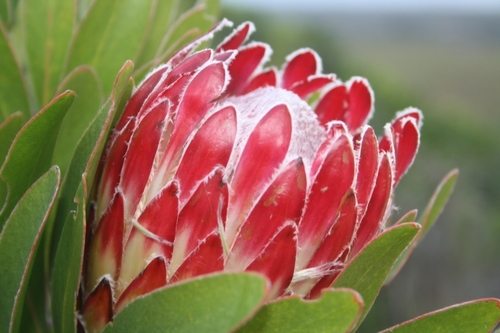
iNaturalist· cc-by-nc
(c) Evert Materman, some rights reserved (CC BY-NC), uploaded by Evert Materman
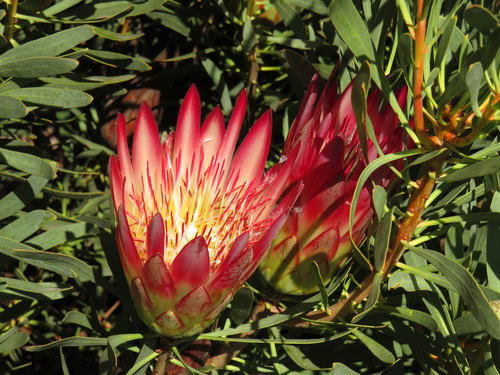
iNaturalist· cc-by
(c) M. Fagg, some rights reserved (CC BY)
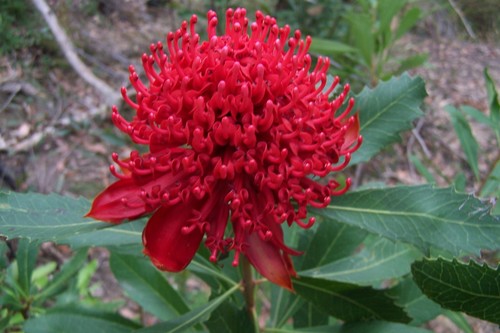
iNaturalist· cc-by-nc
(c) eliotmiller, some rights reserved (CC BY-NC)
Description
An evergreen tree. It grows up to 20-30 m high. It spreads 5-8 m wide. The leaves are simple and 9-35 cm long. They can be entire or have teeth along the edge. The young leaves have lobes and mature leaves are shiny on the upper side. Flowers are small and congested. They occur in slender racemes which droop. The fruit are 4 cm long by 3.5 cm wide. They are blue. They hang on stalks. They can be on the end of twigs or hang from the trunk. There is one seed inside. The kernel of the seed is edible.
Edible Uses
The bluish purple, fleshy, plum-like fruit is up to 4cm long and contains a delicious, sweet, crispy kernel. The outer skin should be avoided since it has a bitter flavour.
Traditional Uses
The kernels are sweet and edible.
This uses section is brief — help expand it
Distribution
A tropical plant. It grows in highland rainforest in Queensland, Australia. It grows up to 1,200 m altitude. It can grow from tropical to warm temperate regions. It needs moist well drained soils. It is frost tender when young.
Where It Grows
Australia*,
Cultivation
Plants can be grown from seed. The seed should be sown fresh. Older seeds need treatment to get them to grow. It can be grown from cuttings.
Propagation
Seed - slow to germinate unless it is scarified first. The seed has a hard seedcoat and may benefit from scarification before sowing in order to speed up germination. This can usually be done by pouring a small amount of nearly boiling water on the seeds (being careful not to cook them!) and then soaking them for 12 - 24 hours in warm water. By this time they should have imbibed moisture and swollen - if they have not, then carefully make a nick in the seedcoat (being careful not to damage the embryo) and soak for a further 12 hours before sowing. Cuttings.
Production
It is slow growing. Flowering and fruiting start at about 7-8 years.
Notes
There is only one Athertonia species.
Nutrition
| Part | Moisture | kJ | kcal | Protein | Vit A | Vit C | Iron | Zinc |
|---|---|---|---|---|---|---|---|---|
| Seeds | 7.7 | 2535 | 606 | 10.3 | — | — | 6.9 | 4.3 |
Synonyms
Also Known As
"Helicia nuts"
References (17)
- Barwick, M., 2004, Tropical and Subtropical Trees. A Worldwide Encyclopedic Guide. Thames and Hudson p 37
- Cherikoff V. & Isaacs, J., The Bush Food Handbook. How to gather, grow, process and cook Australian Wild Foods. Ti Tree Press, Australia p 157
- Cooper W & Cooper W T, 1994, Fruits of the Rain Forest. RD Press p 46
- Cooper, W. and Cooper, W., 2004, Fruits of the Australian Tropical Rainforest. Nokomis Editions, Victoria, Australia. p 406
- Cribb, A.B. & J.W., 1976, Wild Food in Australia, Fontana. p 103 (As Helicia diversifolia)
Show all 17 references Hide references
- Elliot, W.R., & Jones, D.L., 1982, Encyclopedia of Australian Plants suitable for cultivation. Vol 2. Lothian. p 253
- Flora of Australia Volume 16, Elaeagnaceae, Proteaceae 1. Melbourne: CSIRO Australia (1995) p 413, 313, 414
- Hibbert, M., 2002, The Aussie Plant Finder 2002, Florilegium. p 36
- Jones D, L, 1986, Ornamental Rainforest Plants in Australia, Reed Books, p 37, 340
- Low, T., 1991, Wild Food Plants of Australia. Australian Nature FieldGuide, Angus & Robertson. p 91
- Molyneux, B & Forrester, S., 1997, The Austraflora A-Z of Australian Plants. Reed. p 47
- Nicholson, N & H., 1996, Australian Rainforest Plants 2, Terania Rainforest Publishing. NSW. p 11
- Queensland Forest Service, 1991, Trees and Shrubs. Department of Primary Industries. p 67
- Radke, P & A, Sankowsky, G & N., 1993, Growing Australian Tropical Plants. Frith & Frith, Australia. p 1, 20
- Recher, P, 2001, Fruit Spirit Botanical Gardens Plant Index. www.nrg.com.au/~recher/ seedlist.html p 1
- Townsend, K., 1994, Across the Top. Gardening with Australian Plants in the tropics. Society for Growing Australian Plants, Townsville Branch Inc. p 91
- Wickens, G.E., 1995, Edible Nuts. FAO Non-wood forest products. FAO, Rome. p147 (As Helicia diversifolia)